

In the aluminum extrusion industry, the moment a profile exits the die at temperatures reaching 500–550°C marks a critical point in the production process . At this stage, the hot, semi-solid aluminum is highly susceptible to surface damage, deformation, and scratching—defects that can render the final product unusable for high-value applications like anodized architectural components or automotive parts .
A felt conveyor belt for aluminum extrusion is more than just a transport mechanism; it is a critical component that safeguards product integrity, reduces downtime, and optimizes throughput. Unlike traditional metal slats or fabric belts, endless needled felt belts offer a unique combination of heat resistance, surface protection, and dimensional stability .
For plant managers, maintenance engineers, and procurement specialists, selecting the appropriate felt conveyor belt—whether PBO, Kevlar, Nomex, or Polyester—directly impacts scrap rates, die life, and overall equipment effectiveness (OEE) . This guide provides an in-depth analysis of felt belts used in aluminum extrusion, detailing material science, application zones, and technical specifications to help you make an informed purchasing decision.
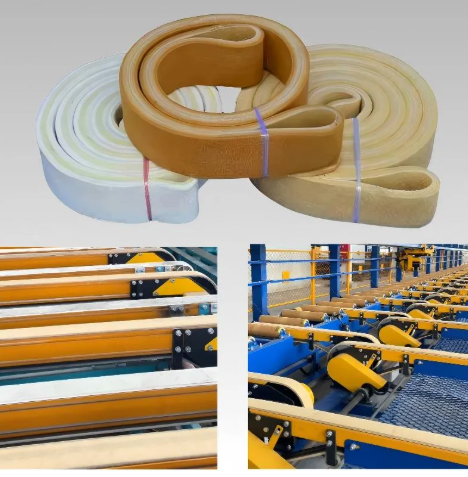
Understanding the Extrusion Process: Temperature Zones and Requirements
The run-out table, where profiles are transported and cooled, is divided into distinct temperature zones. Each stage requires a specific type of felt belt to handle varying thermal loads and mechanical stresses .
| Process Stage | Temperature Range | Primary Function | Recommended Belt Material |
|---|---|---|---|
| Die Exit / Runout Table | 500°C – 600°C | Immediate support, scratch prevention, initial cooling | PBO, PBO/Kevlar blend |
| Primary Cooling Table | 200°C – 500°C | Continuous transport, further cooling, shape stabilization | Kevlar (Para-Aramid) |
| Stretcher / Saw Table | Up to 280°C | Transport for cutting and stretching processes | Nomex (Meta-Aramid) |
| Storage / Stacking | Up to 180°C | Final transport, stacking, surface protection | Polyester |
Material Selection: PBO, Kevlar, Nomex, and Polyester
The choice of fiber material defines the belt’s performance, lifespan, and cost-effectiveness. Here is a breakdown of the four primary materials used in aluminum extrusion felt belts :
1. PBO (Polybenzoxazole) – Ultra-High Temperature Zone
PBO (often branded as Zylon) represents the pinnacle of heat resistance for felt belts. It is specifically engineered for the harsh environment immediately following the extrusion press.
- Temperature Resistance: Up to 600°C continuously. This is the only material capable of withstanding the initial blast of heat without degrading or burning the aluminum surface .
- Application: High-capacity presses (>2000T), large and complex profiles, and the "front end" of the runout table .
- Advantages: Exceptional thermal shock resistance, low elongation, and no surface marking. PBO belts often have a characteristic orange or brown color .
- Key Specs: Thickness ranges from 4mm to 12mm; typical widths are up to 2,200mm .
2. Kevlar (Para-Aramid) – High-Temperature Zone
Kevlar is a workhorse in the extrusion line, offering a balance of high heat resistance, durability, and cost-effectiveness.
- Temperature Resistance: Up to 480–500°C (peak/short-term) and ~200°C continuous .
- Application: Primary and secondary cooling tables, handling/transfer tables.
- Advantages: Excellent abrasion resistance and tensile strength. Prevents elongation under heavy loads. Standard Kevlar belts are usually yellow .
- Key Specs: Commonly available in thicknesses of 5mm to 14mm and widths up to 3,000mm .
3. Nomex (Meta-Aramid) – Medium-Temperature Zone
Nomex is used where temperatures are still significant but not extreme, such as downstream operations.
- Temperature Resistance: Up to 280°C .
- Application: Areas post-stretcher, saw tables, and pre-cutting transfer.
- Advantages: Good thermal stability with a lower cost structure. Often white in color. Suitable for most standard extrusion profiles .
- Key Specs: Density typically ranges from 0.15 to 0.45 g/cm³ .
4. Polyester – Low-Temperature Zone
Polyester belts are the economical choice for the final stages of the extrusion line.
- Temperature Resistance: Up to 150–180°C .
- Application: Saw tables, stacking areas, storage, and anodizing preparation lines.
- Advantages: Lower cost, easy to replace, and provides a non-marking surface. Usually beige or white .
- Key Specs: Commonly available in thicknesses like 3mm, 5mm, 6mm, and 8mm .
Top 5 Critical Advantages of Seamless Endless Felt Belts
To protect high-value aluminum profiles from defects, the belt itself must be flawless. Here’s why endless needled felt construction outperforms laced or spliced alternatives :
- Zero Surface Defects (Scratch-Free): The key benefit is the smooth, non-marking surface that prevents scratches and dents on delicate, high-finish extrusions (e.g., polished or anodized surfaces). This ensures high-quality output and reduces scrap rates .
- Elimination of Weak Points: Laced or spliced belts create a "weak point" that is prone to failure under high temperatures and tension. Seamless belts distribute stress evenly, significantly increasing the belt’s operational lifespan .
- High Tensile & Low Elongation: Needled felt belts, particularly those reinforced with aramid fibers (Kevlar), exhibit minimal stretch. This maintains consistent belt tracking and tension, ensuring stable production speeds and reducing maintenance needs .
- Superior Wear & Abrasion Resistance: The high-density fiber structure of needle-punched felt provides excellent resistance to friction from sharp edges and heavy loads, ensuring long service life even under continuous operation .
- Thermal Stability & Conductivity: Felt acts as a natural insulator, allowing for a controlled cooling process. It prevents surface oxidation and "hot spots" on the profile .
Technical Specifications to Consider
When procuring a felt conveyor belt for your extrusion line, ensure you verify the following technical parameters with your supplier:
- Width: Typically ranges from 20mm to 3,000mm depending on the press size and profile dimensions .
- Length (Circumference): Varies widely, from 1,780mm to 25,000mm for standard lines, with some systems requiring up to 40,000mm .
- Thickness: Standard range is 3mm to 14mm. For heavy-duty applications, customized productions up to 80mm are possible .
- Density: Ranges from 0.15 to 0.45 g/cm³; higher density generally indicates better wear resistance and compression set behavior .
- Surface Treatment: Options include PU (polyurethane) finishing for enhanced surface smoothness, anti-static finishes to prevent dust attraction, and edge sealing to prevent fraying

R&D Team
Annilte has a research and development team consisting of 35 technicians. With strong technical research and development capabilities, we have provided conveyor belt customization services for 1780 industry segments, and gained recognition and affirmation from 20,000+ customers. With mature R&D and customization experience, we can meet the customization needs of different scenarios in various industries.

Production Strength
Annilte has 16 fully automated production lines imported from Germany in its integrated workshop, and 2 additional emergency backup production lines. The company ensures that the safety stock of all kinds of raw materials is not less than 400,000 square meters, and once the customer submits an emergency order, we will ship the product within 24 hours to respond to the customer's needs efficiently.
As a leading Chinese conveyor belt manufacturer with 17 years of industry experience, Annilte is proud to hold both ISO quality management certification and the RoHS environmental directive. Our manufacturing facilities meet “Green Factory” standards, and we are also an internationally recognized SGS Gold Supplier.
We offer a comprehensive range of customizable belt solutions under our own brand "ANNILTE", designed to meet diverse industrial needs.
Should you require further information about our products or capabilities, please do not hesitate to contact us.
WhatsApp: +86 185 6019 6101 Tel/WeChat: +86 185 6010 2292
E-mail: 391886440@qq.com Website: https://www.annilte.net/
Post time: Jul-01-2026