

In the aggressive environments of mining, quarrying, and chemical processing, a vibrating screen is arguably the most demanding application for any drive system. Unlike standard conveyors, these machines operate under constant, high-frequency oscillation, placing immense stress on every component. At the heart of this motion is the vibrating screen timing belt—a component that must maintain perfect synchronization while absorbing violent shocks.
For procurement managers and equipment engineers, the choice of a timing belt is a choice between continuous productivity and catastrophic failure. This guide examines the engineering requirements for vibrating screen belts and why material science is the key to reducing the Total Cost of Ownership (TCO).
1. The Vibration Challenge: Why Standard Belts Fail
Standard industrial timing belts are designed for steady-state torque. However, a vibrating screen introduces dynamic loads and resonant frequencies that can lead to:
- Tooth Shear: The rapid acceleration and deceleration can literally tear the teeth off a standard belt.
- Tensile Fatigue: Constant vibration causes the internal cords to snap if they aren't specifically engineered for high-flex fatigue.
- Heat Buildup: The internal friction caused by rapid oscillation can overheat standard rubber compounds, leading to premature aging and cracking.
ANNILTE’s Approach: We engineer our timing belts with a specialized rubber or polyurethane compound that features high internal damping properties, effectively absorbing a portion of the vibration before it reaches the tensile members.
2. Material Science: The Backbone of High-Torque Transmission
To survive in a vibrating screen, the internal architecture of the belt must be superior. At ANNILTE, we focus on three core layers:
High-Strength Tensile Cords
The "muscles" of the belt. For vibrating screens, we offer:
- Fiberglass Cords: Excellent for dimensional stability and resisting stretch.
- Aramid (Kevlar) Cords: Ideal for shock loads, providing superior impact resistance and preventing the belt from snapping during sudden stops or starts.
Precision-Molded Tooth Profiles
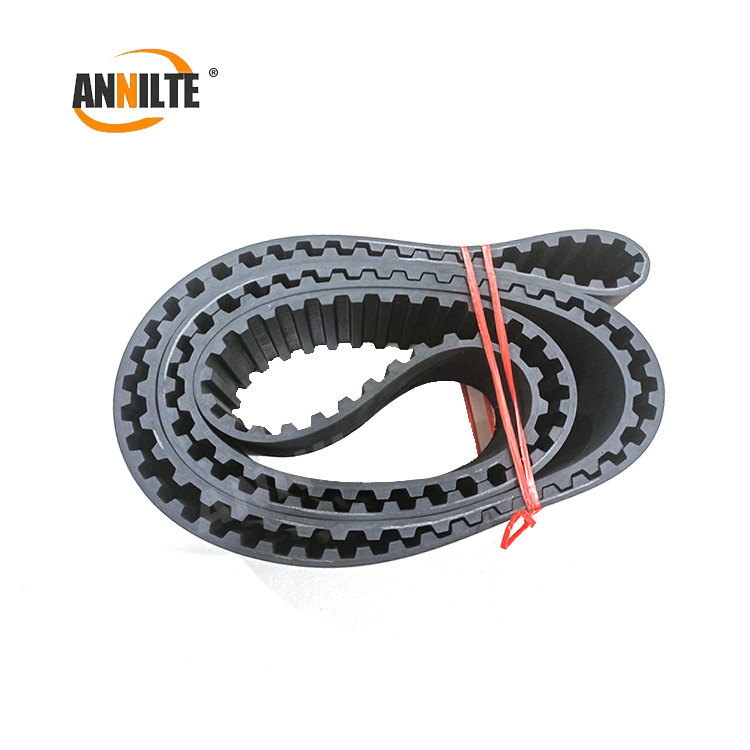
Whether your equipment requires HTD (High Torque Drive), STD (Super Torque Drive), or RPP profiles, the molding must be flawless. A slight mismatch in the tooth-to-pulley fit will result in "tooth jumping," which quickly leads to drive failure. Our CNC-molded belts ensure a perfect mesh, reducing noise and vibration at the source.
Abrasion-Resistant Fabric Cover
Vibrating screens are often surrounded by dust, grit, and abrasive particles. We use a high-tenacity nylon fabric to cover the teeth, which reduces friction and protects the belt from wear in dusty mining environments.
3. Synchronized Precision: Maintaining the "Timing" in Timing Belts
In a vibrating screen, two shafts often need to be perfectly synchronized to create the correct screening motion (circular, linear, or elliptical). If the belt stretches or a tooth skips, the motion becomes unbalanced, leading to:
- Reduced Screening Efficiency: Material doesn't move across the screen as intended.
- Mechanical Damage: Unbalanced vibration can damage bearings, shafts, and the machine frame.
ANNILTE belts are pre-stretched during the manufacturing process to ensure "zero-stretch" performance from day one, maintaining perfect synchronization throughout their service life.
4. Custom Engineering for OEM and Aftermarket
As a leading industrial belt manufacturer, ANNILTE understands that one size does not fit all. We provide custom solutions for major vibrating screen brands, optimizing:
- Width and Pitch: Tailored to your specific torque requirements.
- Hardness: Adjusting the compound durometer to match the ambient operating temperature.
- Chemical Resistance: Specialized coatings for screens used in chemical or fertilizer processing.
5. Procurement Checklist: Evaluating Your Timing Belt Supplier
When sourcing high-performance belts for heavy machinery, ask these 5 critical questions:
- What is the shear strength of the teeth?
- What tensile member is used? (Demand Aramid or high-grade Fiberglass for vibration).
- Is the belt resistant to the specific environmental contaminants of your site (oil, dust, UV)?
- Can the manufacturer provide a performance guarantee for high-vibration applications?
- What is the lead time for custom widths? (ANNILTE provides rapid fabrication to reduce your inventory needs).

R&D Team
Annilte has a research and development team consisting of 35 technicians. With strong technical research and development capabilities, we have provided conveyor belt customization services for 1780 industry segments, and gained recognition and affirmation from 20,000+ customers. With mature R&D and customization experience, we can meet the customization needs of different scenarios in various industries.

Production Strength
Annilte has 16 fully automated production lines imported from Germany in its integrated workshop, and 2 additional emergency backup production lines. The company ensures that the safety stock of all kinds of raw materials is not less than 400,000 square meters, and once the customer submits an emergency order, we will ship the product within 24 hours to respond to the customer's needs efficiently.
As a leading Chinese conveyor belt manufacturer with 17 years of industry experience, Annilte is proud to hold both ISO quality management certification and the RoHS environmental directive. Our manufacturing facilities meet “Green Factory” standards, and we are also an internationally recognized SGS Gold Supplier.
We offer a comprehensive range of customizable belt solutions under our own brand "ANNILTE", designed to meet diverse industrial needs.
Should you require further information about our products or capabilities, please do not hesitate to contact us.
WhatsApp: +86 185 6019 6101 Tel/WeChat: +86 185 6010 2292
E-mail: 391886440@qq.com Website: https://www.annilte.net/
Post time: Jul-03-2026