

Choosing the right gold sluice mat starts with knowing what’s available. There are five main types, each suited to different gold sizes, water conditions, and budgets. Here’s the breakdown.
1. V-Mat (Riffle Mat)
Structure: V-shaped grooves running across the mat width.
How it works: Water flows over the V-grooves and creates turbulence. Heavy gold drops into the trough while lighter sand washes over.
Best for: Coarse gold above 40 mesh.
Recovery rate: 45–55%.
Pros: Simple, proven, widely available. Low cost. Easy to clean.
Cons: Fine gold slides straight through. Loses effectiveness under high water flow.
Verdict: A solid entry-level choice for coarse gold operations. Not suitable if your deposit contains significant fine gold.
2. Grass Mat (Turf Mat / Gold Rush Mat)
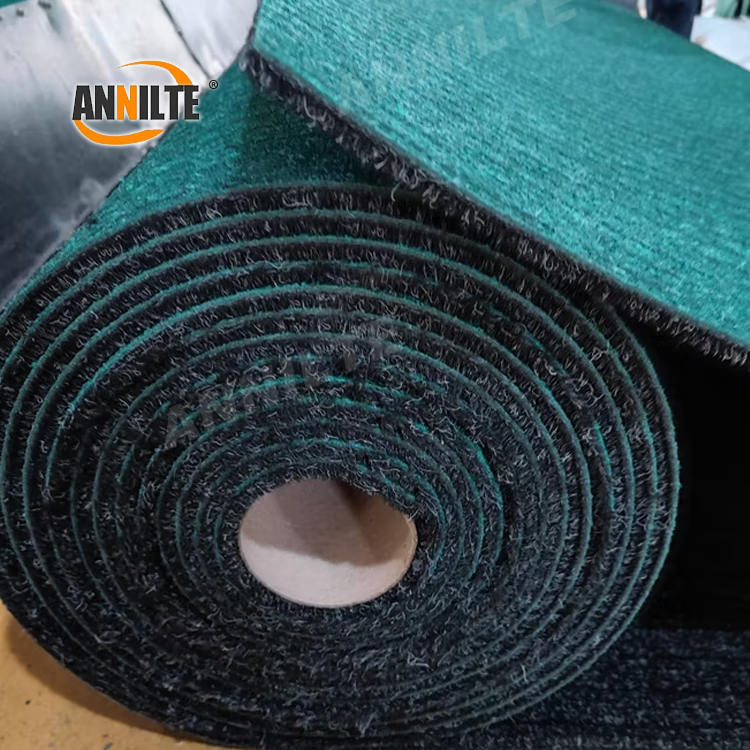
Structure: Dense upright fibers mimicking natural grass—the most common type in African artisanal and small-scale mining today.
How it works: The “grass blades” create a 3D labyrinth. Gold particles lose velocity as they navigate between fibers and settle by gravity.
Best for: Coarse to medium gold (40–100 mesh).
Recovery rate: 50–60% at standard density. Exceeds 90% with high-density embossed designs like Annilte’s (72,000 tufts/m², 28–30mm thickness).
Pros: Good all-rounder. High-density versions capture fine gold effectively. Durable under African sun (when UV-stabilized PE).
Cons: Standard low-density grass mats miss ultra-fine gold. Cheaper versions collapse and mat down after weeks of use.
Verdict: The best price-to-performance ratio for most African operations. Choose high-density (70,000+ tufts/m²) and thickened design (28mm+) for serious recovery.
3. Miner’s Moss
Structure: Short, random fiber nap resembling carpet—the traditional “old school” choice.
How it works: Gold particles get trapped by friction within the fiber nap. No structured pattern—just surface roughness.
Best for: All particle sizes, but excels at none.
Recovery rate: 40–50%.
Pros: Low upfront cost. Widely available. Works with very fine gold that structured mats might miss.
Cons: Wears out fast. Fibers mat down under heavy water flow, losing trapping ability. Cleaning is slow and labor-intensive—gold clings to the fibers. False economy: replacement costs add up.
Verdict: OK as a secondary layer under a V-mat or grass mat. Not recommended as your primary recovery surface.
4. S-Wave Mat (Wave Blade Technology)
Structure: S-shaped wavy blades with split micro-fiber tips. Annilte’s proprietary “black technology” design.
How it works: Three mechanisms working together:
- S-wave blades act as micro speed bumps—disrupting laminar flow and creating low-velocity zones where gold settles naturally
- Branched micro-fiber tips form a “micro-maze” that traps ultra-fine gold powder
- Rigid roots + flexible tips resist heavy water impact while gently holding gold particles
Best for: Full spectrum—coarse to ultra-fine gold (<100 mesh).
Recovery rate: 59.22% on coarse gold (60–80 mesh) in lab tests—26 percentage points above Japanese competitors. With optimized setup, combined recovery exceeds 95%.
Pros: Highest recovery in its class. Traps fine gold that other mats miss. Industrial-grade durability (13.89 MPa tensile strength, 1215.8 N breaking force). Excellent bend recovery—won’t collapse.
Cons: Higher unit price than standard grass mats (lower total cost over lifespan).
Verdict: The professional’s choice. If maximizing profit per ton of material is your goal, this is the answer.
5. Drop Riffle Mat
Structure: Stair-step horizontal barriers. Simple and often home-made by small miners.
How it works: Water drops over each riffle step, creating a pocket where gold settles behind the barrier.
Best for: Very coarse gold only (>20 mesh).
Recovery rate: 40–55% for large gold. Near zero for fine gold.
Pros: Extremely simple. Can be made from local materials. No purchase required.
Cons: Useless for fine gold. Requires precise water flow angle. Clogs easily with heavy sediment.
Verdict: Only for coarse placer gold in low-budget setups. Not a serious option for commercial recovery.
Quick Comparison
| Type | Gold Size | Recovery | Lifespan | Price | Best Use |
|---|---|---|---|---|---|
| V-Mat | Coarse | 45–55% | 6–12 mo | $ | Budget coarse gold |
| Grass Mat (Standard) | Medium-coarse | 50–60% | 6–12 mo | $$ | Most small-medium operations |
| Miner’s Moss | All sizes | 40–50% | 3–6 mo | $ | Secondary layer only |
| S-Wave Mat ⭐ | All sizes | 59–95% | 12–18 mo+ | $$$ | Maximum profit, professional |
| Drop Riffle | Very coarse | 40–55% | Variable | DIY | Ultra-budget coarse gold |
How to Choose (30-Second Guide)
- Coarse gold only, tight budget → V-Mat or Drop Riffle
- Mix of coarse and medium gold, small-medium scale → Grass Mat (get high-density, 28mm+)
- Fine gold in your deposit → S-Wave Mat — standard mats simply won’t catch it
- Maximum profit, professional setup → S-Wave Mat — the recovery gap pays for itself in weeks
- Just need a secondary layer → Miner’s Moss (but don’t make it your primary)
| Material | Advantages | Disadvantages | Suitable Scenarios |
|---|---|---|---|
| PE (Polyethylene) | Good balance of rigidity and flexibility, chemical resistance, cost-effective | Heat resistance is average (not an issue for sluice scenarios) | Most open-air or semi-open-air mines in Africa |
| PVC (Polyvinyl Chloride) | Durable, flame-retardant | Becomes brittle under prolonged sun exposure, stiffens at low temperatures | Under shade structures or indoor beneficiation plants |
| Rubber | Extremely wear-resistant, high gold recovery | Heavy, expensive, fine gold is difficult to clean | Large-scale industrial sluices, mainly for coarse gold |
| Nylon / Polypropylene Fiber | Good adsorption, lightweight | Ages quickly under sunlight | Shaking tables, small-scale tailings recovery |




R&D Team
Annilte has a research and development team consisting of 35 technicians. With strong technical research and development capabilities, we have provided conveyor belt customization services for 1780 industry segments, and gained recognition and affirmation from 20,000+ customers. With mature R&D and customization experience, we can meet the customization needs of different scenarios in various industries.

Production Strength
Annilte has 16 fully automated production lines imported from Germany in its integrated workshop, and 2 additional emergency backup production lines. The company ensures that the safety stock of all kinds of raw materials is not less than 400,000 square meters, and once the customer submits an emergency order, we will ship the product within 24 hours to respond to the customer's needs efficiently.
As a leading Chinese conveyor belt manufacturer with 17 years of industry experience, Annilte is proud to hold both ISO quality management certification and the RoHS environmental directive. Our manufacturing facilities meet “Green Factory” standards, and we are also an internationally recognized SGS Gold Supplier.
We offer a comprehensive range of customizable belt solutions under our own brand "ANNILTE", designed to meet diverse industrial needs.
Should you require further information about our products or capabilities, please do not hesitate to contact us.
WhatsApp: +86 185 6019 6101 Tel/WeChat: +86 185 6010 2292
E-mail: 391886440@qq.com Website: https://www.annilte.net/
Post time: Jun-18-2026