

A poultry manure belt specified for a European or Chinese layer house does not automatically transfer to a Philippine operation. The cage systems are often different. The humidity is higher. The import path has its own requirements. And the belt that seemed like a good deal on a quotation sheet can sit in a warehouse waiting for documents while the birds keep producing manure.
This guide covers the specification and procurement variables that matter for Philippine layer and breeder farms, written for the people who run the houses and sign the purchase orders.
The Cage Type Decides the Belt Before Anything Else
The first question is not width or thickness. It is whether the house uses H-type or A-type cages.
H-type stacked cages require a belt under every tier. Manure cannot fall to a pit below because the tiers are stacked vertically. Each level needs its own PP belt running to the row end, where a scraper discharges onto a cross conveyor.
A-type step cages typically use a scraper in a pit. The cages step outward, manure falls down, and a blade pulls it along the floor. A belt on an A-type row is not a standard configuration. It is a retrofit, and an expensive one.
A supplier who quotes a price without asking your cage type is quoting a commodity, not a specification. For Philippine farms running imported H-type systems from Chinese or European integrators, the belt width must match the original cage manufacturer’s dimensions, not an approximate measurement from the frame.
Thickness: Why 1.2mm Is the Safer Starting Point in the Philippines
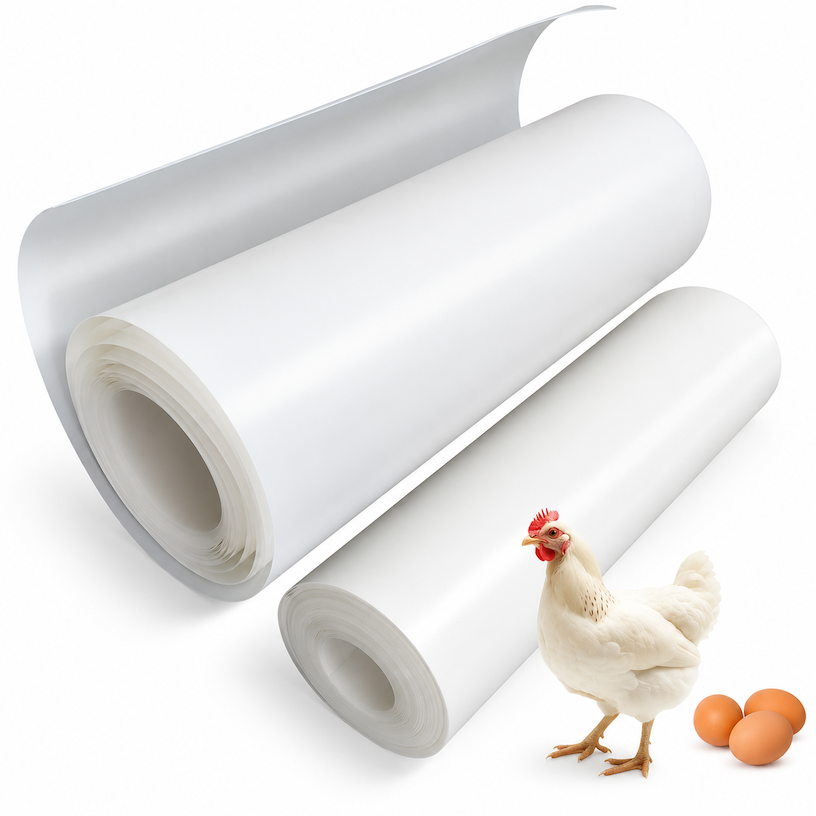
Annilte supplies PP manure belts from 0.8mm to 2.0mm, with 1.0mm and 1.2mm covering most layer applications. In temperate climates, 1.0mm handles standard rows up to roughly 100 meters. In the Philippines, the calculation shifts.
Two factors push toward 1.2mm. First, humidity. Higher moisture content in manure means the belt carries more weight per meter, and the load sits on the belt longer between cleaning cycles. Second, many Philippine layer houses run longer rows or multi-tier H-type systems where the belt path adds up.
The 1.2mm belt is stiffer, but on systems with properly sized drive and tension rollers, the extra thickness provides margin against stretching and elongation. If the belt you are replacing failed by elongating rather than wearing through, that is a tensile issue, not a thickness issue, and going thicker will not solve it. Check the original specification first.
Width: Measure the Old Belt, Not the Cage Bank
This is the most common replacement-order error. The cage bank width is not the belt width. The belt runs over rollers and guides, and the usable width accounts for edge clearance.
For Philippine farms importing replacement belts, measure the old belt if one exists. If the belt is too degraded to measure reliably, measure the roller face and subtract clearance for the tracking guides. A belt that is slightly too wide rubs the frame. Slightly too narrow leaves manure falling past the edges. Neither becomes obvious until the system runs a full cycle.
Annilte customizes PP belt widths up to 3000mm. The number you send must be the running width, not an estimate.
Tracking Problems: Three Causes and How to Check Them
Belt deviation is the most common complaint in Philippine poultry houses, and the belt itself is rarely the only cause. Annilte’s engineers investigated over 300 farm sites and traced most deviation issues to three sources.
No deviation correction device. Many cage systems lack proper guide rollers or edge guides. A new belt on a frame without tracking control will wander regardless of belt quality. Before ordering a replacement for a belt that failed by deviation, inspect the frame. If there are no self-aligning rollers, the new belt will fail the same way.
Uneven belt thickness from low-grade PP. Recycled or inconsistent polypropylene creates thickness variation across the width. The belt steers toward the thicker side. Annilte uses virgin PP and controls extrusion thickness to minimize this.
Weld quality. A poorly welded joint creates a thickness bump that steers the belt off-center every time it passes over a roller. Annilte uses high-frequency welding for PP belt joints, which produces consistent thickness across the splice. If you are comparing quotes, ask how the joint is made. “Welded” is not enough.
Import Documentation: What Philippine Buyers Should Prepare
The belt itself is only part of the procurement. Philippine importation of agricultural equipment involves documentation that, if missing, can hold a shipment at customs longer than the belt’s production lead time.
Under the Agriculture and Fisheries Modernization Act, enterprises certified by the Department of Agriculture may be eligible for tariff exemptions on agricultural equipment and machinery, including conveyors. The certification process requires coordination with the DA and the Board of Investments. If your farm or integrator holds this certification, confirm with your customs broker that the PP manure belt classification falls within the eligible items.
For buyers without the certification, standard import duties and taxes apply. The practical step: confirm the HS code with your supplier before shipment. Annilte provides commercial invoices and packing lists with the correct HS classification for conveyor belts. A supplier who cannot provide this documentation clearly is a supplier who has not shipped to the Philippines before.
What to Send Before Requesting a Quote
A useful quote request includes:
- Cage type: H-type or A-type
- Number of tiers and row length (approximate is fine, but specify if over 100 meters)
- Belt width: measured from the old belt or roller face minus clearance
- Thickness preference: or row length and manure conditions if unsure
- Failure mode of the previous belt, if this is a replacement
- Whether the frame has tracking guides or self-aligning rollers
- Import certification status, if applicable
The failure mode is diagnostic. Edge fraying points to tracking. Lengthwise cracking points to tension or material degradation. A tear at the weld points to joining quality.
Annilte manufactures PP poultry manure belts using virgin polypropylene and high-frequency welded joints, in widths up to 3000mm and thicknesses from 0.8mm to 2.0mm. If you are specifying a replacement or equipping a new house in the Philippines, send the system details and we will confirm the specification before you commit.
Internal links:
- PP Manure Belt product page — full specification table and customization options
- What is the PP manure belt? — material and application overview for first-time buyers

R&D Team
Annilte has a research and development team consisting of 35 technicians. With strong technical research and development capabilities, we have provided conveyor belt customization services for 1780 industry segments, and gained recognition and affirmation from 20,000+ customers. With mature R&D and customization experience, we can meet the customization needs of different scenarios in various industries.

Production Strength
Annilte has 16 fully automated production lines imported from Germany in its integrated workshop, and 2 additional emergency backup production lines. The company ensures that the safety stock of all kinds of raw materials is not less than 400,000 square meters, and once the customer submits an emergency order, we will ship the product within 24 hours to respond to the customer's needs efficiently.
As a leading Chinese conveyor belt manufacturer with 17 years of industry experience, Annilte is proud to hold both ISO quality management certification and the RoHS environmental directive. Our manufacturing facilities meet “Green Factory” standards, and we are also an internationally recognized SGS Gold Supplier.
We offer a comprehensive range of customizable belt solutions under our own brand "ANNILTE", designed to meet diverse industrial needs.
Should you require further information about our products or capabilities, please do not hesitate to contact us.
WhatsApp: +86 185 6019 6101 Tel/WeChat: +86 185 6010 2292
E-mail: 391886440@qq.com Website: https://www.annilte.net/
Post time: Nov-23-2026