

Polyester Mesh Conveyor Belt: What to Specify Before You Send an RFQ
Most RFQs for polyester mesh conveyor belts arrive with three numbers: width, length, and “food grade.” That’s not enough to quote accurately, and it’s the reason a fair share of first orders end up as replacements. This guide covers the specifications that actually determine whether a belt performs on your line — and the questions worth settling before you commit.
Mesh Opening vs. Open Area: The Number That Changes Your Energy Bill
The published mesh opening (say, 2 mm) is a nominal figure. It tells you the approximate hole size, but not how much air or water actually passes through. That’s governed by open area percentage.
A 2 mm mesh in a plain weave might deliver 35% open area. The same nominal opening in a different weave structure could be closer to 45%, or lower . For a dewatering or drying line, open area is the number that determines airflow resistance. If your dryer is working harder than it should, and the belt is “the right size,” open area is the first thing to check.
Practical threshold: For air-knife dewatering of leafy vegetables and cut fruit, ask for open area ≥40%. For through-air drying, ≥45% is worth targeting . If a supplier can’t provide a measured open area figure, that’s a data point in itself.
Edge Sealing: The Failure Mode Nobody Checks Until QA Finds a Strand
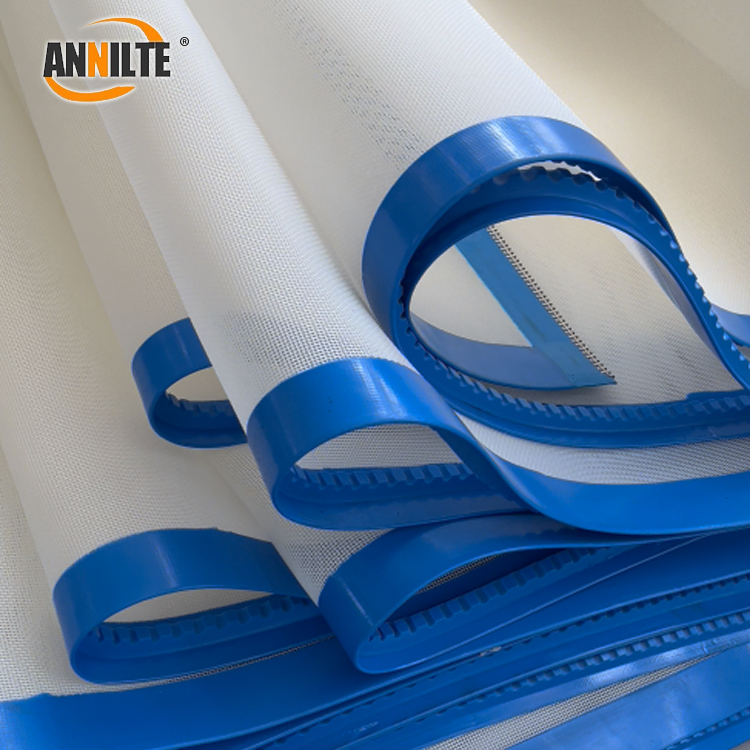
Fruit and vegetable lines run wet. Belt edges contact the frame, guide rollers, and scrapers continuously. If the edge isn’t properly sealed, individual monofilament strands work loose over time. You won’t see it during a visual walkaround. You’ll see it when a customer complaint or an internal audit pulls a sample.
Two edge constructions dominate the food market: heat-sealed polyester edge and TPU edge. Heat-sealed polyester edges are the standard for fruit and vegetable dewatering — they’re flexible, food-compliant, and don’t introduce a second material into the waste stream . TPU edges offer better low-temperature flexibility and hydrolysis resistance in constant washdown environments, but they add cost and require migration documentation for the TPU itself .
What to ask: “Is the edge sealed with polyester or TPU? Can you send the migration test report for the edge material under FDA 21 CFR and EC 1935/2004?” A supplier who has the reports on file will send them without a three-week delay. One who doesn’t will change the subject.
Joint Type: Endless vs. Mechanical, and the Tension Trap
Endless (woven-in or welded) belts have no weak point and no metal near product. For hygienic food lines, this is the default. Mechanical joints — stainless clips, spiral rings, hinge connectors — install faster on wide conveyors but introduce a metal component and a known fatigue point .
The trap is tension. A mechanical joint has its own tensile rating, separate from the belt’s. If you tension the belt to the belt’s rating rather than the joint’s, the joint becomes the first failure. Rule of thumb: Set working tension to no more than 70% of the joint’s rated strength, and confirm that figure with the supplier before installation .
Temperature and Chemistry: The Honest Numbers
Polyester mesh belts are commonly rated from roughly -40°C to +130°C peak, with continuous operating temperature typically capped lower . The figure that matters is your continuous temperature, not the peak. A belt rated to 130°C peak running continuously at 110°C in a steamy drying tunnel will hydrolyze faster than the spec sheet suggests.
Chemistry: Polyester resists most food acids, oils, and fats. It does not resist strong alkalis or concentrated acids well . If your CIP program uses caustic at elevated concentration and temperature, confirm compatibility with the belt supplier before the first wash cycle, not after.
MOQ, Lead Time, and What a 2 m² Trial Actually Tells You
For a first order or a specification change, a small trial quantity is the cheapest validation available. A 2 m² minimum order is common in the Chinese mesh belt market, and it’s enough to check weave consistency, measure actual open area, inspect edge sealing, and run a short trial on your line .
What it won’t tell you: long-term wear under tension, hydrolysis resistance over months, or how the edge holds up after 500 washdown cycles. Treat the trial as a filter for clearly wrong specifications, not as a lifetime guarantee.
Lead time benchmark: Standard production for custom widths and lengths runs 15–30 days from order confirmation, depending on mesh type and edge finishing. Emergency stock programs exist, but confirm the specific mesh and width are covered before you rely on a 24-hour dispatch claim .
A Pre-Order Checklist You Can Send to Any Supplier
Before you approve a PO for a polyester mesh conveyor belt, get written answers to these:
| # | Item | What “good” looks like |
|---|---|---|
| 1 | Measured open area (%) | Within ±3% of the quoted figure; test method stated |
| 2 | Edge material and sealing process | Polyester heat-sealed for food; TPU if low-temp/hydrolysis resistance required |
| 3 | Joint type and rated strength | Endless preferred for hygiene; mechanical joint rating ≥ working tension ÷ 0.7 |
| 4 | Continuous vs. peak temperature | Continuous rating stated separately from peak |
| 5 | Food contact documentation | FDA 21 CFR and/or EC 1935/2004 migration reports available on request |
| 6 | Dimensional tolerances | Width and length tolerances stated numerically, not “standard” |
| 7 | Trial quantity and lead time | 2 m² trial available; production lead time confirmed in writing |
One Question That Separates Manufacturers from Resellers
Ask: “What’s the warp and weft tensile strength of this specific mesh, in N/cm?”
A manufacturer will have the figure, because they weave the fabric. A reseller will need to check with their supplier. Both answers are useful, but only one tells you whether you’re talking to the people who control the quality.
Need a specification review? Send us your line width, product type, wash/dry process, and continuous operating temperature. We’ll come back with a specific mesh recommendation — measured open area included — not a catalog page. For urgent replacement, include your downtime window.
Related pages: Food Grade Polyester Mesh Conveyor Belt · Polyester Mesh Belt for Fruit Processing

R&D Team
Annilte has a research and development team consisting of 35 technicians. With strong technical research and development capabilities, we have provided conveyor belt customization services for 1780 industry segments, and gained recognition and affirmation from 20,000+ customers. With mature R&D and customization experience, we can meet the customization needs of different scenarios in various industries.

Production Strength
Annilte has 16 fully automated production lines imported from Germany in its integrated workshop, and 2 additional emergency backup production lines. The company ensures that the safety stock of all kinds of raw materials is not less than 400,000 square meters, and once the customer submits an emergency order, we will ship the product within 24 hours to respond to the customer's needs efficiently.
As a leading Chinese conveyor belt manufacturer with 17 years of industry experience, Annilte is proud to hold both ISO quality management certification and the RoHS environmental directive. Our manufacturing facilities meet “Green Factory” standards, and we are also an internationally recognized SGS Gold Supplier.
We offer a comprehensive range of customizable belt solutions under our own brand "ANNILTE", designed to meet diverse industrial needs.
Should you require further information about our products or capabilities, please do not hesitate to contact us.
WhatsApp: +86 185 6019 6101 Tel/WeChat: +86 185 6010 2292
E-mail: 391886440@qq.com Website: https://www.annilte.net/
Post time: Nov-23-2026