

When Standard Belts Fail, Kevlar Excels
In high-temperature industrial environments—glass manufacturing, steel processing, and heat treatment lines—standard conveyor belts degrade quickly under thermal stress, leading to costly downtime and frequent replacements. For plant managers, procurement engineers, and equipment integrators facing extreme heat challenges, the question is critical: What is a high temperature Kevlar conveyor belt, and why does it outperform conventional options?
A high temperature Kevlar conveyor belt is an industrial belting solution engineered with DuPont™ Kevlar® aramid fiber—or a blend of Kevlar with stainless steel and PBO fibers—designed to withstand continuous operating temperatures from 260°C up to instantaneous peaks of 550°C while maintaining exceptional tensile strength and dimensional stability . Unlike polyester/nylon (EP) or steel cord belts that stretch, degrade, or lose integrity under heat, Kevlar-based belts deliver long service life in the most demanding thermal environments.
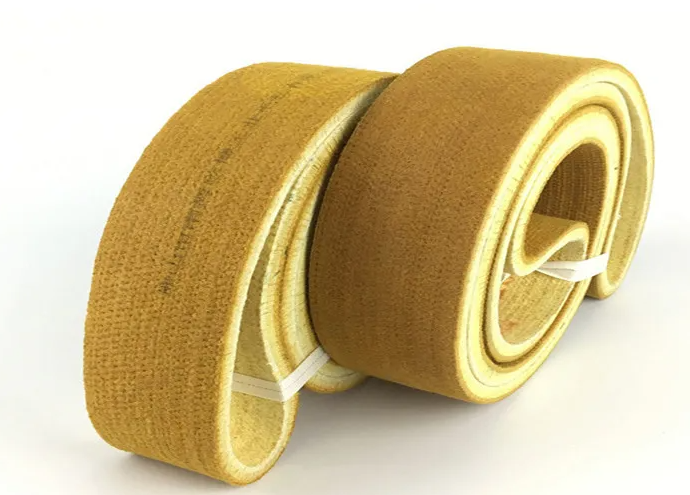
What Makes Kevlar Conveyor Belts High Temperature Resistant?
The Kevlar Advantage
Kevlar is a high-strength, lightweight aramid fiber developed by DuPont, offering:
- Exceptional heat resistance: Continuous operation up to 260°C; instantaneous peaks reaching 550°C
- Superior tensile strength: Handles heavy loads without stretching or breaking
- Low elongation: Typically less than 0.5%, ensuring dimensional stability under load
- Lightweight: Up to 30% lighter than steel wire rope belts of equal strength, reducing energy consumption
- Chemical and corrosion resistance: Unaffected by water vapor, corrosive minerals, and most chemicals
Composite Blends for Enhanced Performance
Many high temperature Kevlar conveyor belts incorporate additional materials to optimize specific properties:
| Blend Type | Components | Temperature Resistance | Key Applications |
|---|---|---|---|
| Kevlar + Stainless Steel | Aramid fiber + SS wire | Up to 550°C (instant) | Glass forming, metal casting |
| Kevlar + PBO + Stainless Steel | PBO fiber for extreme heat | Up to 600°C | Annealing furnaces |
| PTFE-coated Kevlar | Kevlar mesh + PTFE coating | -70°C to +260°C | Drying ovens, food processing |
| Kevlar Felt | Multi-layer Kevlar fabric | Up to +510°C | Specialized high-heat conveyance |
Types of High Temperature Kevlar Conveyor Belts
1. Flat Woven Kevlar Belts
Manufactured using high-density, multi-layered weaving techniques. Typical thickness ranges from 0.7mm to 6mm, with widths up to 500mm or more. These belts are durable, robust, and prevent marking or thermal shock on conveyed items .
2. PTFE-Coated Kevlar Mesh Belts
A Kevlar substrate coated with PTFE (Teflon) provides a non-stick, chemical-resistant surface. These open-mesh belts are ideal for drying ovens, PCB curing, and textile drying lines. Tensile strength can reach 3,500/3,300 N/5cm .
3. Kevlar Felt Belts
Multi-layer Kevlar felt construction with 5 or more reinforcing layers. Temperature resistance up to 510°C, with thickness ranging from 5mm to 14mm. Available endlessly woven or with mechanical fasteners .
4. PTFE-Coated Kevlar Fabric Belts
Kevlar base fabric coated with PTFE resin for applications requiring non-stick surfaces and chemical resistance. Temperature range: -140°C to 360°C. Tensile strength up to 1,500/1,250 N/cm .
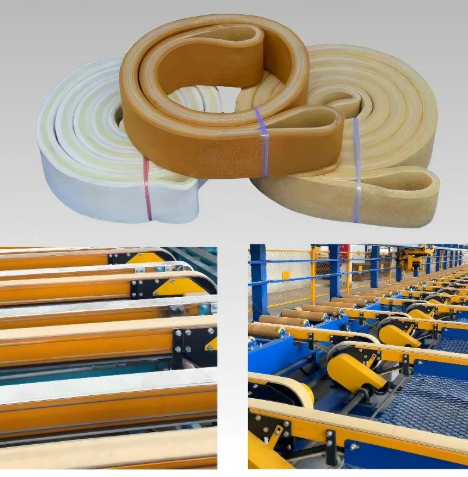
Key Applications by Industry
Glass Manufacturing
The most demanding application for high temperature Kevlar conveyor belts. Belts transport hot glass items—stemware, washing machine windows, tableware—from forming presses to annealing lehrs, where temperatures are extreme and thermal shock is a constant risk . The belt's heat resistance prevents marking, glazing, or deformation of glass surfaces .
Metallurgy & Steel Processing
Conveying hot steel sheets, welded castings, sintered ore, and clinker. In steel plants, Kevlar belts handle hot materials from continuous casting or galvanizing processes, maintaining integrity where standard rubber belts would harden and crack . EPDM-based Super-K® belts are another heat-resistant option, but Kevlar offers superior tensile strength and lightweight construction .
Mining & Heavy Industry
Mining conveyor belts with Kevlar® carcasses replace conventional polyester/nylon and steel cord belts. Benefits include increased lifespan, reduced rolling resistance, lower energy consumption, and fewer splices. Lightweight design reduces equipment structural demands and operating costs .
Drying & Curing Operations
PTFE-coated Kevlar mesh belts are used in:
- Textile flat-bed dryers and flocking lines
- Far-infrared curing tunnels
- PCB drying ovens
- Industrial food dehydration lines
- Packaging lamination and garment shrink-setting
The open mesh design allows airflow while the non-stick PTFE surface ensures easy material release .
Technical Specifications: What to Look For
When evaluating high temperature Kevlar conveyor belts for your application, consider these key parameters:
Temperature Resistance
- Continuous operating temperature: Typically 260°C–400°C depending on construction
- Instantaneous peak temperature: Up to 550°C–600°C for PBO blends
- Low-temperature limit: As low as -196°C for PTFE-coated versions
Tensile Strength
- Kevlar mesh belts: 3,500/3,300 N/5cm
- Kevlar fabric belts: Up to 1,500/1,250 N/cm
- Low elongation (≤0.5%) ensures dimensional stability
Dimensions
- Width: Up to 4,000mm for mesh belts; typically 300–500mm for woven flat belts
- Thickness: 0.7mm to 6mm for woven; up to 14mm for felt; 0.08mm to 1.5mm for coated fabrics
Certifications
Look for ISO 9001 quality management and CE marking for European compliance. For mining applications, verify compliance with relevant industry standards .
How to Choose the Right High Temperature Kevlar Belt
1. Assess Temperature Requirements
Define your maximum continuous temperature and peak instantaneous temperature. If your process exceeds 260°C continuously, consider stainless steel/PBO blends or felt construction .
2. Evaluate Mechanical Demands
- Load weight and conveyor length
- Abrasiveness and potential for puncture/tear
- Required tensile strength and elongation limits
3. Determine Belt Configuration
- Open mesh: For drying, airflow requirements
- Flat woven: For glass, metal, and high-load applications
- Felt: For extreme temperature or specialized processes
- PTFE-coated: For non-stick, chemical-resistant needs
4. Consider Total Cost of Ownership
While initial cost may be higher than standard belts, the extended service life, reduced downtime, and lower energy consumption of Kevlar belts deliver significant long-term value .
Conclusion: The Strategic Value of High Temperature Kevlar Belts
A high temperature Kevlar conveyor belt is more than a replacement part—it is a strategic investment in operational reliability. By withstanding extreme heat, maintaining dimensional stability, and resisting wear, Kevlar belts reduce downtime, lower maintenance costs, and improve product quality in demanding industrial processes.
For industries pushing the limits of production speed and temperature, Kevlar-based belting solutions represent the new standard. As one manufacturer noted, this technology "marks a significant leap in addressing the complex needs of heat-intensive production lines" .

R&D Team
Annilte has a research and development team consisting of 35 technicians. With strong technical research and development capabilities, we have provided conveyor belt customization services for 1780 industry segments, and gained recognition and affirmation from 20,000+ customers. With mature R&D and customization experience, we can meet the customization needs of different scenarios in various industries.

Production Strength
Annilte has 16 fully automated production lines imported from Germany in its integrated workshop, and 2 additional emergency backup production lines. The company ensures that the safety stock of all kinds of raw materials is not less than 400,000 square meters, and once the customer submits an emergency order, we will ship the product within 24 hours to respond to the customer's needs efficiently.
As a leading Chinese conveyor belt manufacturer with 17 years of industry experience, Annilte is proud to hold both ISO quality management certification and the RoHS environmental directive. Our manufacturing facilities meet “Green Factory” standards, and we are also an internationally recognized SGS Gold Supplier.
We offer a comprehensive range of customizable belt solutions under our own brand "ANNILTE", designed to meet diverse industrial needs.
Should you require further information about our products or capabilities, please do not hesitate to contact us.
WhatsApp: +86 185 6019 6101 Tel/WeChat: +86 185 6010 2292
E-mail: 391886440@qq.com Website: https://www.annilte.net/
Post time: Jul-11-2026