

Why the Zipper Pouch Machine Punishes Ordinary Belts
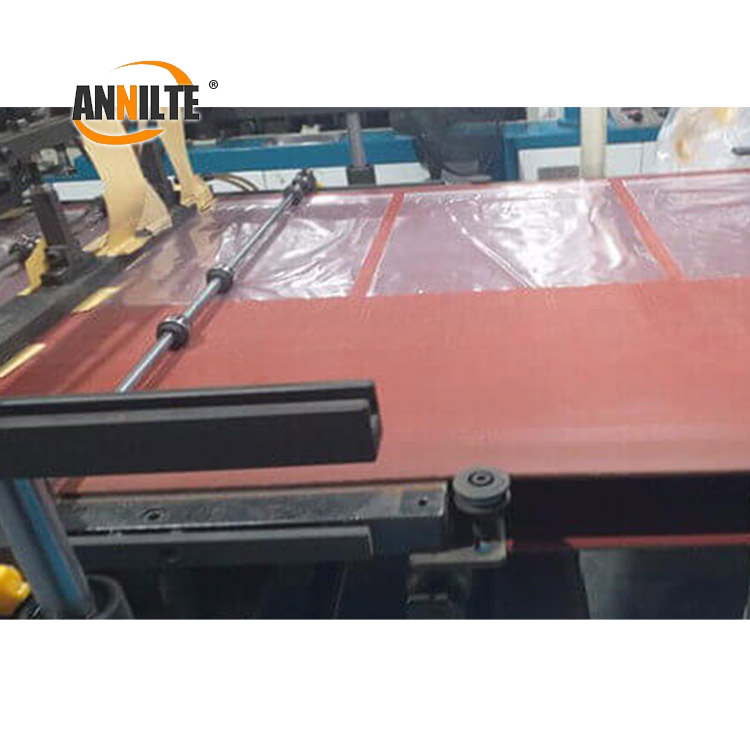
Zipper pouch production differs from standard bag making in a way that most belt suppliers overlook: the zipper profile creates localized thickness and thermal mass at the sealing interface. The belt must compress film and zipper tape simultaneously while maintaining flatness across a width that may exceed 600mm.
When a spliced belt rotates, the joint creates a momentary pressure drop at the sealing jaw. On a bottom-seal station, that drop produces incomplete seals. On a zipper-attach station, it distorts the zipper track. Operators see the symptom—rejected pouches, skewed zippers, inconsistent seal strength—but the root cause sits beneath the film, invisible until the belt is removed and inspected.
Annilte’s seamless silicone belts eliminate this variable. Each belt is vulcanized as a continuous loop with no finger joint and no mechanical discontinuity. The surface your film encounters is identical at every degree of rotation. For procurement teams calculating total cost of ownership, this translates into fewer QC rejects and less operator intervention per shift.
The Three Failure Modes That Drive Replacement Decisions
Adhesive residue accumulation. Molten polyethylene and zipper tape adhesive transfer to belt surfaces under sealing pressure. Standard PU belts glaze and harden, accelerating adhesion. Operators scrape the surface, which degrades it further. Annilte silicone belts maintain release properties through continuous operation—residual material rates drop below 0.1% in field reports, extending cleaning intervals from hours to days.
Thermal dimensional instability. Zipper pouch sealing jaws routinely exceed 200°C. Belts that “meet specification” on day one begin to stretch or shrink under sustained thermal load, causing tracking errors and zipper misalignment. Annilte belts hold dimensional stability at up to 260°C continuous.
Particle contamination. Dark-colored belts shed carbon particles onto white and transparent films, generating rejects in food-grade and premium retail packaging. Annilte offers white FDA-grade silicone that eliminates visible contamination risk without sacrificing release performance.
The Specification Most Buyers Miss: Flatness Across Width
Dimension and hardness numbers are straightforward to compare across quotations. The specification that deserves equal scrutiny is flatness tolerance across the belt width.
On a zipper pouch machine, the zipper track runs through a defined lateral position. If the belt has crowning, edge waviness, or thickness variation, the zipper profile does not receive uniform compression. The result is inconsistent zipper attachment—visible as skewed or partially sealed tracks that pass visual inspection but fail peel testing downstream.
Annilte controls flatness through drum vulcanization technology and knife-coating application that distributes silicone evenly without ridges or bubbles. For a 600mm-wide belt running a center-positioned zipper track, this means the pressure at the zipper flange equals the pressure at the film edges.
Sourcing Checklist for Zipper Pouch Belt Replacement
Before requesting a quotation, gather these parameters. They determine whether a supplier can match your machine or is guessing:
Pulley configuration: minimum pulley diameter and center distance. Small diameters demand higher flexibility; fixed centers require precise length control to maintain tension without external take-up.
Zipper position: center, offset, or dual-track. This defines width tolerance requirements and whether surface texture is needed for stacking control.
Film structure: PE, PP, or laminated composites behave differently at sealing temperature. The belt’s release properties must match your film’s tackiness curve.
Cleaning protocol: if operators currently scrape or solvent-wipe, the replacement belt must either tolerate that protocol or the protocol must change to protect the new belt’s surface.
Annilte manufactures to these parameters rather than forcing a catalog size. Standard custom ranges include widths up to 1500mm, circumferences up to 4000mm, and thicknesses from 2mm to 10mm.
What Changes After the Switch
The first shift after installing a seamless belt typically produces a noticeable change: the rhythmic bump at the joint disappears. Bag length consistency improves without any adjustment to machine settings. Zipper alignment stabilizes because the pressure at the sealing interface is now uniform across every rotation.
One adjustment operators should anticipate: tension setting. A seamless belt has no joint to absorb minor length variations and must be tensioned correctly from installation. Over-tensioning accelerates edge wear; under-tensioning allows slippage. Annilte provides tensioning guidance based on belt thickness and pulley configuration with every order.
Evaluating Suppliers: Manufacturer Versus Trader
The zipper pouch belt market includes manufacturers, converters, and trading companies. The distinction matters at the specification stage. A manufacturer controls vulcanization, silicone compound formulation, and flatness tolerance. A trader forwards dimensions and may not know whether the resulting belt will run flat on a 600mm-wide sealing station.
Annilte operates 16 automated production lines and maintains a 35-engineer R&D team that has customized belts for over 1,780 industry segments. The company serves 18 Fortune 500 customers and holds ISO and SGS Gold Supplier certifications. For zipper pouch applications specifically, Annilte maintains technical stock specifications for common machine models and can ship emergency orders within 24 hours.
Next Step: Test on Your Own Line
The only reliable evaluation method is a production trial. Annilte provides technical samples for testing against your actual film, zipper profile, and sealing parameters. Provide your belt dimensions or machine model, and the team will match the sample specification.
Contact Annilte with your zipper pouch machine details to request a sample or quotation.

R&D Team
Annilte has a research and development team consisting of 35 technicians. With strong technical research and development capabilities, we have provided conveyor belt customization services for 1780 industry segments, and gained recognition and affirmation from 20,000+ customers. With mature R&D and customization experience, we can meet the customization needs of different scenarios in various industries.

Production Strength
Annilte has 16 fully automated production lines imported from Germany in its integrated workshop, and 2 additional emergency backup production lines. The company ensures that the safety stock of all kinds of raw materials is not less than 400,000 square meters, and once the customer submits an emergency order, we will ship the product within 24 hours to respond to the customer's needs efficiently.
As a leading Chinese conveyor belt manufacturer with 17 years of industry experience, Annilte is proud to hold both ISO quality management certification and the RoHS environmental directive. Our manufacturing facilities meet “Green Factory” standards, and we are also an internationally recognized SGS Gold Supplier.
We offer a comprehensive range of customizable belt solutions under our own brand "ANNILTE", designed to meet diverse industrial needs.
Should you require further information about our products or capabilities, please do not hesitate to contact us.
WhatsApp: +86 185 6019 6101 Tel/WeChat: +86 185 6010 2292
E-mail: 391886440@qq.com Website: https://www.annilte.net/
Post time: Nov-23-2026