

Why Square Baler Belts Are a Different Sourcing Problem
Round baler belts dominate the aftermarket conversation. They are large, expensive, and visibly wear out. Square baler belts operate in the background—driving the pickup, the thrower, and the knotter—and they fail differently.
The distinction matters for distributors. A round baler belt that stretches causes bale formation problems the operator can see. A square baler belt that fails at the splice stops the entire machine. The knotter misses. The thrower jams. The customer calls you, not the OEM, because you sold them the belt.
Square baler belt demand is smaller in volume but higher in urgency per incident. Distributors who stock the right specifications capture repeat business from farmers who cannot afford to wait for a dealer order during hay season.
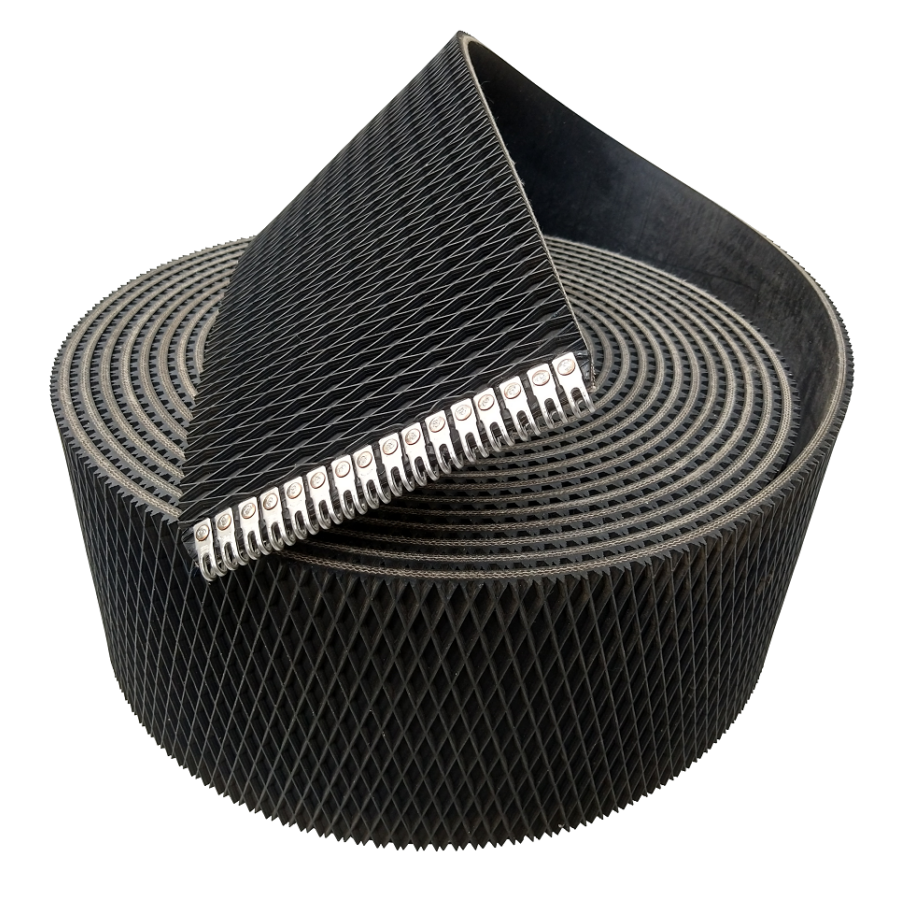
Where Square Baler Belts Actually Fail
The failure pattern is consistent across brands and models. The belt body rarely fails first. The splice does.
New Holland square baler belts, including part numbers like 9808497 used on the 565, 570, and 575 models, are laced belts that rely on a splicing pin to form a continuous loop . John Deere’s installation documentation for its balers specifies exact hook counts—44 hooks on one end, 45 on the other—and a specific pin bend angle of 70 to 80 degrees . These are not suggestions. They are engineering requirements that determine whether the splice holds under load.
Aftermarket suppliers that treat the splice as an afterthought deliver belts that install correctly and fail prematurely. The rubber may be sound. The fabric may be sound. But if the hook pattern does not match the OEM specification, the splice becomes the weakest point in a system already under constant cyclic loading.
The Specification Problem: “Close Enough” Does Not Install
Square baler belts come in configurations that vary by position and function. A pickup drive belt is not the same as a thrower drive belt. A knotter drive belt is not the same as a bale forming belt.
The specifications reflect this. AGCO lists a bale forming belt for the MF 1835 small square baler as 3-ply, 481.5 inches long, and 7.00 inches wide . A Ford/New Holland 268 replacement belt is listed as a classical V-belt, C124 profile, 7/8-inch top width, and 128 inches outside length . A Hesston 4450 bale thrower drive belt is specified as 5/8-inch by 108 inches, double angle . These are not interchangeable dimensions.
For distributors, the practical risk is clear. A belt ordered by “approximate size” may fit onto the pulleys but fail to maintain tension. A belt that is slightly too long will slip under load, accelerating wear on both the belt and the driven components. A belt that is slightly too short may not install at all, or may overload the bearings when forced.
ANNILTE manufactures square baler belts to specification, not to nearest-stock size. Distributors provide the OEM part number or the physical dimensions—width, ply, length, and splice configuration—and we produce to that specification.
Brands and Models That Matter for Distributor Stocking
Square baler belt demand concentrates around a core group of machines that remain in service across North America, Europe, and export markets.
New Holland is the most visible in the aftermarket, with the 565, 570, and 575 series small square balers generating consistent belt demand . These machines are widely used and widely serviced by independent distributors.
John Deere square balers, while less numerous than New Holland in some regions, still require replacement belts at predictable intervals. Deere’s documentation specifies belt routing and splice orientation precisely, which means aftermarket belts must match those requirements to function correctly .
Massey Ferguson small square balers, including the MF 1835, use specific bale forming belt dimensions that do not cross-reference to other brands .
Hesston (now part of AGCO) and Case IH square balers round out the major demand segments. Hesston 4450 thrower belts and Case IH LB series belts represent ongoing aftermarket opportunities .
For distributors serving mixed fleets, the stocking challenge is real. But the solution is not to carry every possible belt. It is to identify the top three to five square baler models in your region, stock the correct specifications for those models, and establish a supplier relationship that can fill gaps quickly when an uncommon model appears.
The Splice Verification Question Every Distributor Should Ask
When evaluating a square baler belt supplier, the most important question is not about price per belt. It is about how the splice is verified before shipment.
A visual inspection confirms that hooks are present. It does not confirm that the hook spacing matches the OEM specification, that the pin material is correct, or that the splice will hold under the tension loads the baler applies. A responsible manufacturer has a documented verification step—whether a pull test, a dimensional check against a master sample, or a batch-level quality gate.
ANNILTE’s production process includes splice verification as a standard step, not an optional add-on. For distributors, this translates into fewer returns, fewer field failures, and a lower total cost of stocking square baler belts.
Sourcing for the Season, Not for the Order
Square baler belt demand is seasonal but predictable. The distributors who serve their customers well are the ones who place orders against forecast, not against current stock levels.
ANNILTE supports distributor stocking programs with specification files held on record for repeat orders, consistent fabric and splice quality across batches, and emergency dispatch within 24 hours when a customer’s season cannot wait. For distributors building a square baler belt program, the value is not in the lowest unit price. It is in the confidence that the belt in the box will install correctly and stay in the field.

R&D Team
Annilte has a research and development team consisting of 35 technicians. With strong technical research and development capabilities, we have provided conveyor belt customization services for 1780 industry segments, and gained recognition and affirmation from 20,000+ customers. With mature R&D and customization experience, we can meet the customization needs of different scenarios in various industries.

Production Strength
Annilte has 16 fully automated production lines imported from Germany in its integrated workshop, and 2 additional emergency backup production lines. The company ensures that the safety stock of all kinds of raw materials is not less than 400,000 square meters, and once the customer submits an emergency order, we will ship the product within 24 hours to respond to the customer's needs efficiently.
As a leading Chinese conveyor belt manufacturer with 17 years of industry experience, Annilte is proud to hold both ISO quality management certification and the RoHS environmental directive. Our manufacturing facilities meet “Green Factory” standards, and we are also an internationally recognized SGS Gold Supplier.
We offer a comprehensive range of customizable belt solutions under our own brand "ANNILTE", designed to meet diverse industrial needs.
Should you require further information about our products or capabilities, please do not hesitate to contact us.
WhatsApp: +86 185 6019 6101 Tel/WeChat: +86 185 6010 2292
E-mail: 391886440@qq.com Website: https://www.annilte.net/
Post time: Nov-23-2026