

The Hidden Cost of a $200 Conveyor Belt
Biomass pellet plant managers know the drill: a sidewall conveyor belt that costs a fraction of the production line, yet accounts for a disproportionate share of unplanned downtime.
Every time material leaks from a cracked sidewall joint, every time fine dust escapes at the transfer point, every time a belt fails prematurely—the real cost isn’t the belt. It’s the cleanup labor, the contaminated product, the safety hazard, and the production hours lost.
For biomass pellet operations running 24/7, these “small” failures compound into tens of thousands of dollars in annual losses.
Why Standard Sidewall Belts Fail in Biomass Plants
The Joint Problem: Traditional Sidewall Belts Have a Fatal Flaw
Most PVC sidewall conveyor belts on the market are manufactured using a cold-bonding or hot-gluing process that creates a visible joint where the sidewall connects to the base belt.
In theory, this works. In practice, biomass pellet plants expose this joint to relentless mechanical stress:
- Cyclic flexing: Every rotation around the drive pulley forces the sidewall joint to stretch and compress. Over thousands of cycles, microscopic cracks form.
- Material infiltration: Fine biomass dust—often with moisture content varying from 10% to 30%—penetrates these cracks. Once inside, it acts as an abrasive wedge, accelerating joint failure.
- Residue buildup: Organic matter trapped in joint crevices creates a hygiene nightmare and a potential ignition point.
The result? Material leakage, contamination, and belt replacement far sooner than any maintenance schedule anticipated.
The Dust Problem: More Than Just a Housekeeping Issue
Biomass dust isn’t just messy—it’s dangerous. The fine particles generated during pellet handling are:
- Combustible: Biomass dust clouds can ignite with as little as 17 mJ of energy. Static electricity from a running conveyor system can easily exceed this threshold.
- Health hazard: Prolonged exposure to fine biomass dust has been linked to respiratory issues and is classified as a human carcinogen.
- Costly: Material that leaks from conveyor edges is product you can’t sell. In facilities handling hundreds of tons per day, even a 1% loss adds up to thousands in wasted feedstock annually.
How ANNILTE’s Patented Seamless Sidewall Changes the Equation
For over 15 years, ANNILTE has manufactured PVC sidewall conveyor belts from our 16 German-imported production lines. When we studied the failure patterns of conventional sidewall belts in biomass applications, we identified the joint as the root cause of most premature failures.
Our solution: Patented Seamless Sidewall Technology.
How It Works
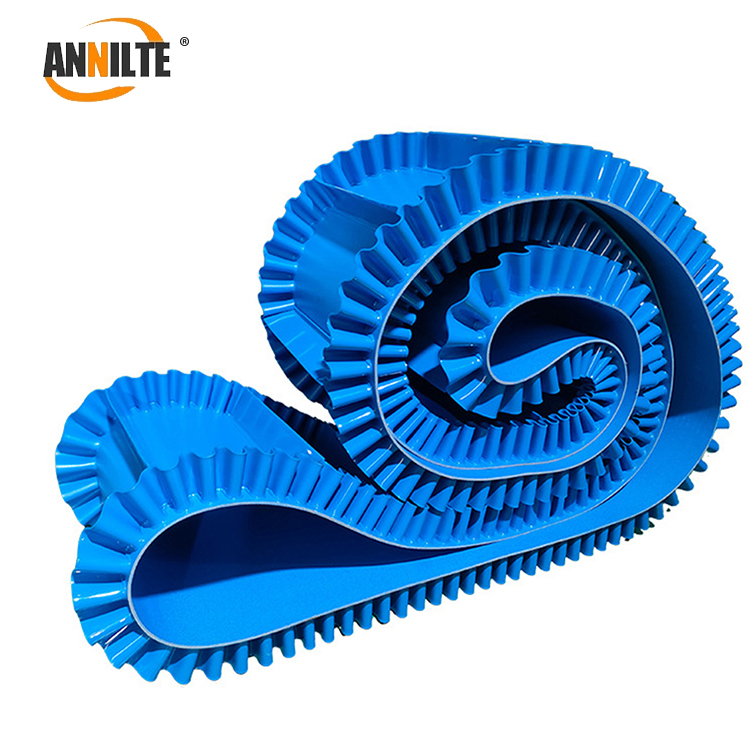
Instead of bonding a separate sidewall strip to the base belt, our seamless process integrates the corrugated sidewall directly into the belt structure through a high-frequency fusion and integrated molding technique. The result is a continuous, joint-free sidewall that behaves as a single molecular unit.
What This Means for Your Plant
| Failure Mode | Traditional Jointed Sidewall | ANNILTE Seamless Sidewall |
|---|---|---|
| Joint cracking | Inevitable within 12-24 months | Eliminated—no joint exists |
| Material leakage | Gradual increase as joint degrades | Zero leakage at sidewall interface |
| Hygiene risk | Crevices harbor bacteria, organic matter | Smooth surface, 100% cleanable |
| Fatigue resistance | Baseline | 200%+ improvement in testing |
| Replacement cycle | Frequent, unpredictable | Extended, predictable |
For biomass pellet plants, the implication is straightforward: you stop replacing belts because the joint failed, and you start replacing them according to your planned maintenance schedule.
Built for the Realities of Biomass Handling
Biomass pellet production isn’t a pristine laboratory environment. It involves:
- Wood chips, sawdust, and agricultural residues with varying moisture content
- Fine dust generation at every transfer and loading point
- Abrasive wear from silica content in certain feedstocks
- Temperature variations from ambient conditions to dryer discharge zones
- Static electricity buildup in dry, dusty environments
ANNILTE’s PVC sidewall conveyor belts are engineered specifically for these conditions.
Key Performance Specifications for Biomass Applications
| Parameter | ANNILTE Capability | Why It Matters for Biomass |
|---|---|---|
| Inclination angle | 0° to 90° | Eliminates bucket elevators; reduces footprint and civil costs |
| Sidewall height | 40mm – 300mm (customizable) | Matches material flow and capacity requirements |
| Cleat profile | T-type, C-type, S-type, customizable | Optimal pocket formation for pellets and chips |
| Cleat spacing | 100mm – 500mm adjustable | Balances capacity with discharge efficiency |
| Tensile strength | Up to 1,200 N/mm | Handles high-volume biomass streams |
| Temperature range | -20°C to +80°C | Covers ambient to dryer-discharge conditions |
| Anti-static treatment | Available on request | Mitigates static discharge risk in dust-rich zones |
| Flame retardant | Self-extinguishing compounds available | Addresses biomass dust ignition concerns |
The “Pocket” Advantage: Replacing Inefficient Conveying Systems
One of the most compelling applications for sidewall belts in biomass plants is replacing bucket elevators and multi-stage conveyor systems.
A bucket elevator for pellet handling:
- Requires significant vertical space and foundation work
- Generates dust at every discharge point
- Has high maintenance costs (chains, buckets, bearings)
- Creates a confined space hazard
A PVC sidewall conveyor belt with properly configured cleats:
- Conveys at angles up to 90° in a single, continuous path
- Eliminates multiple transfer points where dust and spillage occur
- Requires minimal civil construction
- Reduces maintenance to belt inspection and tensioning checks
For a biomass plant, replacing a bucket elevator with a sidewall belt system can reduce capital expenditure and dramatically cut ongoing maintenance costs.
The Biomass Buyer’s Checklist: What to Ask Before You Order
When sourcing PVC sidewall conveyor belts for a biomass pellet plant, don’t settle for a generic product description. Ask these questions:
1. “Is the sidewall truly seamless, or is it bonded?”
If the answer includes words like “glued,” “vulcanized joint,” or “cold-bonded,” you’re looking at a future leak point. Demand visual evidence of the manufacturing process or a sample showing a continuous sidewall cross-section.
2. “What is the fabric reinforcement specification?”
Biomass streams can carry abrasive particles that degrade the base belt over time. For heavy-duty applications, specify 3-4 ply construction with high-tenacity polyester fabric.
3. “Are the cleats integrated or welded on?”
High-frequency welded cleats (like ANNILTE’s process) create a molecular bond between cleat and belt. Cold-glued cleats are a common failure point under repeated loading and discharge cycles.
4. “Can you provide a fatigue test report?”
A reputable manufacturer should have data on sidewall joint fatigue resistance. If they can’t provide it, the “seamless” claim may be marketing language rather than engineering reality.
5. “What certifications apply?”
For food-adjacent applications (pelletizers often share facilities with feed production), ask about FDA compliance for the PVC compound. For dust-hazard zones, inquire about anti-static and flame-retardant properties.
Why ANNILTE?
Manufacturing depth: 16 fully automated production lines imported from Germany, plus 2 emergency backup lines. Raw material safety stock maintained at 400,000+ square meters. Emergency orders ship within 24 hours.
Engineering capability: 35 full-time R&D technicians. Custom sidewall heights, cleat profiles, and belt constructions developed in-house.
Quality systems: ISO-certified manufacturing. International SGS-certified gold product manufacturer. 15+ years serving global industrial customers.
Proven in the field: Our PVC sidewall belts operate in biomass, recycling, food processing, and chemical facilities worldwide.

R&D Team
Annilte has a research and development team consisting of 35 technicians. With strong technical research and development capabilities, we have provided conveyor belt customization services for 1780 industry segments, and gained recognition and affirmation from 20,000+ customers. With mature R&D and customization experience, we can meet the customization needs of different scenarios in various industries.

Production Strength
Annilte has 16 fully automated production lines imported from Germany in its integrated workshop, and 2 additional emergency backup production lines. The company ensures that the safety stock of all kinds of raw materials is not less than 400,000 square meters, and once the customer submits an emergency order, we will ship the product within 24 hours to respond to the customer's needs efficiently.
As a leading Chinese conveyor belt manufacturer with 17 years of industry experience, Annilte is proud to hold both ISO quality management certification and the RoHS environmental directive. Our manufacturing facilities meet “Green Factory” standards, and we are also an internationally recognized SGS Gold Supplier.
We offer a comprehensive range of customizable belt solutions under our own brand "ANNILTE", designed to meet diverse industrial needs.
Should you require further information about our products or capabilities, please do not hesitate to contact us.
WhatsApp: +86 185 6019 6101 Tel/WeChat: +86 185 6010 2292
E-mail: 391886440@qq.com Website: https://www.annilte.net/
Post time: Oct-13-2026