

Bulk material transportation is where sidewall belts earn their place—or fail early. Powders, pellets, granules, and flakes all behave differently on an incline. A belt that handles fertilizer cleanly may leak sawdust at every joint. A belt that runs fine on a horizontal line may shed its cleats within months on a 60° lift.
Most quotations for a PVC sidewall conveyor belt look interchangeable. Width, sidewall height, cleat pitch, tensile strength. The numbers are there. What the quotation rarely answers is whether the belt will still be conveying material in three years, or whether the sidewall joint will start leaking in eighteen months.
This guide covers what procurement and engineering teams should verify when sourcing a PVC sidewall belt for bulk material transportation—beyond the spec sheet.
The Joint Is Where Bulk Material Belts Fail First
Every sidewall belt has a point where the corrugated sidewall meets the base belt. On most belts, this is a bonded or vulcanized joint. In bulk material service, that joint faces continuous flexing around pulleys, dust infiltration, and moisture variation from the material itself.
Fine bulk materials are the worst offenders. Powdered chemicals, flour, sawdust, and fine biomass particles penetrate any gap wider than a few microns. A bonded joint creates exactly that gap. Once material enters the joint line, it acts as an abrasive wedge. The bond weakens. Material starts leaking. By the time the leak is visible on the floor, the belt is already past the point of economical repair.
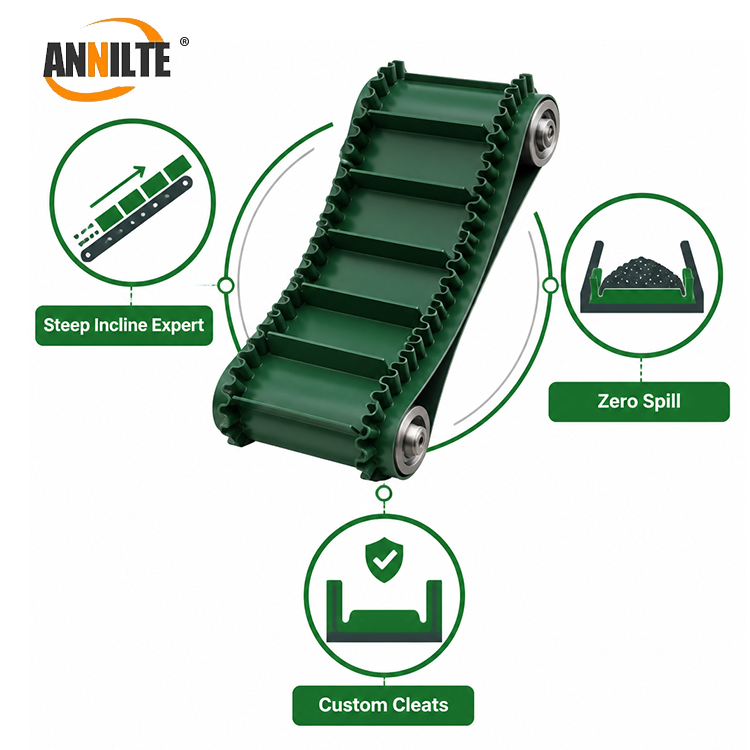
ANNILTE’s patented seamless skirt addresses this failure mode directly. The corrugated sidewall is integrated into the belt structure through high-frequency fusion and integrated molding—no bond line, no crevice for material to hide in . For bulk material transportation, this means the most common leak path is eliminated by design, not by maintenance.
Matching Cleat Profile to Your Bulk Material
The cleat—the transverse rib that forms the pocket with the sidewall—determines whether material stays in the pocket or slides back. The profile matters more than the height.
T-type cleats work for most free-flowing bulk materials: plastic pellets, grain, fertilizer granules, and biomass pellets. The straight profile forms a clean pocket and discharges efficiently at the head pulley.
C-type cleats are better for materials with some stickiness or moisture—wine lees, wet feed, or chemical powders that tend to cling. The curved profile aids release.
Cleat spacing is the other variable buyers often overlook. Spacing that is too wide reduces pocket capacity and allows material to roll back between cleats on steep inclines. Spacing that is too tight limits discharge efficiency. For bulk materials, spacing is typically matched to the material’s angle of repose and the incline angle, not selected from a standard table .
A supplier who asks about your material before quoting cleat dimensions is doing the engineering work. A supplier who quotes from a catalog is not.
Effective Pocket Width: The Number That Determines Capacity
This is a specification gap that catches many buyers. The belt width on the quotation is not the width available for carrying material.
A 1,000 mm belt with 100 mm sidewalls on each side has an effective pocket width closer to 700–800 mm, depending on sidewall base width. If the capacity calculation was based on the nominal belt width, the installed belt will underperform—sometimes by 30% or more .
When reviewing a quotation, ask for a cross-section drawing that shows:
- Effective pocket width between sidewalls
- Cleat height relative to sidewall height
- Fill ratio at the design incline angle
This is especially important for bulk materials with low bulk density, where volumetric capacity matters more than weight capacity.
Installation Realities for Sidewall Belts
Sidewall belts track differently than flat belts. The cleats and sidewalls create asymmetric loading, and the return run requires clearance for the sidewalls. A conveyor designed for a flat belt will not run a sidewall belt correctly without modification.
Return idlers must be arranged to clear both sidewalls. Standard three-roll troughing idlers will flatten the corrugation on the return strand. Flat return rollers under the center, with clearance for the sidewalls, are the correct arrangement .
Loading must be centered and full-width. An off-center feed fills one side of the pocket more than the other, creating a tracking force that no amount of training idlers will fully correct. A well-designed feed chute is worth more than any tracking device added later.
Splice quality matters more on sidewall belts because the splice must carry the belt tension and maintain the sidewall and cleat alignment. A splice that is not fully cured or properly stepped will fail at the sidewall line first.
Supplier Verification for Bulk Material Applications
Ask for a peel test. A sidewall belt sample with the sidewall attached should be pulled apart. The failure mode should show material torn from both the sidewall and the base belt—not a clean separation at the bond line. A clean separation means the bond is the weak point .
Verify the PVC compound. Standard PVC works for many bulk materials, but check oil resistance if your material contains oils or fats. Check temperature range if the material comes from a dryer or process heat. Standard PVC covers operate roughly from 0°C to +60°C; outside that range, the compound behavior changes .
Confirm anti-static properties if dust is present. Bulk material handling generates dust. If the material is combustible—biomass dust, chemical powders, flour—static discharge from the belt is a real ignition risk. Anti-static compounds must be specified at the time of order; they are not an aftermarket addition.
ANNILTE operates 16 automated production lines with 400,000+ square meters of raw material stock, enabling 24-hour shipment for urgent orders . The company holds ISO quality certification and SGS gold supplier status, with documentation available on request.

R&D Team
Annilte has a research and development team consisting of 35 technicians. With strong technical research and development capabilities, we have provided conveyor belt customization services for 1780 industry segments, and gained recognition and affirmation from 20,000+ customers. With mature R&D and customization experience, we can meet the customization needs of different scenarios in various industries.

Production Strength
Annilte has 16 fully automated production lines imported from Germany in its integrated workshop, and 2 additional emergency backup production lines. The company ensures that the safety stock of all kinds of raw materials is not less than 400,000 square meters, and once the customer submits an emergency order, we will ship the product within 24 hours to respond to the customer's needs efficiently.
As a leading Chinese conveyor belt manufacturer with 17 years of industry experience, Annilte is proud to hold both ISO quality management certification and the RoHS environmental directive. Our manufacturing facilities meet “Green Factory” standards, and we are also an internationally recognized SGS Gold Supplier.
We offer a comprehensive range of customizable belt solutions under our own brand "ANNILTE", designed to meet diverse industrial needs.
Should you require further information about our products or capabilities, please do not hesitate to contact us.
WhatsApp: +86 185 6019 6101 Tel/WeChat: +86 185 6010 2292
E-mail: 391886440@qq.com Website: https://www.annilte.net/
Post time: Nov-05-2026