

Poultry Manure Belt: What to Check Before You Order
A manure belt that runs off-center doesn’t fail on day one. It starts with edge wear, then a fray, then a tear at the weld. By the time the belt is visibly gone, the house has been running with a compromised removal system for weeks.
Most of these failures trace back to two decisions made at the ordering stage: thickness and width. Get those right, and the belt does its job. Get them wrong, and you spend the next season chasing tracking issues and replacing belts ahead of schedule.
This guide covers the variables that matter for poultry manure belt selection, written for the people who specify and purchase rather than the people who sell catalogues.
Thickness: The 1.0 vs 1.2 Decision
Annilte supplies PP manure belts from 0.8mm to 2.0mm, with 1.0mm and 1.2mm covering most layer and breeder cage applications. The instinct is to go thicker for durability. That instinct is only half right.
A thicker belt is stiffer. On cage systems with smaller drive or tension rollers, a stiffer belt may not wrap cleanly, which increases tracking stress and edge wear. The belt that runs perfectly on one house’s roller configuration can wander on another simply because the thickness changed.
The practical split: 1.0mm handles standard layer rows up to roughly 100 meters. Longer rows, wetter manure conditions, or breeder operations move to 1.2mm. If the belt you’re replacing failed by stretching or elongating rather than wearing through, thickness isn’t your problem. That points to tensile strength or material quality.
Width: Measure the Belt, Not the Cage
This is where many replacement orders go wrong. The cage bank width is not the belt width. The belt runs over rollers and guides, and the usable width must account for edge clearance and tracking hardware.
Measure the old belt if one exists. If not, measure the roller face and subtract clearance for the guides. A belt that’s slightly too wide will rub the frame. Slightly too narrow leaves manure falling past the edges. Neither is obvious until the system runs.
Annilte customizes widths up to 3000mm for PP belts. The specification only works if the number you send is the actual running width, not an estimate from the cage frame.
The Weld: Where Belts Quietly Fail
PP manure belts can be supplied open-ended or joined into an endless loop. For new installations, endless construction removes the joint as a failure point. For replacements where the frame cannot be opened, a field weld is necessary.
The quality of that weld determines whether the belt tracks true. A poorly welded or uneven joint creates a thickness variation that steers the belt off-center every time it passes over the rollers. Annilte uses high-frequency welding for belt joints, which produces a consistent thickness across the splice.
If you’re comparing quotes, ask how the joint is made. A lower price often means a simpler heat-seal that won’t hold tension.
Why Belts Run Off-Center
Deviation is the most common complaint in manure belt systems. The belt itself is rarely the only cause. Three things account for most tracking problems.
No deviation correction device. Many cage systems lack proper guide rollers or edge guides. A new belt on a frame without tracking control will wander regardless of belt quality.
Uneven belt thickness. Low-grade PP with inconsistent filler distribution creates thickness variations across the width. The belt steers toward the thicker side. Annilte uses virgin PP from Sinopec and controls extrusion thickness to minimize this.
Improper tension. Too loose and the belt slips and wanders. Too tight and it stretches unevenly. The belt should run flat and centered, with enough tension to drive without slipping.
Before ordering a replacement for a belt that failed by deviation, check the tracking hardware. A new belt on a misaligned frame will fail the same way.
What PP Handles, and What It Doesn’t
PP manure belts from Annilte operate from -40°C to +90°C. That covers the range for poultry houses in most climates, including cold-weather regions where belts must not become brittle and tropical environments where humidity is constant.
Chemical resistance is the more relevant property. PP resists the ammonia, uric acid, and cleaning chemicals present in poultry waste. It doesn’t absorb moisture, which means the belt doesn’t gain weight or sag as it runs. The smooth surface releases manure at the scraper without buildup.
What PP doesn’t handle well: sharp metal edges. A burr on a guide roller or a bent cage wire will score the belt surface and create a starting point for a tear. Inspect the conveyor path when installing a new belt.
What to Send Before Requesting a Quote
To get an accurate quote and avoid a belt that almost fits, provide:
- Belt width, measured from the old belt or the roller face minus clearance
- Thickness preference, or the load conditions if you’re unsure
- Overall belt length, or the machine model for reference
- Whether the belt needs to be endless or open-ended for field joining
- How the previous belt failed, if this is a replacement
The failure mode matters. Edge fraying points to tracking. Lengthwise cracking points to material degradation. A tear at the weld points to joining quality. A supplier who asks about the failure is more useful than one who only quotes a price.
Annilte manufactures PP poultry manure belts in standard and custom widths, with virgin PP material and high-frequency welded joints. If you’re specifying a replacement or equipping a new house, send the details and we’ll confirm the specification before you commit.

R&D Team
Annilte has a research and development team consisting of 35 technicians. With strong technical research and development capabilities, we have provided conveyor belt customization services for 1780 industry segments, and gained recognition and affirmation from 20,000+ customers. With mature R&D and customization experience, we can meet the customization needs of different scenarios in various industries.

Production Strength
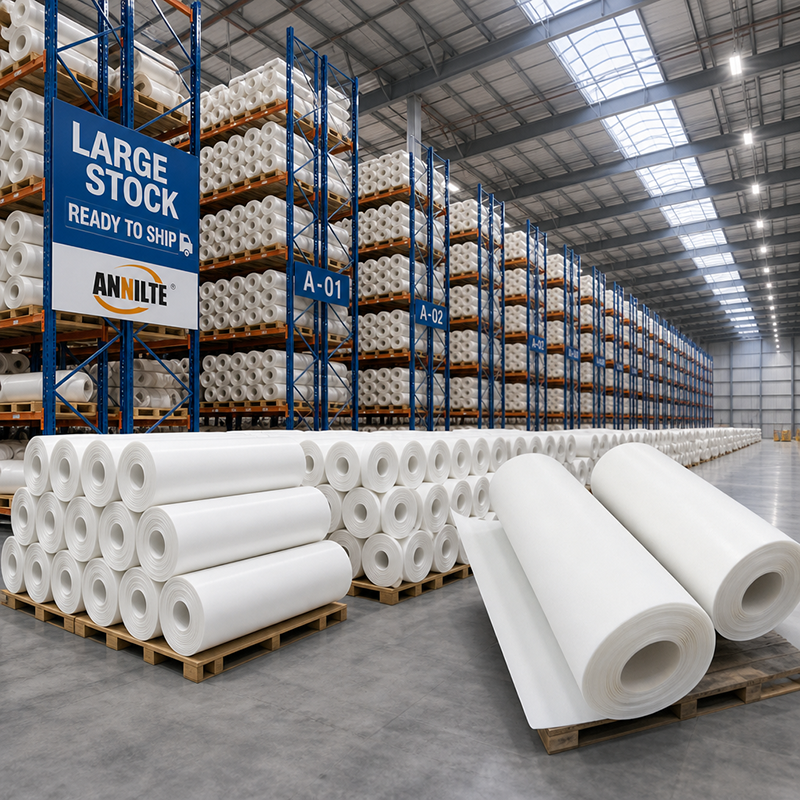
Annilte has 16 fully automated production lines imported from Germany in its integrated workshop, and 2 additional emergency backup production lines. The company ensures that the safety stock of all kinds of raw materials is not less than 400,000 square meters, and once the customer submits an emergency order, we will ship the product within 24 hours to respond to the customer's needs efficiently.
As a leading Chinese conveyor belt manufacturer with 17 years of industry experience, Annilte is proud to hold both ISO quality management certification and the RoHS environmental directive. Our manufacturing facilities meet “Green Factory” standards, and we are also an internationally recognized SGS Gold Supplier.
We offer a comprehensive range of customizable belt solutions under our own brand "ANNILTE", designed to meet diverse industrial needs.
Should you require further information about our products or capabilities, please do not hesitate to contact us.
WhatsApp: +86 185 6019 6101 Tel/WeChat: +86 185 6010 2292
E-mail: 391886440@qq.com Website: https://www.annilte.net/
Post time: Oct-23-2026