

Poultry Farm Egg Protection Pads: Cushioning Specs, Wash-Down Fit, and Landed-Cost Math for European Buyers
Egg protection pads exist for one reason: to absorb the impact of a hen settling and an egg dropping, without turning into a manure trap. In a European laying house, that job is harder than it looks. Wash-down systems, disinfectant cycles, and free-range or barn-housing scratch behaviour all push a pad toward early failure. A pad that protects eggs in a cage-free barn in Spain may delaminate after two months in a humid Dutch barn with pressure washing.
This guide is written for distributors and farm procurement managers who need to compare pads on measurable criteria rather than supplier claims. It covers cushioning thresholds, wash-down compatibility, landed cost per protected egg, and the documentation European buyers should request before a first order.
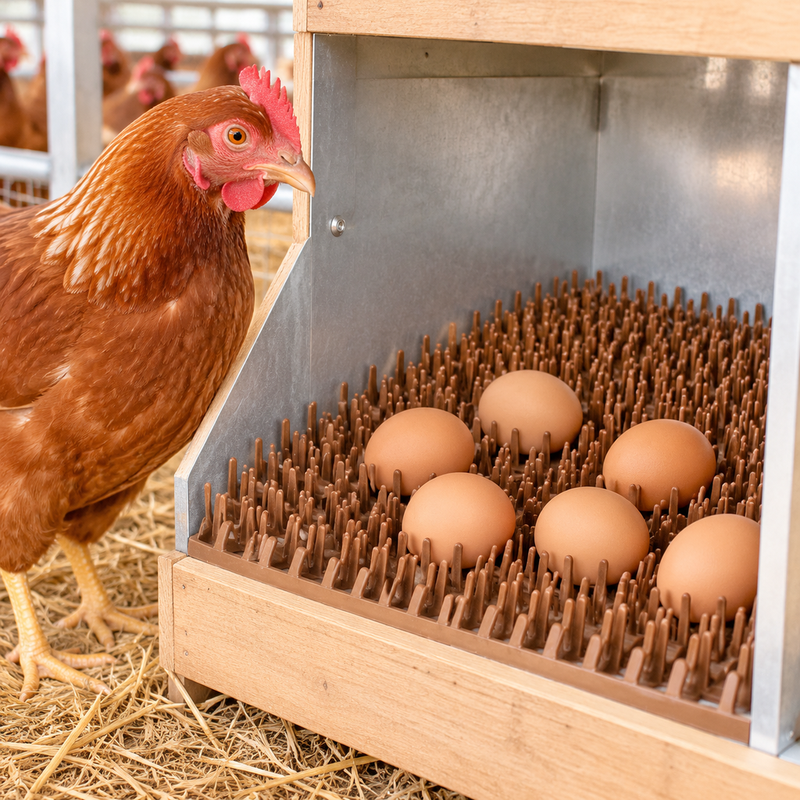
Set a Minimum Cushioning Threshold Before You Compare Suppliers
The core function of an egg protection pad is deceleration. An egg dropped from a standing hen hits the pad at roughly 1.5–2.5 m/s depending on nest box height. The pad must deform enough to spread that impact over a longer distance. A pad that is too thin or too rigid passes the impact straight through to the eggshell.
A workable screening test: place a fresh egg in the centre of a sample pad laid on a hard surface. Drop a 200g steel weight from 15 cm directly above the egg. Repeat ten times across different points on the pad. Count cracks. A pad that cracks more than one egg in ten drops lacks the cushioning your operation needs. This is crude, but it separates pads by a real performance margin in under ten minutes.
Thickness is not cushioning. A 10 mm pad of dense, hard plastic can transmit more impact than a 6 mm pad of properly formulated TPE. Ask for the pad’s compression deflection at a defined load — typically 25% compression at 0.5–1.0 MPa for elastomer pads. Suppliers who cannot state a compression figure are selling thickness, not cushioning.
Recovery matters as much as deflection. A pad that stays compressed after the hen leaves develops hard spots. Test recovery by placing a 2 kg weight on a sample for 12 hours, then measuring thickness one hour after removal. A pad that recovers less than 80% of its original thickness will lose cushioning within a laying cycle.
Match Pad Surface to Your Wash-Down Method
European laying houses split broadly into manual scrape-out, belt-cleaning, and pressure wash-down systems. Each punishes a different pad weakness.
| Wash-down method | Pad failure risk | Pad feature to specify |
|---|---|---|
| Manual scrape + spot clean | Surface abrasion from scrapers | Sealed, smooth surface; no stitched or laminated edges |
| Belt cleaning under nest | Pad migration and edge lift | Weighted base or textured underside; minimum 400 g per pad |
| Pressure wash-down (60–80 bar) | Delamination and edge curl | Single-piece moulded construction; no glued layers |
| Disinfectant fogging | Chemical attack on polymer | Supplier-confirmed resistance to [请补充消毒剂名称] at use concentration |
The delamination test: run a sample pad through five hot-water wash cycles at 60°C with standard farm detergent, then inspect the perimeter. If the edge lifts, separates, or shows a visible seam, the pad will trap manure in that gap and fail your cleaning inspection.
Pressure-wash caution: even a well-made TPE pad can be damaged by holding a 80 bar lance too close to the surface. Ask the supplier for a recommended wash distance and nozzle type, and pass that to your farm staff. A pad destroyed by poor wash technique is not a warranty claim — it is a training gap.
Landed Cost per Protected Egg, Not Price per Pad
A €1.20 pad and a €2.00 pad can carry the same real cost. What matters is cost per protected egg over the pad’s service life. Build the comparison on four numbers:
- Pad price landed — FOB price plus freight, duty (HS 8436 at 1.7% MFN into the EU), and import VAT.
- Service life in wash cycles — not calendar months. A pad washed three times a week ages faster than one washed weekly.
- Eggs protected per pad per cycle — roughly equal to the number of hens per nest box, multiplied by laying rate.
- Crack and dirty-egg reduction — the delta between your current bedding and the pad, measured over one production cycle.
A worked example: a 400 g TPE pad at €1.80 landed, lasting 18 months at three washes per week, serving one nest box shared by five hens at 90% lay rate. That is roughly 2,460 eggs per pad over its life. At a 2% reduction in cracked and dirty eggs (50 eggs saved per pad), the pad’s cost per saved egg is about €0.036 — before you count the labour hours saved on bedding replacement. Run the same math on your current straw or shavings cost, including labour, and the comparison usually favours a durable pad.
MOQ lever for distributors: suppliers quoting 5,000-piece MOQs for custom logo or retail packaging will typically ship standard product at 500–1,000 pieces. Split the first order (standard product, low MOQ, performance validation) from the second (custom packaging, higher MOQ). Do not commit to a container of printed cartons before a farm trial confirms the pad survives your wash-down regime.
Documentation European Buyers Should Request Before Ordering
EU rules for laying hen accommodation require equipment in contact with birds to be capable of being thoroughly cleaned and disinfected. There is no single “EU nesting pad certificate,” but your national competent authority can ask for evidence during inspection. Request these from any supplier before a first order:
- Material safety data sheet (SDS) for the polymer compound.
- Migration or leach test report from an EU-recognised laboratory, where available.
- Written cleaning and disinfection recommendation, including compatible disinfectant families and contact time.
- Compression deflection and recovery data at a defined load and temperature.
- 10-digit TARIC classification confirmed with your customs broker. Poultry-keeping equipment typically falls under HS 8436 at 1.7% MFN duty, but pad material composition can affect classification. A misclassified entry costs more in delay than in duty.
Suppliers who cannot provide the first three items are a compliance risk. Treat a low price from an undocumented supplier as a hidden cost, not a saving.
Field Failure Modes to Screen for in the First 30 Days
Install half your sample pads in the highest-traffic nest box row and leave the other half in storage. Inspect at 7, 14, and 30 days for these three failures:
Edge curl. Lift the pad perimeter. Any gap between pad and box floor collects manure and defeats wash-down. A pad that curls within 30 days will curl worse after a summer of pressure washing.
Surface porosity. Hold the pad under a light at eye level. Pinholes and a rough matte finish indicate open porosity. Manure solids lodge there and resist rinsing. Smooth, sealed surfaces release debris with a hose-down.
Permanent compression. Press a thumb firmly into the pad centre. A pad that stays dented after pressure release has lost recovery and will develop hard spots. This is the earliest visible sign of cushioning failure.
FAQ: Egg Protection Pad Sourcing for European Operations
Do poultry farm egg protection pads need food-contact approval in the EU?
No. A nesting pad is not a food-contact material. You need evidence the polymer does not leach harmful substances under barn conditions — an SDS and, where available, a migration test report. Food-contact certification is not the relevant standard here.
What lead time should a European buyer plan for a first order?
Production of standard TPE pads runs 15–25 days after deposit. Sea freight to Rotterdam, Hamburg, or Antwerp adds 30–40 days port-to-port, plus clearance. Budget 8–10 weeks from payment to farm delivery. Air freight is viable only for samples.
Can one pad type serve both broiler and layer houses?
No. Layer hens settle and scratch differently from broilers. A pad soft enough for sustained nesting weight may be too soft for broiler-house wash-down. Specify operation type when requesting samples.
How many pads per nest box?
One pad per box, covering 80–90% of the floor. Oversized pads curl at the edges and create manure traps.

R&D Team
Annilte has a research and development team consisting of 35 technicians. With strong technical research and development capabilities, we have provided conveyor belt customization services for 1780 industry segments, and gained recognition and affirmation from 20,000+ customers. With mature R&D and customization experience, we can meet the customization needs of different scenarios in various industries.

Production Strength
Annilte has 16 fully automated production lines imported from Germany in its integrated workshop, and 2 additional emergency backup production lines. The company ensures that the safety stock of all kinds of raw materials is not less than 400,000 square meters, and once the customer submits an emergency order, we will ship the product within 24 hours to respond to the customer's needs efficiently.
As a leading Chinese conveyor belt manufacturer with 17 years of industry experience, Annilte is proud to hold both ISO quality management certification and the RoHS environmental directive. Our manufacturing facilities meet “Green Factory” standards, and we are also an internationally recognized SGS Gold Supplier.
We offer a comprehensive range of customizable belt solutions under our own brand "ANNILTE", designed to meet diverse industrial needs.
Should you require further information about our products or capabilities, please do not hesitate to contact us.
WhatsApp: +86 185 6019 6101 Tel/WeChat: +86 185 6010 2292
E-mail: 391886440@qq.com Website: https://www.annilte.net/
Post time: Nov-28-2026