

Most procurement conversations about person conveyor belts start in the wrong place. The buyer asks for a price per meter. The supplier quotes a number. Everyone shakes hands. Then the belt arrives, and six months later it‘s cracking at the pulley or slipping under wet ski boots—and nobody can quite explain why.
The problem usually isn’t the supplier. It‘s that “person conveyor belt” is treated as a commodity when it’s actually a component with very specific operating demands. Ski resorts and amusement parks both move people, but the conditions couldn’t be more different. A belt that works fine in an indoor water park will fail miserably on an alpine slope in February. And a belt over-engineered for a gentle scenic ride wastes money on capabilities nobody needs.
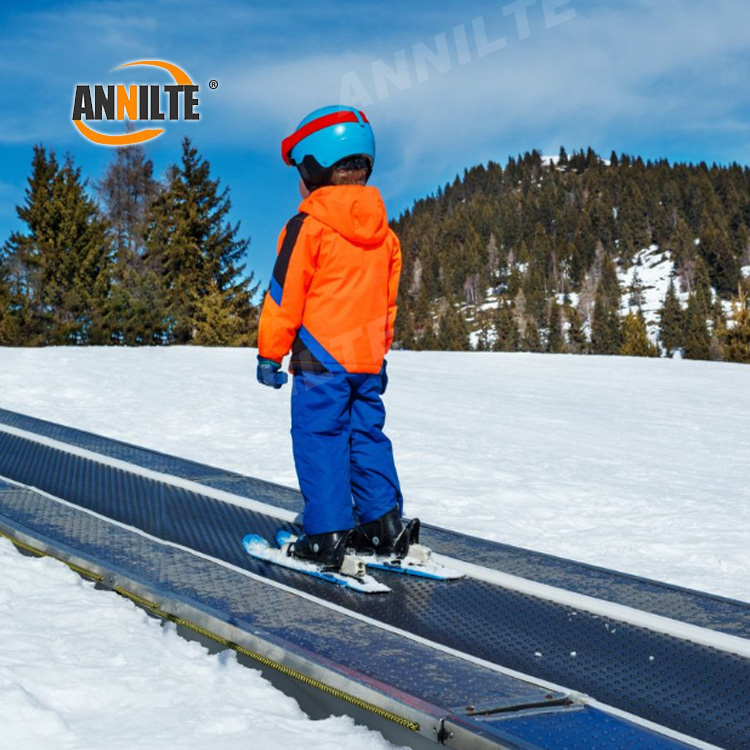
Here’s what actually matters when sourcing a person conveyor belt, depending on where it‘s going to run.
Ski resorts punish belts in ways that are easy to underestimate. The operating temperature is the obvious factor. Standard rubber compounds harden below -15°C or so, and once they harden, flex cracks start at every pulley contact point. At -25°C, a skier stepping onto the belt delivers an impact load that a brittle belt can’t absorb. Annilte manufactures belts rated down to -40°C specifically because “winter” in the Alps or the Rockies isn‘t the same as “winter” in a factory. If your supplier can’t tell you the actual low-temperature rating of their compound, that‘s a red flag.
The surface pattern matters just as much in cold conditions. Ski boots are rigid. Snow and ice accumulate. A belt that doesn’t shed water properly develops ice patches that no tread pattern can grip through. The grass-pattern cover we use channels water off the surface, which keeps friction consistent even when guests track snow onto the belt. European operators in particular often ask for visible lane markings—yellow lines on green, for example—to help skiers position themselves before boarding . That‘s a small detail that reduces loading accidents.
Amusement parks have a different set of failure modes. Temperature is rarely the issue, but throughput and duty cycle often are. A park running a conveyor from open to close, seven days a week, accumulates hours fast. The belt needs to handle constant starts and stops, varying passenger weights, and whatever environmental quirks the location brings—humidity, UV exposure, chlorinated water nearby if there’s a water park component.
The other thing amusement park buyers care about that ski resort buyers sometimes forget: guest experience is visible. A worn or discolored belt looks bad. A belt that tracks poorly and rubs the frame creates noise. These aren’t safety failures, but they affect how the park is perceived. Annilte offers blue and green covers alongside the standard black, and we can match existing color schemes if a park is replacing belts across multiple rides.
The joint question is where a lot of buyers get stuck. Mechanical fasteners are cheaper and faster to install. They’re also the single most common point of failure on any person conveyor belt. When a fastener separates under load, you‘re not looking at a maintenance ticket—you’re looking at a potential injury and a liability review. For passenger transport, seamless hot splicing is almost always the right call. It costs more up front and takes longer to install, but it eliminates the joint as a failure mode entirely. Mechanical fasteners still make sense in field-installation scenarios where splicing equipment isn‘t available, but if you have the option, go seamless.
What Annilte actually does. We manufacture conveyor belts. We don’t build complete person conveyor machines—if you need a new installation, we‘ll tell you to talk to the machine builders, and we mean it. Our focus is the belt itself: the wear component that determines how reliable your system is and how often your maintenance team has to touch it.
We’ve been making belting for 17 years, serving over 20,000 customers across 1,780 industry segments. For person conveyor applications, that experience mostly translates into getting the specifications right the first time. Width, thickness, tensile core, pulley compatibility, joint type—these aren’t guesswork for us. We also keep over 400,000 square meters of raw material in stock and run 16 automated production lines, with emergency capacity reserved for urgent orders. If a belt fails mid-season, we can ship within 24 hours once specs are confirmed.
We hold ISO and RoHS certification and SGS Gold Supplier status. For European and North American buyers who need documentation for vendor onboarding, that usually covers it.
One thing worth saying plainly: if you‘re comparing quotes from three suppliers and the prices are wildly different, ask each one what compound they’re using and what the cold rating is. The cheapest quote is often a standard belt dressed up as a cold-weather product. It will run. It just won‘t run through February.
Send us your belt specs—length, width, thickness, pulley diameter, and whether you want mechanical or spliced. We’ll come back with a quote and a realistic delivery date.

R&D Team
Annilte has a research and development team consisting of 35 technicians. With strong technical research and development capabilities, we have provided conveyor belt customization services for 1780 industry segments, and gained recognition and affirmation from 20,000+ customers. With mature R&D and customization experience, we can meet the customization needs of different scenarios in various industries.

Production Strength
Annilte has 16 fully automated production lines imported from Germany in its integrated workshop, and 2 additional emergency backup production lines. The company ensures that the safety stock of all kinds of raw materials is not less than 400,000 square meters, and once the customer submits an emergency order, we will ship the product within 24 hours to respond to the customer's needs efficiently.
As a leading Chinese conveyor belt manufacturer with 17 years of industry experience, Annilte is proud to hold both ISO quality management certification and the RoHS environmental directive. Our manufacturing facilities meet “Green Factory” standards, and we are also an internationally recognized SGS Gold Supplier.
We offer a comprehensive range of customizable belt solutions under our own brand "ANNILTE", designed to meet diverse industrial needs.
Should you require further information about our products or capabilities, please do not hesitate to contact us.
WhatsApp: +86 185 6019 6101 Tel/WeChat: +86 185 6010 2292
E-mail: 391886440@qq.com Website: https://www.annilte.net/
Post time: Nov-17-2026