

Why the Perforated Belt Is No Longer Optional
If you manage a commercial layer operation, you already know that every cracked egg is a direct hit to your margin. But here is what the top ten Google results won't tell you: the difference between a standard solid belt and a properly engineered perforated egg collection belt is not just about breakage rates—it is about the total cost of ownership over the next five years.
Annilte has manufactured conveyor solutions for poultry operations for over fifteen years. We have seen farms switch from woven belts to perforated polypropylene (PP) belts, only to realize they purchased the wrong perforation pattern or a belt that loses tension within eighteen months. This guide is designed to help procurement managers and farm engineers avoid that mistake.
In this guide, you will learn:
- The engineering behind perforation geometry and how it protects eggs
- Why polypropylene (PP) is the industry standard—and what to verify before buying
- A specification checklist for procurement teams
- The total cost of ownership calculation most buyers miss
- How to verify a supplier before placing a purchase order
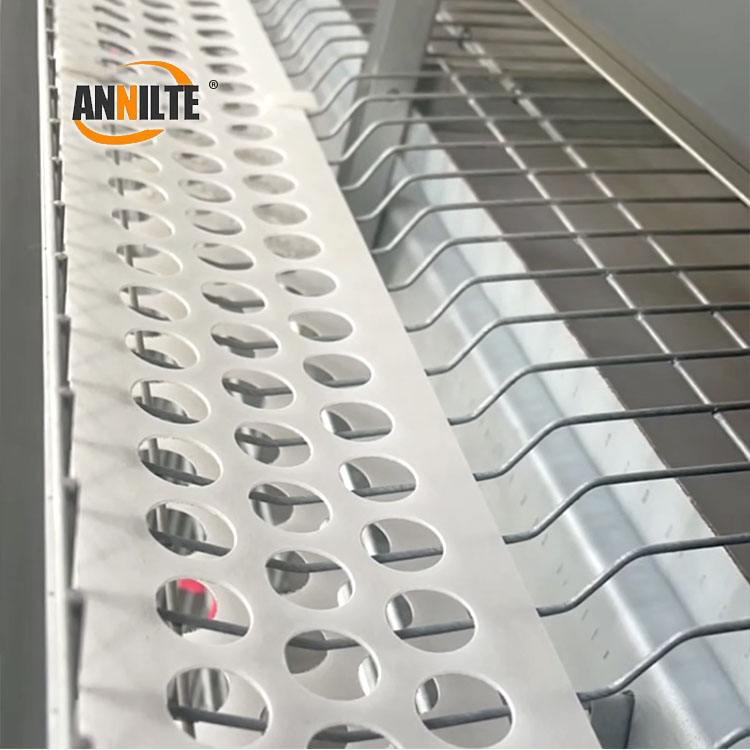
The Engineering Behind the Perforation: More Than Just Holes
At first glance, a perforated egg collection belt looks simple: a polypropylene belt with a pattern of holes punched through it. In reality, the geometry of those holes determines whether your eggs arrive at the collection table intact or in pieces.
How Perforations Protect the Egg
When an egg is laid, it rolls from the cage onto the belt. On a solid surface, eggs accumulate against one another. The vibration of the drive motor and the normal jostling of the system cause micro-fractures at the contact points.
A perforated belt solves this by allowing each egg to settle slightly into a recessed opening. The holes are sized and spaced so that the egg is cradled rather than crushed. The result is isolation: egg-to-egg contact is minimized, and the belt itself absorbs vibration that would otherwise travel directly into the shell.
The Overlooked Benefit: Passive Debris Management
There is a secondary benefit that often gets overlooked during procurement: debris management.
- Feathers, dust, and manure fragments are inevitable in any layer house.
- On a solid belt, these contaminants ride along with the eggs, increasing the risk of bacterial transfer.
- The open area of a perforated belt allows these materials to fall through before they ever reach the collection point.
This passive self-cleaning action reduces labor hours spent on manual belt scraping and supports higher sanitary standards for table egg production.
Material Matters: Why PP Is the Standard (and When It Isn't)
The vast majority of PP egg conveyor belts on the market are made from polypropylene. There is a reason for this dominance.
Key properties of PP:
- Inherently resistant to bacterial and fungal growth
- Does not absorb water
- Can be formulated with UV stabilizers and anti-static additives
- Maintains flexibility at low temperatures (unlike solid PVC, which can stiffen and crack)
Not All PP Is Created Equal
However, not all PP is created equal. The global supply chain contains a spectrum of raw material quality, from virgin food-grade resin to compounded material containing recycled fillers.
A belt made with recycled content may look identical on the invoice, but it will exhibit accelerated elongation and edge fraying under continuous tension. For a layer farm operating a 300-meter system, that difference translates directly into unplanned downtime and replacement labor.
Annilte's Material Commitment
Annilte manufactures its perforated egg collection belts from virgin polypropylene with documented traceability. We add anti-aging agents during the extrusion process and finish the surface to resist dust adhesion. For operations in regions with intense sunlight exposure, our UV-stabilized formulation extends service life outdoors.
We are ISO-certified and hold SGS gold supplier status, documentation that procurement teams can use to verify material claims before placing a purchase order.
Specification Checklist for Procurement Teams
Before requesting a quotation, gather the following parameters. A reputable supplier will ask for these immediately; if they do not, that is a signal that they are a trader rather than a manufacturer.
Belt Width
- Most common widths for layer cage systems: 100 mm, 125 mm, and 250 mm
- H-type and A-type cage configurations vary significantly
- Measure the existing belt or the drive pulley width
- Annilte supports custom widths from 50 mm to 700 mm for retrofit projects and non-standard cage layouts
Thickness and Tension Rating
- Standard perforated PP belts run between 1.0 mm and 1.5 mm in thickness
- Thicker is not always better; the belt must remain flexible enough to track properly around small-diameter pulleys
- What matters more is tensile strength and low elongation under load
- Ask for the manufacturer's elongation specification at operating tension
Perforation Pattern
- Hole diameter and spacing should be matched to the average egg size of your flock
- A hole that is too large allows eggs to sit too deep and jam
- A hole that is too small fails to provide the stabilizing effect
- Annilte offers round, square, and custom patterns based on your collection system's requirements
Connection Method
- Belts are joined either by sewing or ultrasonic welding
- For long-term reliability, we recommend ultrasonic welding at the primary joint, followed by reinforced stitching at the edges
- A poorly joined belt is the single most common failure point in egg collection systems
Certifications
- Request food-contact material documentation
- Where applicable, request third-party test reports for bacterial resistance
- If you are supplying eggs to retail chains or export markets, this paperwork is non-negotiable
Frequently Asked Questions
What is a perforated egg collection belt?
A perforated egg collection belt is a polypropylene conveyor belt with a pattern of holes that cradle each egg, reduce egg-to-egg contact, and allow debris to fall through. It is used in commercial layer houses to transport eggs from cages to the collection point with lower breakage rates.
What width options are available?
Common widths include 100 mm, 125 mm, and 250 mm. Annilte also offers custom widths from 50 mm to 700 mm for non-standard cage layouts and retrofit projects.
How long should a quality belt last?
A well-manufactured virgin PP perforated belt should deliver 3–5 years of service under normal operating conditions. Low-grade belts with recycled fillers may need replacement every 18–24 months.
How do I request a quote?
Send your belt width, thickness, perforation pattern, and cage type to Annilte's engineering team. We will review your specifications and recommend a configuration that balances breakage protection with long-term durability.

R&D Team
Annilte has a research and development team consisting of 35 technicians. With strong technical research and development capabilities, we have provided conveyor belt customization services for 1780 industry segments, and gained recognition and affirmation from 20,000+ customers. With mature R&D and customization experience, we can meet the customization needs of different scenarios in various industries.

Production Strength
Annilte has 16 fully automated production lines imported from Germany in its integrated workshop, and 2 additional emergency backup production lines. The company ensures that the safety stock of all kinds of raw materials is not less than 400,000 square meters, and once the customer submits an emergency order, we will ship the product within 24 hours to respond to the customer's needs efficiently.
As a leading Chinese conveyor belt manufacturer with 17 years of industry experience, Annilte is proud to hold both ISO quality management certification and the RoHS environmental directive. Our manufacturing facilities meet “Green Factory” standards, and we are also an internationally recognized SGS Gold Supplier.
We offer a comprehensive range of customizable belt solutions under our own brand "ANNILTE", designed to meet diverse industrial needs.
Should you require further information about our products or capabilities, please do not hesitate to contact us.
WhatsApp: +86 185 6019 6101 Tel/WeChat: +86 185 6010 2292
E-mail: 391886440@qq.com Website: https://www.annilte.net/
Post time: Oct-20-2026