

How to Specify a Perforated Egg Belt That Fits Spanish Layer Houses
A perforated egg belt that runs clean in a Dutch barn may crack shells in a Spanish summer. The difference is not the belt brand—it is whether the specification matches the house. For procurement teams sourcing punched egg belts for layer operations in Spain, three variables decide success: belt width against your cage or nest row, hole pattern against your egg size and manure load, and polypropylene grade against ambient temperatures that regularly push past 35°C in Castilla-La Mancha and Andalucía. This guide gives you the thresholds to check before you send an inquiry.
Match Belt Width to Housing Type Before You Compare Prices
Conclusion first: A 100 mm belt suits H-type cage tiers. A 250 mm belt suits most community nest rows. A 500 mm belt is for double-face nest configurations that share a center return. Quoting a single width for a farm running both cage and nest systems will produce at least one wrong belt.
Spanish layer farms increasingly run a mix of enriched cages and aviary or barn systems. The belt does not “know” which system it is in—but the width does. In an H-type cage, the egg rolls from the cage floor lip onto a narrow tier belt, typically around 100 mm . These tier belts then transfer onto a cross conveyor. If the cross conveyor runs slower than the tier belt, eggs accumulate at the transfer point and crack under pressure from following eggs. The belt width is correct; the drive synchronization is wrong.
For automatic nest systems—common in newer Spanish barn projects aiming at alternative housing compliance—the belt runs the length of the row and is substantially wider. Community nests commonly use 250 mm; configurations where two nest faces discharge onto a shared center belt use 500 mm . The critical interface is the table end, where eggs must stop on a surface before manual or robotic packing. A nest belt specified without confirming the table height and tray approach will deliver eggs faster than staff can handle them during the morning peak.
Take-away check: Before requesting pricing, record your system type, tier count, and the width of the existing belt you are replacing. If you are building new, ask the house integrator for the discharge-end drawing—not just the belt width.
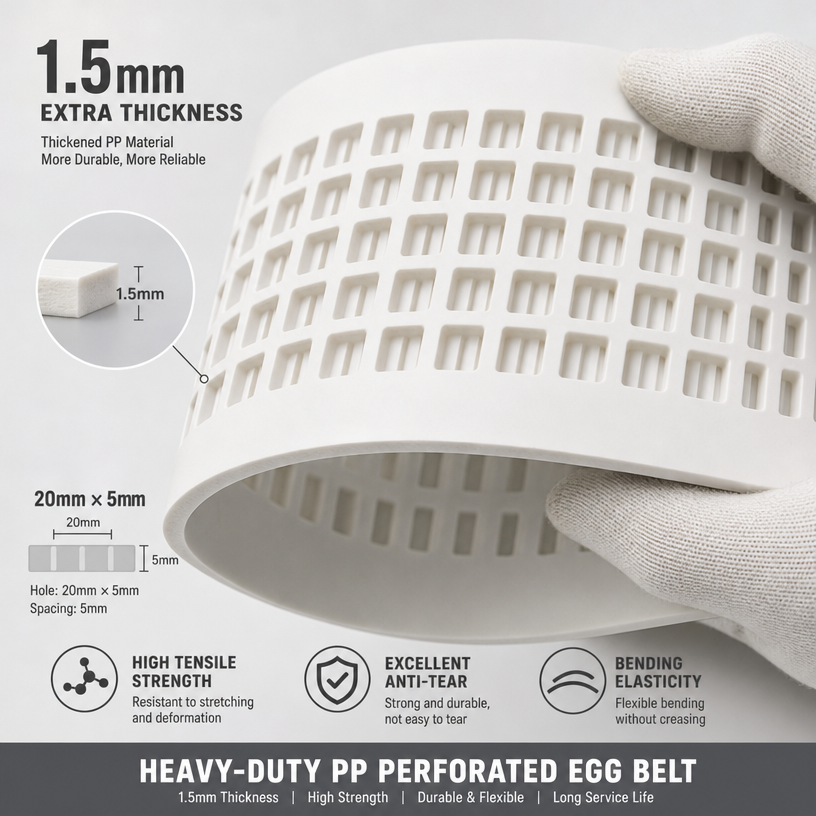
H2: Hole Pattern and Perforation Geometry: What Actually Reduces Cracked Eggs
Conclusion first: Perforation does two jobs—it seats the egg to prevent rolling contact between neighbors, and it lets dirt and broken-egg residue fall through. A hole that is too large lets small eggs tilt and jam. A hole that is too small blinds with manure in high-dust houses.
The perforated design is not decorative. In nest systems, the holes hold each egg in a stable position as the belt moves, reducing shell-to-shell contact that produces micro-cracks invisible at collection but rejected at grading . The open area also allows ventilation and debris passage, which matters in Spanish houses where manure drying is often marginal in humid coastal regions.
What the catalogues rarely state: hole pitch and diameter must match your egg size distribution. A belt perforated for 60–70 g eggs will behave differently when your flock delivers 75 g eggs at peak production. The egg sits higher in the hole, increasing roll-out height at the transfer and the impact when it lands. For farms supplying eggs to Spanish packing centres that grade by weight and shell quality, this is a measurable loss.
Practical threshold: Ask the belt supplier for the hole diameter and pitch in millimetres, not just “standard perforation.” Compare against your average egg width at the equator. A hole should locate the egg without gripping it; the egg should sit with roughly one-third of its height below the belt surface. If you cannot get this number from the supplier, you are buying a commodity, not a specified component.
Heat, Cleaning, and UV: Why Standard PP May Not Survive a Spanish Summer
Conclusion first: Polypropylene is the correct base material for egg belts—it does not absorb water, resists common disinfectants, and does not harbour salmonella the way woven cotton or contaminated fabric belts can . But standard PP stabilised only for indoor northern European conditions will embrittle faster under Spanish UV loads and repeated hot-water wash cycles.
Spanish layer houses frequently rely on natural ventilation and open side curtains. Belts running near side walls receive direct UV exposure for several hours daily in summer. UV-stabilised PP is not a premium option in this market—it is the baseline. Without it, the belt surface chalks and the perforation edges crack before the tensile strength fails. The belt then fails at the splice or tears at a hole.
Wash-down practice varies by region and integrator. Some Spanish farms use cold pressure washing; others use hot water up to 60–70°C with alkaline detergents between flocks . Standard PP softens and stretches when repeatedly exposed to water above 60°C under tension. If your cleaning protocol exceeds 60°C, ask for a PP grade with documented heat stabilisation, or accept a shorter replacement interval and budget accordingly.
Verification step: Request the supplier’s UV stabiliser package description and the recommended maximum continuous service temperature. A supplier who cannot state these two parameters is not supplying a specification-grade belt. Note that specific certification names for food-contact or agricultural use should be confirmed against your buyer’s requirements—[请补充认证名称]—and verified on the supplier’s documents, not assumed from a website claim.
MOQ, Lead Time, and the Spanish Import Reality
Conclusion first: For custom perforated PP egg belts from Chinese manufacturers, a realistic MOQ sits around 100 metres per width and specification. Standard production lead time is roughly 25 working days after deposit and specification confirmation . Sea freight to Valencia or Barcelona adds 30–40 days depending on routing and congestion.
These numbers matter because Spanish layer farms often plan belt replacement around flock changes. If you pull a flock and clean the house, you have a narrow window before the new pullets arrive. A belt that arrives two weeks late forces either a delay in placement or a temporary manual collection—both expensive.
MOQ is negotiable when you consolidate widths. A farm running 100 mm tier belts and 250 mm nest belts can often meet a supplier’s minimum by combining the order, provided the total meterage is meaningful. Ask explicitly whether mixed widths count toward the MOQ and whether the supplier will palletise by width for your warehouse.
Negotiation points to confirm in writing:
- MOQ per width versus total order.
- Lead time clock start: deposit receipt or specification sign-off?
- Splice type: finger splice, lap splice, or metal lacing? For egg belts, a smooth finger splice with matched hole pattern avoids a bump that cracks eggs at every revolution.
- Packaging: rolls on cardboard cores, wrapped in UV-opaque film, with width and length labelled on each roll.
A Five-Point Acceptance Check When the Belt Arrives
Do not install directly from the pallet. Spanish import schedules rarely allow a replacement belt to be ordered twice before flock placement. Use this checklist at goods-in:
- Width tolerance: Measure three points along the first roll. Variance beyond ±2 mm across a 250 mm belt will cause tracking drift on crowned pulleys.
- Hole registration at the splice: Run the splice over a flat surface. Holes must align within 1 mm. Misalignment means every egg crossing the splice sits unevenly.
- Edge finish: Cut edges should be sealed or cleanly welded. Frayed edges wick water and manure into the belt body.
- Length per roll: Confirm against the packing list. A roll short by 1 metre cannot be stretched; it will be discarded at installation.
- Surface feel: Run a gloved hand across the egg-side surface. Any raised burr at a perforation will mark shells.
Document any failure with photographs before signing the delivery note. Claims after installation are difficult to enforce.
FAQ
Can I use the same perforated belt for cage tiers and nest rows?
No. Cage tier belts are narrower and run at different speeds relative to the cross conveyor. Nest belts are wider and terminate at a table. The perforation pattern may also differ. Order by system, not by the phrase “egg belt.”
What PP thickness should I specify?
Common cage tier belts run around 1.2–2.0 mm; nest belts vary with width and support. Thicker is not automatically better—a belt too stiff for the pulley diameter will track poorly. Match thickness to the smallest pulley in your system.
How do I verify UV stabilisation without a lab?
Ask for the supplier’s technical data sheet stating UV stabiliser content and a UV exposure test reference. A supplier who only says “UV treated” without a number is giving you a marketing phrase, not a specification.

R&D Team
Annilte has a research and development team consisting of 35 technicians. With strong technical research and development capabilities, we have provided conveyor belt customization services for 1780 industry segments, and gained recognition and affirmation from 20,000+ customers. With mature R&D and customization experience, we can meet the customization needs of different scenarios in various industries.

Production Strength
Annilte has 16 fully automated production lines imported from Germany in its integrated workshop, and 2 additional emergency backup production lines. The company ensures that the safety stock of all kinds of raw materials is not less than 400,000 square meters, and once the customer submits an emergency order, we will ship the product within 24 hours to respond to the customer's needs efficiently.
As a leading Chinese conveyor belt manufacturer with 17 years of industry experience, Annilte is proud to hold both ISO quality management certification and the RoHS environmental directive. Our manufacturing facilities meet “Green Factory” standards, and we are also an internationally recognized SGS Gold Supplier.
We offer a comprehensive range of customizable belt solutions under our own brand "ANNILTE", designed to meet diverse industrial needs.
Should you require further information about our products or capabilities, please do not hesitate to contact us.
WhatsApp: +86 185 6019 6101 Tel/WeChat: +86 185 6010 2292
E-mail: 391886440@qq.com Website: https://www.annilte.net/
Post time: Nov-26-2026