

Why Nomex Felt Is Not a Commodity Consumable
If you operate a rotary heat transfer or sublimation calender, you already know that the felt blanket is not merely an accessory. It is the interface that determines whether heat distributes evenly across a 3-meter drum, whether pressure remains consistent through an eight-hour shift, and whether your printed fabric emerges with sharp edges or ghosting defects.
The problem is that the global supply chain treats Nomex felt for heat press applications as a generic “consumable.” Search results are dominated by marketplace listings that quote a price per piece but offer no engineering context. Density ranges vary from 2,200 to 4,400 g/m², thickness from 6mm to 12mm, and temperature claims from 160°C to 280°C—often without explaining what those numbers mean for your specific machine and production conditions.
This guide is written for the procurement engineers, maintenance managers, and production directors who need more than a price. It covers the operational parameters that actually matter, the failure modes that cost you downtime, and the specification questions you should ask before placing an order.
What Nomex Felt Actually Does Inside a Heat Press
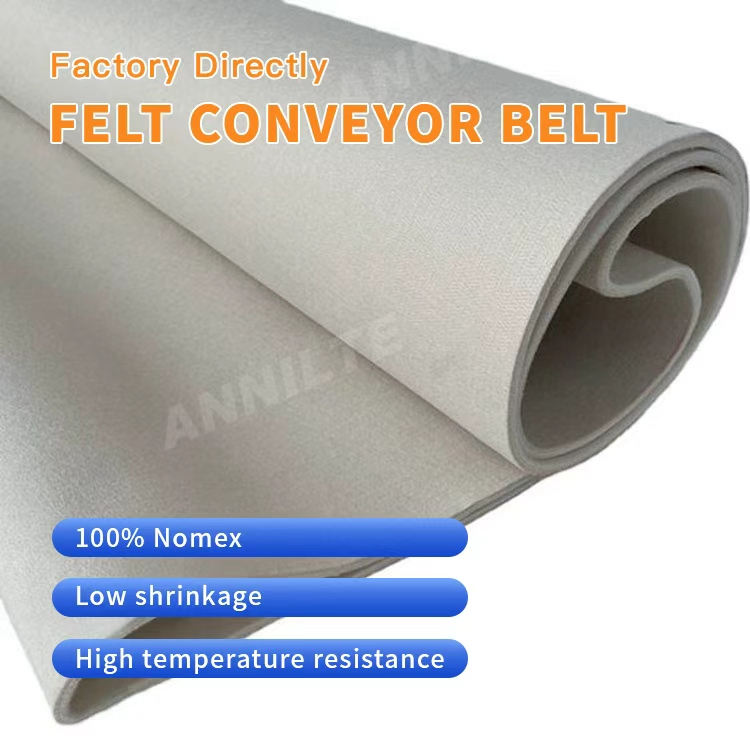
In a rotary heat transfer printing machine, the endless Nomex felt blanket serves three simultaneous functions that no other material combination can replicate economically:
Thermal buffering. The blanket sits between the heated drum and the transfer paper/fabric assembly. It must conduct heat efficiently while preventing localized hot spots that cause scorching or uneven dye sublimation. Aramid fiber (the generic term for DuPont‘s Nomex) maintains structural integrity at continuous operating temperatures up to 260°C, with short-term excursions to 280°C.
Pressure equalization. The felt compresses under the drum’s nip pressure, distributing force evenly across the full width of the fabric. This is why density matters more than thickness alone. A blanket that is too soft will compress permanently under sustained load; one that is too hard will fail to conform to fabric irregularities, leaving pressure marks.
Dimensional stability. The endless (seamless) construction eliminates the tracking problems and joint failures that plague joined belts. Thermal shrinkage must remain below 1% to prevent the blanket from tightening on the rollers and distorting the print register.
Specification Parameters: What the Numbers Actually Mean
When evaluating a Nomex felt supplier for heat press applications, four parameters determine whether the blanket will perform in your production environment.
Density (g/m²)
The market offers Nomex felts from 2,200 g/m² to 4,800 g/m². Lower densities (2,200–2,800 g/m²) suit lower-pressure flatbed presses or applications where fabric texture retention is critical. Higher densities (3,000–4,000 g/m²) are standard for rotary calender machines running sustained nip pressure. A density that is too low for your line speed will compact prematurely; one that is too high may fail to conform to seam-sensitive fabrics.
Thickness
Standard rotary heat transfer blankets run 6–10mm, with 8mm being the most common specification in the field. Thicker blankets (10–12mm) provide more compression recovery for high-pressure applications but require more heat energy to reach operating temperature. Annilte‘s standard range covers 6–12mm, with custom thicknesses available for machines with non-standard nip geometries.
Working Temperature
100% Nomex felt performs continuously at 200–260°C, with short-term peaks to 280°C. If your press operates above 260°C, you should discuss alternatives (such as PBO fiber) rather than pushing Nomex beyond its design envelope. Be cautious of suppliers who quote 280°C as a continuous rating—that is a peak temperature, not a sustained operating limit.
Width and Perimeter
Annilte manufactures endless Nomex blankets in widths from 600mm to 3,800mm and perimeters from 1,200mm to 8,000mm, with OEM customization available. The critical dimension is not the nominal width but the actual usable width after edge stabilization. Specify the fabric width you need to print, not the drum face width, and allow for edge trim.
The Failure Modes That Cost You Money
A Nomex felt blanket does not fail suddenly. It degrades in predictable ways that telegraph themselves before production quality drops.
Thermal shrinkage. As the aramid fibers age under cyclic heating, the blanket can shrink. When this happens, tension increases on the rollers, the blanket may track off-center, and print registration drifts. A quality blanket should maintain thermal shrinkage below 1% through its service life. If you observe the blanket tightening noticeably after several weeks, the fiber or needling process is suspect.
Surface hardening and glazing. The felt surface in contact with transfer paper accumulates sublimation dye residue and thermal degradation byproducts. Over time, this creates a glazed layer that reduces heat transfer efficiency and can leave marks on fabric. Some suppliers offer surface treatments or recommend periodic cleaning protocols. The ability to clean and restore the surface without damaging the fiber structure is a meaningful differentiator between suppliers.
Edge fraying. On wide blankets, the edges experience the highest mechanical stress and thermal cycling. Poorly needled or unstabilized edges begin to shed fiber, which contaminates the fabric and eventually leads to tracking failure. Annilte‘s manufacturing process includes edge densification to extend service life on wide-format machines.
Permanent compression set. A blanket that has lost its resilience will show visible thin bands or depressions corresponding to the roller positions. Once compression set occurs, the blanket cannot be restored and must be replaced. Higher-density, properly needled felts resist this degradation significantly longer than low-cost alternatives.
Supplier Evaluation: Questions That Reveal Capability
Most Nomex felt suppliers on B2B marketplaces are trading companies repackaging the same limited set of mill outputs. To identify a manufacturer with genuine application engineering capability, ask these questions:
“What is the fiber source and needling process?” 100% virgin Nomex fiber (not recycled or blended) is the baseline for heat press applications. The needling density and pattern determine surface smoothness and compression recovery. A supplier who cannot describe their needling process is likely not the manufacturer.
“Can you provide the actual shrinkage test data for the specific production batch?” Thermal shrinkage below 1% is the standard claim, but the test method matters. A responsible manufacturer can provide batch-level shrinkage data, not just a catalog specification.
“What is your experience with my machine brand?” Rotary heat transfer machines from Klieverik, Monti, Transmatic, Lemaire, Practix, and Stork each have specific blanket dimensions, tensioning systems, and nip pressure profiles. A supplier who has supplied blankets for your machine type can pre-configure the dimensions and joint specifications correctly on the first order.
“What is the realistic service life under my operating conditions?” A blanket rated for “one year” in a catalog means nothing. Ask for references from customers running similar line speeds, temperatures, and fabric types. A manufacturer with genuine application experience will give you a range based on comparable installations, not a single optimistic number.
Annilte‘s manufacturing operation includes in-house R&D and custom sizing based on machine drawings or old blanket measurements. The company supplies endless Nomex felts to heat transfer printing operations globally, with specifications tailored to the customer‘s press model rather than limited to catalog stock sizes.
Request a Specification Review
If you are sourcing Nomex felt for heat press applications, the most efficient path is to send your machine details rather than browse catalog pages. Provide:
- Machine brand and model
- Drum diameter and face width
- Current blanket dimensions (width × perimeter × thickness)
- Operating temperature and line speed
- Fabric types and typical run lengths
Annilte‘s engineering team will confirm the appropriate density, thickness, and endless construction for your application and provide a quotation with realistic lead time. For operations running multiple machines or planning fleet replacements, consolidated custom manufacturing reduces per-unit cost and ensures dimensional consistency across blankets.

R&D Team
Annilte has a research and development team consisting of 35 technicians. With strong technical research and development capabilities, we have provided conveyor belt customization services for 1780 industry segments, and gained recognition and affirmation from 20,000+ customers. With mature R&D and customization experience, we can meet the customization needs of different scenarios in various industries.

Production Strength
Annilte has 16 fully automated production lines imported from Germany in its integrated workshop, and 2 additional emergency backup production lines. The company ensures that the safety stock of all kinds of raw materials is not less than 400,000 square meters, and once the customer submits an emergency order, we will ship the product within 24 hours to respond to the customer's needs efficiently.
As a leading Chinese conveyor belt manufacturer with 17 years of industry experience, Annilte is proud to hold both ISO quality management certification and the RoHS environmental directive. Our manufacturing facilities meet “Green Factory” standards, and we are also an internationally recognized SGS Gold Supplier.
We offer a comprehensive range of customizable belt solutions under our own brand "ANNILTE", designed to meet diverse industrial needs.
Should you require further information about our products or capabilities, please do not hesitate to contact us.
WhatsApp: +86 185 6019 6101 Tel/WeChat: +86 185 6010 2292
E-mail: 391886440@qq.com Website: https://www.annilte.net/
Post time: Oct-22-2026