

Why This Component Deserves a Specification Review, Not a Catalog Order
If you are reading this, you are likely in one of two situations: you are commissioning a new metal engraved panel line, or your current belt is underperforming and the blame is being passed between the belt supplier, the equipment integrator, and your production team.
Both situations share a root cause. Conveyor belts for engraved panel lamination are frequently treated as a commodity—a rubber band sourced on price and lead time. They are not. The belt is the interface between the decorative face of your panel and the pressure zone of the double-belt press. Its geometry, thermal behavior, and joint integrity directly determine surface flatness, foam core uniformity, and your scrap rate. A belt that costs a fraction of your line budget can quietly consume multiples of its cost in rejected panels and unplanned stoppages.
This guide is written for the engineer or procurement manager who needs to move beyond “we need a belt, what’s your price” and toward a specification conversation. The sections below address the failure modes that matter most in engraved panel production and the supplier capabilities that separate a reliable belt from a recurring problem.
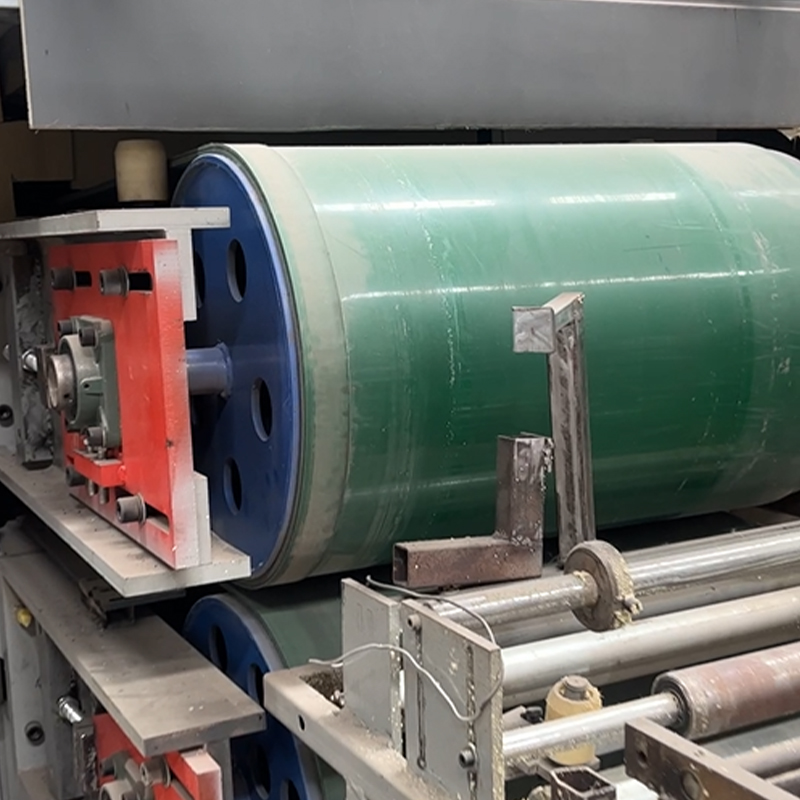
1: Pressure Strip Separation
The pressure strip—sometimes called a cleat or profile—is the raised element that compresses the panel assembly during lamination. In conventional belt construction, the strip is cold-bonded or glued to the base belt. Under repeated compression cycles, thermal expansion, and release-agent exposure, that bond degrades. The strip lifts at the edges, shifts laterally, or detaches entirely.
The operational consequences are not subtle. A lifted strip creates an uneven pressure profile across the panel width, producing visible surface distortion on the decorative face. A detached strip becomes a foreign object in the press, capable of marking panels or damaging the belt itself. Production stops for re-gluing or replacement.
The alternative is a molded construction. Annilte uses German superconducting vulcanization technology to form the pressure strip and base belt as a single, continuous unit rather than an assembly. The firmness of the strip-to-base interface is increased by approximately 70% compared to cold-bonded alternatives. For procurement, the specification question is straightforward: Is the pressure strip bonded or molded? If the supplier cannot answer with process documentation, the belt is a consumable, not a component.
2: Joint Geometry and Surface Transfer
Every belt has at least one joint. On a decorative panel line, that joint passes over the panel face repeatedly. If the joint is proud of the belt surface by even a fraction of a millimeter, it will transfer a corresponding mark to the panel. On a smooth surface, this might be tolerable. On an engraved or textured decorative face, it is a defect that cannot be polished out.
The industry benchmark for joint flatness tolerance on engraved panel belts is 0.5 mm or better. Achieving that tolerance requires controlled joint geometry (composite tooth structures rather than simple finger splices) and a curing process that maintains dimensional stability across the joint zone.
Annilte‘s joint specification targets this tolerance through composite tooth construction and imported curing agents, with the goal of maintaining tensile consistency across the joint and preventing the “open tooth” failure mode that begins as a hairline crack and propagates into a full separation. When vetting suppliers, request the joint tolerance in writing and ask what test method is used to verify it. A supplier who cannot state a number is not controlling the variable.
3: Thermal Softening and Creep
The lamination environment is not ambient. PU foaming generates exothermic reaction heat, and many lines add heated platens to accelerate curing. Operating temperatures in the 70–80°C range are common, with excursions higher at the platen interface. Under sustained thermal load, general-purpose rubber compounds soften, lose Shore hardness, and creep—the belt elongates irreversibly, losing tension and tracking stability.
The result is a belt that was flat on installation day and is wavy three months later. Waviness in the belt translates directly to waviness in the panel. Tracking drift follows, leading to edge damage and uneven pressure distribution.
The material answer is a compound formulated with polymer temperature-resistant additives rather than relying on the base rubber alone. Annilte specifies virgin rubber compounds with these additives, rated for continuous operation at 80°C without deformation. The procurement question here is about compound documentation, not marketing language. Ask for the continuous service temperature rating and the basis for that rating. “High temperature” is not a specification.
4: Hardness Loss and Support Deflection
The belt must resist deflection under the foaming pressure. If the belt carcass is insufficiently rigid—or if the compound softens under thermal load—the belt deflects between the press platens. The foam expands into that deflection, producing thickness variation across the panel width.
Annilte addresses this through carcass construction: upgraded fabric plies and reinforced rubber compound that increase internal support force by approximately 60% compared to standard construction. The practical effect is that the belt maintains its profile under the 3 kg/cm² foaming pressures typical of PU sandwich panel lines, without the “dished” cross-section that produces thin edges and over-thick centers.
For a procurement engineer, the relevant question is whether the supplier can correlate carcass construction to your specific line pressure and panel width. A belt that performs on a 1,000 mm line may deflect on a 1,200 mm line at the same pressure. Specification without application context is guesswork.
Vetting the Supplier: Five Questions That Separate Manufacturers from Traders
The global conveyor belt supply chain includes manufacturers, converters, and trading companies. For a component this process-critical, the distinction matters. A trader can quote a price and a lead time. A manufacturer can answer the questions below.
1. What is the continuous service temperature of the compound, and what test method supports that figure?
A manufacturer will cite a number and a method (e.g., ISO 815 compression set, or internal ASTM D573 air oven aging). A trader will say “heat resistant.”
2. Is the pressure strip molded or bonded? Can you provide the vulcanization process specification?
Molded construction is the single most important differentiator for engraved panel belts. The process should be documented, not asserted.
3. What is the joint flatness tolerance in millimeters, and how is it measured?
The answer should be a number at or below 0.5 mm, with a measurement method (e.g., straightedge and feeler gauge across the joint, or dial indicator on a granite surface).
4. What is the diagonal deflection specification, and what is the QC procedure?
Belt tracking begins with geometric accuracy. Annilte measures diagonals during fabrication to control deflection within a defined range. A manufacturer will have a documented QC step here. A trader will not.
5. Can you provide a reference from a customer running the same panel width and foam chemistry?
This is the hardest question to answer without actual manufacturing relationships. It also happens to be the most predictive of your outcome.
Annilte is an ISO-certified manufacturer with 15 years of production experience and SGS gold certification, operating 16 automated production lines and serving over 300 metal engraved panel producers. We answer the five questions above as standard practice, not as a special request.
A Note on Customization and Line Integration
Engraved panel lines are not standardized. Belt widths range from compact 300 mm machines to 2,400 mm double-belt presses. V-guides, side guides, and surface textures vary by integrator. A supplier who offers only catalog sizes will force compromises that show up as tracking problems or edge wear.
Annilte manufactures to line specification: width, thickness, guide configuration, and surface hardness are set against the customer‘s press dimensions and foam chemistry. This is not a premium service—it is the minimum requirement for a belt that will run for years rather than months.

R&D Team
Annilte has a research and development team consisting of 35 technicians. With strong technical research and development capabilities, we have provided conveyor belt customization services for 1780 industry segments, and gained recognition and affirmation from 20,000+ customers. With mature R&D and customization experience, we can meet the customization needs of different scenarios in various industries.

Production Strength
Annilte has 16 fully automated production lines imported from Germany in its integrated workshop, and 2 additional emergency backup production lines. The company ensures that the safety stock of all kinds of raw materials is not less than 400,000 square meters, and once the customer submits an emergency order, we will ship the product within 24 hours to respond to the customer's needs efficiently.
As a leading Chinese conveyor belt manufacturer with 17 years of industry experience, Annilte is proud to hold both ISO quality management certification and the RoHS environmental directive. Our manufacturing facilities meet “Green Factory” standards, and we are also an internationally recognized SGS Gold Supplier.
We offer a comprehensive range of customizable belt solutions under our own brand "ANNILTE", designed to meet diverse industrial needs.
Should you require further information about our products or capabilities, please do not hesitate to contact us.
WhatsApp: +86 185 6019 6101 Tel/WeChat: +86 185 6010 2292
E-mail: 391886440@qq.com Website: https://www.annilte.net/
Post time: Oct-17-2026