

Manure Removal Belt: Three Specification Errors That Cause Premature Failure
A manure removal belt is one of the few components in a poultry house that runs every day, carries an aggressive material, and is expected to last years. When it fails early, the conversation usually turns to belt quality. Quality matters. But in most of the failed installations we see, the belt was the wrong specification for the system it was installed on—or the system around it was never set up to let the belt run correctly.
This guide is not a product catalogue. It covers three specification errors that account for a disproportionate share of premature failures, and what to verify before placing an order.
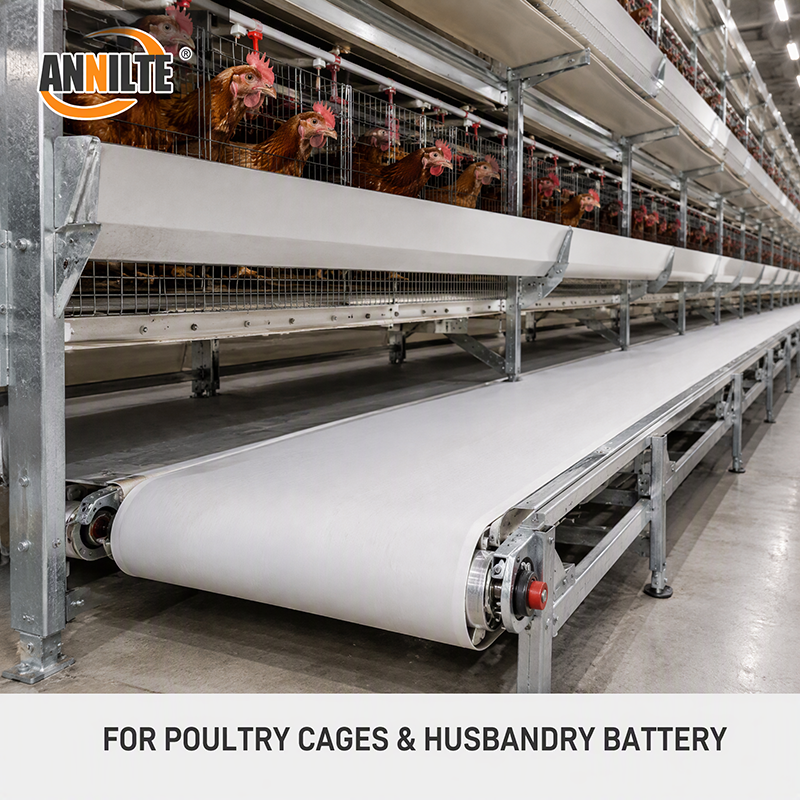
Error 1: Treating H-Type and A-Type Cages as Interchangeable
The first question a supplier should ask is not “what width?” It is “what cage type?” The answer determines whether a belt is the right solution at all.
H-type stacked cages require a manure belt under each tier. The tiers sit vertically, so manure cannot fall to a pit below. Each level needs its own catch surface, and the belt carries manure to the row end where a scraper discharges it onto a cross conveyor .
A-type step cages typically use a scraper in a pit. The cages step outward, manure falls down, and a blade pulls it along the pit floor. Putting a belt on an A-type row is not a standard configuration. It is a rebuild, and a costly one .
The mismatch shows up at installation. A belt specified for an H-type system will not fit an A-type frame without modification. If a quote arrives without the cage type being confirmed, the specification is incomplete.
What to send: H-type or A-type, number of tiers, row length, cage width, and whether the house runs layers or breeders.
Error 2: Buying a Belt Without Checking the Tracking System
Belt deviation is the most common complaint in manure belt systems. The instinct is to blame the belt. The more common cause is the absence of proper tracking control on the frame.
Polypropylene belts are not self-centering. They rely on rollers, guides, and alignment to stay on path. On a long row—100 meters or more—small misalignments compound. A drive roller that is slightly out of square with the belt path will steer the belt toward one edge over the length of the run .
The practical tolerance is tighter than most operators expect. Industry guidance puts tracking drift limits at ±8mm for rows under 80 meters, ±10mm for 80–150 meters, and ±12mm beyond that . A belt that wanders beyond these limits will fray at the edge against the frame.
Before ordering a replacement belt for a system that failed by deviation, inspect the tracking hardware. If the frame has no self-aligning rollers or edge guides, a new belt will fail the same way. Some operations add automatic belt adjustment systems that use sensors to detect deviation and correct it via the drive motor . That is a system upgrade, not a belt purchase.
What to check: Are the drive and idler rollers parallel? Is the cage structure level within a reasonable tolerance? Are tracking guides present and in contact with the belt edges?
Error 3: Guessing at Tension
Tension is the variable most often set by feel. That is a problem, because polypropylene has a narrow window between slipping and over-stretching.
Industry field data puts the target at 0.8–1.2% belt elongation . Too loose, and the belt slips under the morning load when manure is heaviest. Too tight, and the polymer stretches prematurely, cracks at the edges, and loads the drive motor beyond its design.
The failure signs are different. A loose belt slips and wanders. An over-tensioned belt runs straight but develops lengthwise cracks and edge stress. If the belt you are replacing failed by cracking rather than fraying, check the tension settings before ordering the same specification.
What to verify: Tension screws or take-up assemblies are functioning and adjusted evenly on both sides. A tension gauge is more reliable than hand tensioning, particularly on multi-tier systems where access is difficult.
Thickness and Width: The Numbers Behind the Specification
Once the system-level issues are addressed, the belt specification follows.
Thickness follows row length
For standard layer rows up to roughly 100 meters, 1.0mm polypropylene is the common specification. Longer rows, wetter manure conditions, or breeder operations move to 1.2mm . Annilte supplies PP manure belts from 0.8mm to 2.0mm, with 1.0mm and 1.2mm covering most layer and breeder applications.
The mistake is assuming thicker is safer. A 1.2mm belt on a short row with small rollers may run stiffer than the system was designed for, increasing tracking stress rather than reducing it.
Width comes from the belt, not the cage
The cage bank width is not the belt width. The belt runs over rollers and guides, and the usable width must account for edge clearance. Measure the old belt if one exists. If not, measure the roller face and subtract clearance for the tracking hardware.
A belt that is slightly too wide rubs the frame. Slightly too narrow leaves manure falling past the edges. Neither becomes obvious until the system runs.
What a Useful Quote Request Includes
A supplier who only asks for width and thickness is quoting a commodity. A supplier who asks about the cage type, row length, tracking setup, and failure mode is helping you specify a component that will run.
Send the following:
- Cage type (H-type or A-type)
- Number of tiers and row length
- Belt width, measured from the old belt or roller face
- Thickness preference, or row length if unsure
- How the previous belt failed, if this is a replacement
- Whether the frame has tracking guides or self-aligning rollers
The failure mode is diagnostic. Edge fraying points to tracking. Lengthwise cracking points to tension or material degradation. A tear at the weld points to joining quality.
Annilte manufactures PP manure removal belts in standard and custom widths, with virgin polypropylene and high-frequency welded joints. If you are specifying a replacement or equipping a new house, send the system details and we will confirm the specification before you commit.

R&D Team
Annilte has a research and development team consisting of 35 technicians. With strong technical research and development capabilities, we have provided conveyor belt customization services for 1780 industry segments, and gained recognition and affirmation from 20,000+ customers. With mature R&D and customization experience, we can meet the customization needs of different scenarios in various industries.

Production Strength
Annilte has 16 fully automated production lines imported from Germany in its integrated workshop, and 2 additional emergency backup production lines. The company ensures that the safety stock of all kinds of raw materials is not less than 400,000 square meters, and once the customer submits an emergency order, we will ship the product within 24 hours to respond to the customer's needs efficiently.
As a leading Chinese conveyor belt manufacturer with 17 years of industry experience, Annilte is proud to hold both ISO quality management certification and the RoHS environmental directive. Our manufacturing facilities meet “Green Factory” standards, and we are also an internationally recognized SGS Gold Supplier.
We offer a comprehensive range of customizable belt solutions under our own brand "ANNILTE", designed to meet diverse industrial needs.
Should you require further information about our products or capabilities, please do not hesitate to contact us.
WhatsApp: +86 185 6019 6101 Tel/WeChat: +86 185 6010 2292
E-mail: 391886440@qq.com Website: https://www.annilte.net/
Post time: Oct-23-2026