

1. Why the Belt Decides Your Board Quality
The conveyor belt is not a passive component on a gypsum board line. It touches the wet slurry, carries the fragile green board through forming, and moves finished boards through drying and stacking.
A belt with the wrong surface texture, unstable tension, or an uneven joint will cause:
- Surface marks that remain visible after drying
- Edge defects and chipping
- Tracking failures that stop the line
Most buyers search for "gypsum board conveyor belt" expecting a price list. What you actually need is a belt specification matched to your line position, board thickness, and surface finish requirements.
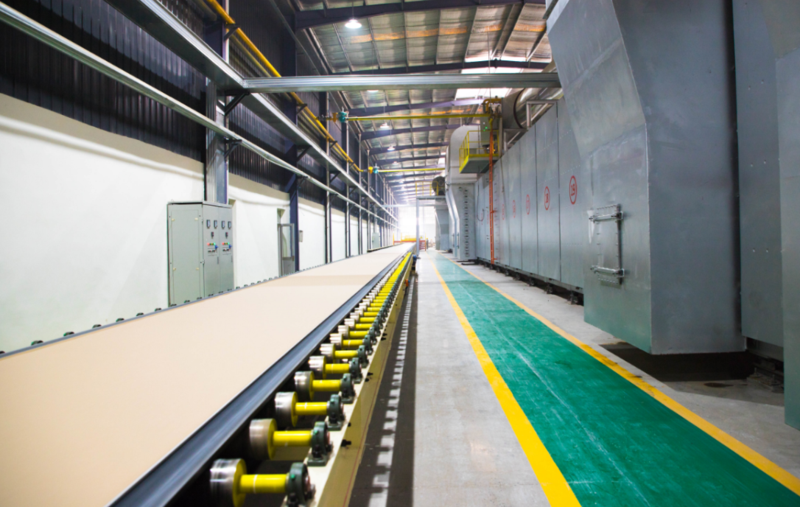
2. Belt Types by Production Stage
2.1 Forming Belt — Where Surface Quality Is Decided
This is the most quality-critical belt on the line. Any micro-texture on the belt surface transfers to the board face and stays there after drying.
What this belt must deliver:
- Mirror-smooth surface — no fabric weave imprints, no fine lines, no roughness. Standard EP belts are not suitable. Mirror-finish belts use high-hardness covers with controlled cooling to achieve zero visible transfer marks.
- Taper-edge compatibility — for tapered-edge boards, the belt must match the edge profile without slurry leakage or edge deformation. Dedicated taper-edge belts are reinforced underneath with soft fabric to protect the forming belt and extend service life.
- Flat, strong joints — a bulky or uneven splice creates a repeating mark on every board. German superconducting vulcanization produces joints that are strong and flush with the belt body.
2.2 Transfer and Roller Drive Belts — Handling the Green Board
After forming, the board moves through transfer sections before the dryer. These belts must grip and drive without slipping or abrading the surface.
What this belt must deliver:
- Consistent friction — grip without over-tensioning (over-tensioning shortens splice life and causes edge buckling)
- Width stability — belts that narrow or wander under load shift the board and damage edges
- Deflection resistance — infrared-positioned diagonal cutting ensures the belt tracks straight without constant adjustment
2.3 Stack Conveyor Belt — Protecting the Finished Product
Stack belts handle the heaviest loads and the most abrasive contact with board edges.
What this belt must deliver:
- High tensile strength — carry multiple boards without elongation or sagging
- Edge durability — resist cutting and chunking from repeated board-corner impact
- Low-friction top surface — let boards slide into position without scuffing the decorative face
3. The Specifications That Actually Matter
Most catalogs list thickness and tensile strength. For gypsum board lines, these four parameters determine whether the belt performs or fails.
3.1 Surface Smoothness (Mirror Grade)
There is no universal "mirror" standard, but the functional requirement is clear: after the belt contacts wet slurry and releases the formed board, the board surface must show no visible belt-induced texture.
Action: Ask for samples and run a trial. A belt that feels smooth may still carry microscopic weave patterns that appear after drying.
3.2 Joint Flatness and Strength
The splice is the weakest point and the most common source of quality defects. A joint even 0.2 mm thicker than the belt body creates a visible mark on every board.
Demand:
- Vulcanized joints, not mechanical fasteners
- Joint thickness deviation within ±0.1 mm of the belt body
- Documented splice strength (typically 80–90% of belt tensile strength for quality vulcanized joints)
3.3 Tracking Stability (Deflection Control)
A belt that wanders off-center damages edges and forces constant operator intervention. Deflection is determined by:
- Accuracy of belt width and diagonal cutting
- Consistency of belt thickness across the width
- Joint squareness (the splice must be cut perfectly perpendicular to the belt edges)
Infrared positioning during cutting and German vulcanization are not marketing phrases — they are process controls that determine whether the belt runs true or needs constant correction.
3.4 Temperature and Chemical Resistance
Confirm the belt cover compound is compatible with:
- Continuous moisture exposure
- Gypsum slurry pH (near neutral, but varies with additives)
- Dryer temperature profile (if the belt enters the dryer)
4. What Separates a Reliable Supplier from a Catalog Vendor
4.1 Application-Specific Engineering, Not Generic Belts
A general supplier will send you a standard EP belt for your forming section. A gypsum board specialist will ask:
- What is your board thickness range?
- Are you running tapered-edge or square-edge boards?
- What is the distance from forming station to first transfer point?
- What is your current belt failure mode (surface marks, edge cracking, splice failure, tracking)?
Annilte manufactures dedicated plasterboard belts rather than repurposed general belts. The forming belt line is engineered specifically for gypsum board surface quality, with R&D support across 1,780 industry segments and customization for line-specific requirements.
4.2 Production Capacity and Emergency Response
A belt failure on a forming line stops the whole plant. Downtime is measured in thousands of dollars per hour.
Check for:
- Stock depth — ready inventory of common specifications (Annilte holds raw material safety stock above 400,000 m²)
- Emergency shipping — documented capability to ship within 24 hours for urgent orders
- Multiple production lines — redundancy so backlogs don't delay your replacement
4.3 Certification and Traceability
For OEMs and tier-one suppliers, belt quality documentation is not optional. ISO certification, SGS gold supplier status, and material traceability from raw compound to finished belt provide the audit trail procurement and quality teams require.

R&D Team
Annilte has a research and development team consisting of 35 technicians. With strong technical research and development capabilities, we have provided conveyor belt customization services for 1780 industry segments, and gained recognition and affirmation from 20,000+ customers. With mature R&D and customization experience, we can meet the customization needs of different scenarios in various industries.

Production Strength
Annilte has 16 fully automated production lines imported from Germany in its integrated workshop, and 2 additional emergency backup production lines. The company ensures that the safety stock of all kinds of raw materials is not less than 400,000 square meters, and once the customer submits an emergency order, we will ship the product within 24 hours to respond to the customer's needs efficiently.
As a leading Chinese conveyor belt manufacturer with 17 years of industry experience, Annilte is proud to hold both ISO quality management certification and the RoHS environmental directive. Our manufacturing facilities meet “Green Factory” standards, and we are also an internationally recognized SGS Gold Supplier.
We offer a comprehensive range of customizable belt solutions under our own brand "ANNILTE", designed to meet diverse industrial needs.
Should you require further information about our products or capabilities, please do not hesitate to contact us.
WhatsApp: +86 185 6019 6101 Tel/WeChat: +86 185 6010 2292
E-mail: 391886440@qq.com Website: https://www.annilte.net/
Post time: Oct-29-2026