

Procurement managers evaluating grain elevator belt suppliers face a familiar dilemma: the quotation with the lowest per-meter price often produces the highest annual cost. This is not a paradox—it is the predictable result of ignoring the variables that determine belt lifespan, replacement frequency, and production downtime in grain handling environments.
Most supplier content focuses on tensile strength and cover thickness. Few address the financial calculus that matters to plant managers and purchasing directors: what does this belt actually cost per ton of grain elevated over its service life? This guide reframes the grain elevator belt decision around total cost of ownership (TCO), covering the failure modes that drive hidden costs and the supplier capabilities that mitigate them.
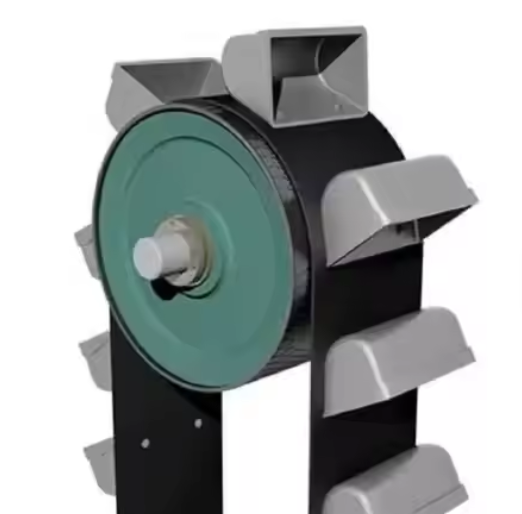
The Hidden Cost Drivers in Grain Elevator Belt Selection
Oil Exposure and Premature Delamination
Grains and oilseeds contain natural oils. In an enclosed elevator leg, grain dust settles on the belt, and these oils gradually penetrate the rubber compound. Standard SBR rubber swells and softens under oil exposure, leading to delamination—the separation of fabric plies that precedes catastrophic belt failure .
The cost implication is severe: a belt that delaminates at 8–10 months instead of achieving a 3–5 year service life triples the annualized belt cost. More critically, unplanned replacement during harvest or peak processing introduces emergency freight, overtime labor, and lost throughput that dwarf the belt’s purchase price.
Annilte addresses this with oil-resistant (OR) rubber compounds containing high NBR content, formulated to maintain hardness and dimensional stability under sustained grain-oil contact . For feed mills handling soybean meal or oilseed processors, this compound choice directly extends replacement intervals.
Bolt-Hole Integrity: The Weakest Link
The bolt holes are the belt’s structural vulnerability. Every revolution subjects the hole perimeter to dynamic stress as buckets load and discharge. Low-quality belts with insufficient cross-weave density allow bolts to “pull through” under surge loads, leading to bucket detachment and downstream equipment damage .
The TCO calculation here is straightforward: a belt that loses buckets during operation causes spillage cleanup costs, potential elevator casing damage, and production interruption. Annilte engineers belts with high-density cross-weave textile layers and high-tenacity rubber to maximize bolt-holding power, with CNC-punched holes matched to your bucket pattern for precise alignment .
Elongation and Take-Up System Limits
All fabric-carcass belts stretch during initial service. The question is how much, and whether the elevator’s take-up system can accommodate it. Belts with excessive permanent elongation force operators to re-splice (shorten) the belt earlier, incurring labor costs and production downtime.
Annilte’s EP fabric carcasses undergo heat-setting to minimize permanent elongation. The specification table below illustrates the elongation performance across Annilte’s grain elevator belt range .
| Model | Tensile Strength (N/mm) | Elongation @ Reference Load | Min. Head Pulley Diameter | Typical Application |
|---|---|---|---|---|
| 600YP | 600 | ≤1.6% | 300 mm | Small flour mills, grain depots |
| 800YP | 800 | ≤1.6% | 400 mm | Feed mills, rice mills |
| 1000YP | 1000 | ≤1.6% | 600 mm | Port terminals, transshipment hubs |
| 1200YP | 1200 | ≤1.6% | 800 mm | Ultra-high, high-capacity systems |
The ≤1.6% elongation figure is significant for TCO: it means the take-up system retains adjustment capacity longer, deferring the first re-splice and reducing maintenance labor over the belt’s life.
Safety Compliance as a Cost Avoidance Measure
Grain dust is combustible. Friction from a misaligned belt, static discharge, or hot bearings can ignite dust accumulations, with consequences that extend far beyond belt replacement costs.
Annilte grain elevator belts meet international safety benchmarks for flame retardancy (ISO 340 / ASTM D378) and anti-static performance (ISO 284), dissipating static charge to ground and self-extinguishing if ignited . For facilities subject to ATEX or OSHA inspections, documented compliance is not optional—it is a procurement requirement that protects against fines, insurance complications, and the unthinkable cost of a dust explosion.
When evaluating suppliers, request the specific test reports for flame retardancy and surface resistivity for the compound you are ordering. Generic “fire-resistant” claims without test documentation provide no TCO protection.
Supplier Capabilities That Reduce Total Cost
Custom Punching Reduces Installation Labor
Manual drilling of hundreds of bolt holes in a replacement belt is labor-intensive and error-prone. Misaligned holes force field modifications, delay startup, and compromise bolt security.
Annilte provides factory-direct CNC punching matched to your bucket pattern. According to the company’s engineering data, pre-punched belts reduce installation time by over 50% compared to field-drilled alternatives . For a plant scheduling belt replacement during a narrow maintenance window, this labor saving directly translates to reduced downtime cost.
Emergency Stock and Lead Time
A grain elevator belt failure during harvest is a revenue emergency. The difference between a 24-hour emergency shipment and a 30-day standard lead time can determine whether a facility meets its contracts or loses them.
Annilte maintains safety stock of raw materials exceeding 400,000 square meters, with a stated capability to ship emergency orders within 24 hours once specifications are confirmed . For procurement planning, this capability should be verified in writing and factored into supplier risk assessment—not treated as a marketing claim.
Engineering Support for Specification Accuracy
Specifying the wrong belt construction is an expensive error that often surfaces months after installation. Annilte’s R&D team of 35 engineers provides application-specific review, matching carcass construction, cover compound, and bolt-hole configuration to the actual operating conditions . This pre-purchase engineering support reduces the probability of a specification mismatch that would generate warranty disputes and downtime.
Evaluating grain elevator belt suppliers on unit price alone? Request Annilte’s TCO comparison worksheet—including elongation data, oil-resistance specifications, and emergency lead-time commitments—to make a procurement decision based on annualized cost rather than invoice price. Contact Annilte’s technical team to begin the analysis.
Frequently Asked Questions
Q: How does oil resistance affect grain elevator belt lifespan in practice?
Standard SBR rubber exposed to grain oils can delaminate within 6–12 months in high-oil applications. Oil-resistant NBR compounds maintain dimensional stability significantly longer. Annilte can provide compound specifications and references from feed mill and oilseed processing applications .
Q: Can Annilte supply a replacement belt with bolt holes matching my existing buckets?
Yes. Provide your bucket bolt pattern (hole diameter, spacing, and edge distance) or a section of the old belt. Annilte’s CNC punching produces matched holes, eliminating field drilling and reducing installation time.
Q: What documentation supports the flame-retardant and anti-static claims?
Annilte belts are tested to ISO 340 / ASTM D378 (flame retardancy) and ISO 284 (anti-static/surface resistivity). Request the specific test reports for the compound and construction you are ordering as part of your supplier qualification.
Q: What is the typical lead time for a custom-punched grain elevator belt?
Standard specifications ship within 7–15 days. Custom punching and non-standard widths may add production time. For emergency breakdowns, Annilte’s raw material stock supports rapid dispatch—confirm the emergency lead-time commitment in your purchase order terms.
Q: Does Annilte offer FDA-compliant compounds for grain contact?
Yes. FDA-compliant food-grade compounds are available for applications requiring direct grain contact documentation, including white cover options for rice milling and flour processing where cleanliness verification is prioritized .
Ready to calculate the real cost of your grain elevator belt? Annilte’s export team can provide a specification comparison, elongation data, and lead-time commitment for your specific elevator parameters. Request a TCO-oriented quotation with certification documentation included.

R&D Team
Annilte has a research and development team consisting of 35 technicians. With strong technical research and development capabilities, we have provided conveyor belt customization services for 1780 industry segments, and gained recognition and affirmation from 20,000+ customers. With mature R&D and customization experience, we can meet the customization needs of different scenarios in various industries.

Production Strength
Annilte has 16 fully automated production lines imported from Germany in its integrated workshop, and 2 additional emergency backup production lines. The company ensures that the safety stock of all kinds of raw materials is not less than 400,000 square meters, and once the customer submits an emergency order, we will ship the product within 24 hours to respond to the customer's needs efficiently.
As a leading Chinese conveyor belt manufacturer with 17 years of industry experience, Annilte is proud to hold both ISO quality management certification and the RoHS environmental directive. Our manufacturing facilities meet “Green Factory” standards, and we are also an internationally recognized SGS Gold Supplier.
We offer a comprehensive range of customizable belt solutions under our own brand "ANNILTE", designed to meet diverse industrial needs.
Should you require further information about our products or capabilities, please do not hesitate to contact us.
WhatsApp: +86 185 6019 6101 Tel/WeChat: +86 185 6010 2292
E-mail: 391886440@qq.com Website: https://www.annilte.net/
Post time: Nov-10-2026