
Most Z7 belt replacement decisions get made under pressure. The belt on the machine is worn, tracking is drifting, or vacuum loss is showing up in cut quality. The buyer needs a replacement fast, and the easiest path is to order from whoever lists “Gerber Z7 compatible” and offers the shortest lead time.
That path works—until it doesn’t. A belt that arrives quickly but fails in six weeks costs more than the belt itself. It costs the downtime to replace it again, the material scrapped during the failure window, and the credibility of whoever approved the purchase.
This guide takes a different angle from the usual specification walkthrough. Instead of asking “what should the belt do,” it asks “how do you tell whether a supplier actually knows what the Z7 needs.” The questions below are the ones that separate a manufacturer from a reseller with a compatibility list.
The Z7 Is Not a Generic Cutting Table
The Z7 is Gerber’s high-ply workhorse, designed for around-the-clock production at cutting speeds up to 30.5 m/min . Its conveyor system is mounted on durable roller bearings to reduce friction, and the digitally-controlled Convey Under Vacuum system maintains material stability through the cutting process . The belt sits inside that system. It has to convey material smoothly while holding vacuum consistently across the cutting window.
That dual demand—conveyance and vacuum—is what makes the Z7 belt different from a standard industrial conveyor belt. A belt optimized for one function often compromises the other. A supplier who understands the Z7 will be able to explain how their belt balances both, not just confirm that it fits the machine.
Question One: What Is Actually Inside the Belt?
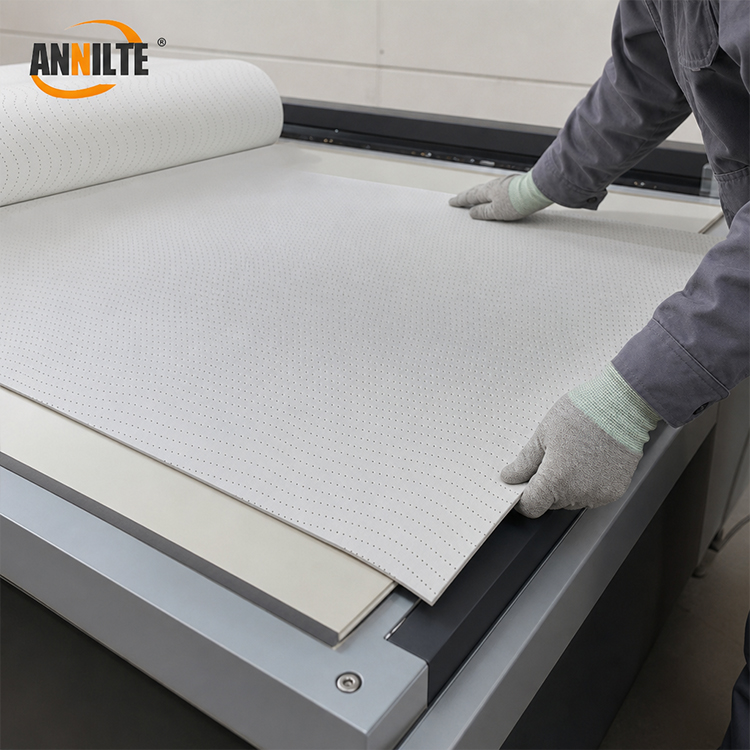
Ask for the tensile layer construction. The Z7’s conveyor runs continuously under tension. A belt that elongates under load will lose tracking, require repeated re-tensioning, and eventually contact the frame. The construction that prevents this is a multi-layer polyester core combined with virgin PU cover material.
The keyword is virgin. Annilte’s Gerber replacement belts use imported virgin PU rather than reclaimed or recycled material . Recycled PU may pass a dimensional check on day one. It will not hold the same cut-resistance or dimensional stability through months of knife contact. A supplier who cannot tell you whether their PU is virgin or recycled has not thought about belt life beyond the invoice date.
Question Two: Can They Show You Test Data, Not Just a Certificate?
ISO 9001 confirms a quality management system exists. SGS certification confirms an audit was passed. Neither confirms that the specific belt construction you are buying has been tested for vacuum consistency, elongation under tension, or cut resistance.
Ask for the data behind the belt. Annilte’s Gerber belts have undergone hundreds of hole-pattern tests to balance adsorption force against tensile strength, specifically to prevent the belt from breaking along the perforation line during extended high-speed operation . That kind of testing is not visible on a certificate. It shows up in how the supplier talks about their product: whether they describe the problem the belt solves, or just list specifications.
Question Three: What Happens After the Belt Ships?
This is the question most buyers skip, and it is the one that determines whether the replacement was actually a good decision.
A belt that tracks poorly three weeks into service is a supplier problem. Does the supplier have a process for diagnosing tracking issues remotely? Can they explain whether the cause is belt construction, installation tension, or a machine-side issue? Or do they default to “it must be installation error” and stop responding?
For distributors, this matters even more. Your customer bought the belt from you, not from the factory. If the supplier disappears after shipment, you absorb the problem. Ask how the supplier handles field issues: what information they need to diagnose, how quickly they respond, and whether they will replace a belt that fails within a defined window for reasons attributable to manufacturing.
Annilte’s 35-engineer R&D team supports customization and troubleshooting across 1,780 industry segments . That scale is not a guarantee of after-sale responsiveness, but it is a signal that the company has infrastructure beyond a sales office. For distributors evaluating a long-term supply relationship, the depth of technical support matters as much as the belt price.
Question Four: Do They Understand the Difference Between Z7 and Other Gerber Models?
A supplier who treats all Gerber belts as interchangeable has not done the engineering work. The Z7, XLC7000, GT5250, and S3200 share some belt characteristics, but their vacuum demands, cutting speeds, and conveyor configurations differ. Annilte manufactures belts for the Z7 alongside Z1, XLC7000, GT5250, S3200, and Paragon HX models, with model-specific hole patterns and dimensions .
Ask a potential supplier to explain what is different about the Z7 belt compared to, say, a GT5250 belt. If the answer is “nothing, they are the same,” that is useful information. If the answer describes vacuum distribution differences or hole spacing adjustments, you are talking to someone who has actually engineered for the machine.
A Supplier Evaluation Checklist for Z7 Belt Replacement
- Tensile layer construction and whether the PU is virgin or recycled
- Hole pattern test data—not just “fits Z7”
- Joint method and thickness tolerance
- After-sale diagnostic process for tracking or vacuum issues
- Whether the supplier differentiates Z7 belts from other Gerber models
- Lead time commitment in writing, including expedited options
The fastest belt is not always the right belt. A supplier who can answer these questions is worth a longer lead time. One who cannot is a risk you are taking on behalf of your production schedule—or your customer’s.

R&D Team
Annilte has a research and development team consisting of 35 technicians. With strong technical research and development capabilities, we have provided conveyor belt customization services for 1780 industry segments, and gained recognition and affirmation from 20,000+ customers. With mature R&D and customization experience, we can meet the customization needs of different scenarios in various industries.

Production Strength
Annilte has 16 fully automated production lines imported from Germany in its integrated workshop, and 2 additional emergency backup production lines. The company ensures that the safety stock of all kinds of raw materials is not less than 400,000 square meters, and once the customer submits an emergency order, we will ship the product within 24 hours to respond to the customer's needs efficiently.
As a leading Chinese conveyor belt manufacturer with 17 years of industry experience, Annilte is proud to hold both ISO quality management certification and the RoHS environmental directive. Our manufacturing facilities meet “Green Factory” standards, and we are also an internationally recognized SGS Gold Supplier.
We offer a comprehensive range of customizable belt solutions under our own brand "ANNILTE", designed to meet diverse industrial needs.
Should you require further information about our products or capabilities, please do not hesitate to contact us.
WhatsApp: +86 185 6019 6101 Tel/WeChat: +86 185 6010 2292
E-mail: 391886440@qq.com Website: https://www.annilte.net/
Post time: Oct-23-2026