

Most S3200 belt purchases are evaluated on one number: the price per belt. That number is easy to compare across suppliers. It is also the least useful number in the decision.
The S3200 is Gerber’s compact high-ply cutter, designed for cutting heights up to 3.2 cm with cutting widths of 1.7, 2.0, or 2.4 meters . It runs in apparel, automotive interiors, and composite cutting rooms where throughput matters and downtime is expensive. The belt sits inside that production flow. When it fails—or when it underperforms—the cost isn’t the belt. It’s the hours of lost cutting, the material scrapped during the failure window, and the labor to replace it.
This guide takes the TCO angle. Instead of asking what the belt should do, it asks what a belt actually costs over its service life—and how to compare suppliers on that basis.
The Three Cost Layers of an S3200 Belt
Layer one: acquisition price. The invoice cost of the belt itself. This is the number most buyers negotiate on, and it’s the smallest part of the total.
Layer two: replacement frequency. How often the belt needs to be replaced. Annilte’s own maintenance guidance for the S3200 recommends a replacement cycle of 6 to 10 months for standard industrial felt belts . A cheaper belt that fails at the low end of that range costs more per month of service than a higher-priced belt that lasts the full cycle or beyond.
Layer three: production impact. What happens while the belt is failing and while it is being replaced. A belt that loses vacuum uniformity before it fails completely will produce cut defects—shifts, lifts, uneven depth—that may not be caught until the lay reaches inspection. A belt that tracks poorly accelerates edge wear and can damage the machine’s conveyor components. The cost of a single scrapped lay in carbon fiber prepreg or automotive leather can exceed the price of several belts.
Why the Cheapest Belt Often Costs More
A low-cost S3200 belt typically makes one of two compromises.
Compromise one: reclaimed or recycled PU. Recycled PU can pass a dimensional check on day one. It will not hold the same cut resistance or dimensional stability through months of knife contact. The S3200’s knife penetrates the belt surface on every cut. A cover compound that hardens or chips under that contact will develop deep knife tracks, lose vacuum through the damaged surface, and fail at the perforations earlier than a virgin PU belt would .
Compromise two: lower tensile construction. The S3200’s conveyor runs under constant tension. A belt with a thinner or lower-grade polyester tensile layer will elongate under load, lose tracking, and require repeated re-tensioning. Each re-tensioning is a maintenance call. Each tracking drift is a potential cut quality issue. The labor cost of those interventions accumulates faster than the price difference between a budget belt and a properly constructed one.
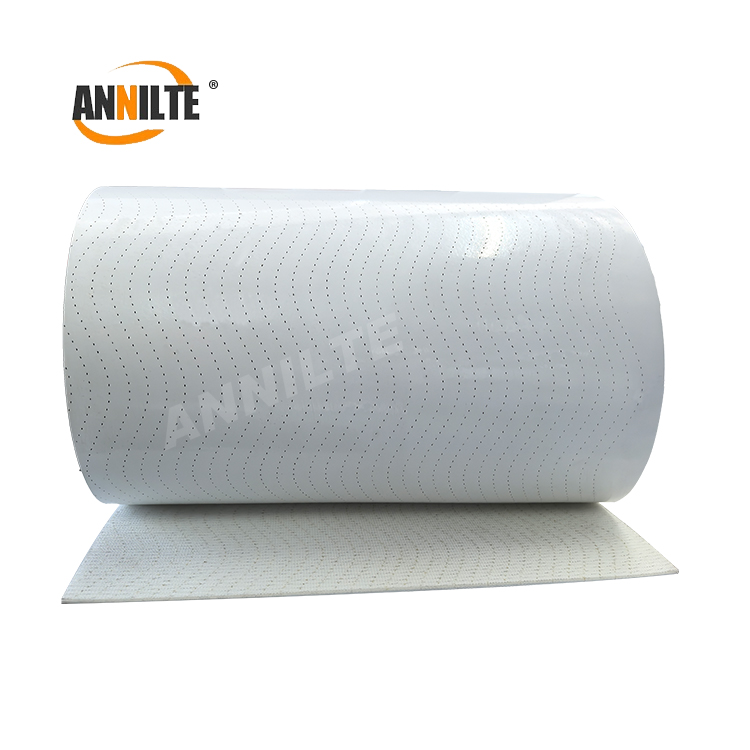
Annilte’s S3200-compatible belts use imported virgin PU combined with a multi-layer polyester tensile skeleton, the same construction used across its Gerber replacement range . The wave-pattern perforation is engineered for uniform vacuum distribution, not just punched for appearance. The relevant claim for TCO purposes is not that the belt lasts forever. It’s that the belt holds its performance characteristics—vacuum consistency, dimensional stability, cut resistance—through the expected service window rather than degrading gradually from the first week.
How to Calculate Cost Per Cut
The practical way to compare S3200 belt suppliers is to translate belt price into cost per cut or cost per lay. The formula is straightforward:
Cost per cut = (Belt price + Replacement labor + Expected downtime cost) / Estimated cuts per belt life
The variables that matter:
- Belt price: the invoice cost.
- Replacement labor: hours to remove and install the belt, multiplied by your maintenance labor rate. The S3200’s belt replacement is a scheduled maintenance task, but it still consumes labor hours.
- Expected downtime cost: if the machine is idle during replacement, the revenue or throughput lost during that window. For a cutting room running multiple shifts, this is often the largest number in the equation.
- Estimated cuts per belt life: how many cutting cycles the belt delivers before vacuum loss or surface damage forces replacement.
A belt that costs 20% more but lasts 40% longer and holds vacuum more consistently will almost always win on cost per cut. The challenge is getting honest numbers for the last variable. Ask suppliers for their expected service life under your specific cutting conditions—material type, ply height, cutting speed, vacuum level. A supplier who cannot give a range based on those variables is guessing.
A Supplier Comparison Framework for S3200 Belts
Put these questions side by side when evaluating quotes:
- PU grade: virgin or recycled? If the supplier cannot answer, assume recycled.
- Tensile construction: how many polyester layers, and what is the elongation rate under working tension?
- Hole pattern: diameter and spacing in millimeters, and whether the pattern was engineered for the S3200’s vacuum characteristics or is a generic perforation.
- Expected service life: a range based on your material and cutting parameters, not a single number.
- Replacement guidance: does the supplier provide a maintenance schedule or inspection criteria?
- Emergency lead time: how fast can a replacement ship if a belt fails unexpectedly? Annilte’s emergency orders ship within 24 hours from stock .
The S3200 is a machine designed for production efficiency. The belt should be specified on the same basis—not on the lowest invoice price, but on the lowest cost per cut over its service life. That calculation changes which supplier looks cheapest.

R&D Team
Annilte has a research and development team consisting of 35 technicians. With strong technical research and development capabilities, we have provided conveyor belt customization services for 1780 industry segments, and gained recognition and affirmation from 20,000+ customers. With mature R&D and customization experience, we can meet the customization needs of different scenarios in various industries.

Production Strength
Annilte has 16 fully automated production lines imported from Germany in its integrated workshop, and 2 additional emergency backup production lines. The company ensures that the safety stock of all kinds of raw materials is not less than 400,000 square meters, and once the customer submits an emergency order, we will ship the product within 24 hours to respond to the customer's needs efficiently.
As a leading Chinese conveyor belt manufacturer with 17 years of industry experience, Annilte is proud to hold both ISO quality management certification and the RoHS environmental directive. Our manufacturing facilities meet “Green Factory” standards, and we are also an internationally recognized SGS Gold Supplier.
We offer a comprehensive range of customizable belt solutions under our own brand "ANNILTE", designed to meet diverse industrial needs.
Should you require further information about our products or capabilities, please do not hesitate to contact us.
WhatsApp: +86 185 6019 6101 Tel/WeChat: +86 185 6010 2292
E-mail: 391886440@qq.com Website: https://www.annilte.net/
Post time: Oct-22-2026