

"Fits a Gerber Paragon" is a compatibility claim, not a specification. It tells you the supplier has heard of the machine. It does not tell you the belt will run on yours.
The Paragon platform spans more than one series, more than one table configuration, and — depending on the installation — more than one belt construction. Two cutting rooms can both be running "a Paragon" and need belts that differ in width, finished length, thickness, surface construction, and splice. A supplier working from the model name alone is guessing at five variables and hoping the sixth one doesn't matter.
This guide is about closing that gap before the purchase order is issued. Every measurement below can be taken in an afternoon with a tape measure, a thickness gauge, and the belt that is currently on the machine. None of them require the OEM parts book — though if you have it, use it as a cross-check.
Why the Model Name Is Not Enough
Three variables change what belt a Paragon actually needs, and none of them appear in the model name.
Series. Gerber's published figures put the L-Series at up to roughly 2.75 cm of vacuum-compressed material and the HX/V-Series at up to about 7.2 cm. Higher cutting stacks mean deeper knife penetration into the belt surface, which pushes the specification toward higher density and greater cut resistance — not simply "a Paragon belt."
Table configuration. Table width and usable cutting length vary by installation and by how the line was specified when it was built. A belt is made to the table in front of you, not to a catalogue line.
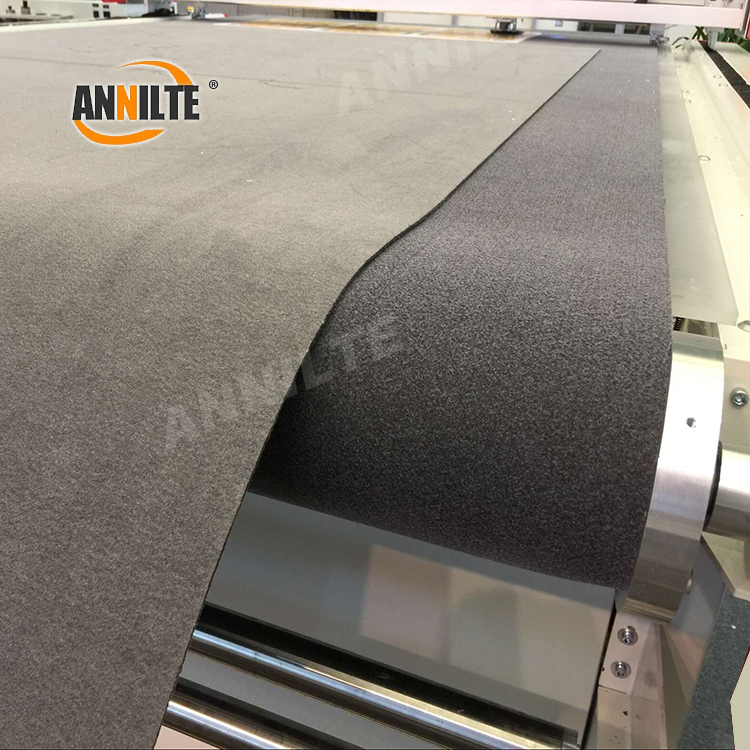
Belt construction. Depending on the table type and how the machine is set up, the belt in service may be a needle-felt underlay or a perforated vacuum belt. These are different products with different measurement priorities: on a felt underlay, thickness, density and air permeability dominate; on a perforated belt, hole diameter, pitch and positional tolerance dominate. Assuming your machine takes one when it takes the other is a common and expensive ordering error — and it is the reason the first step below is to identify what is actually on the table.
Measurement 1: Belt Width
Width is the measurement buyers get wrong most often, because the intuitive source is the wrong one.
Do not measure the table frame, the cutting window, or the material being cut. Measure the belt.
How to do it properly:
- Run the belt so a clean section is accessible at the loading end.
- Measure across the belt body at three points — left edge, centre, right edge of the same section — using a steel tape held flat against the surface. Felt edges can be slightly ragged; measure to the structural edge, not to the longest loose fibre.
- Repeat at a second section roughly a metre away.
- Record the narrowest reading as the working width.
Why the narrowest, not the average: a belt that is fractionally wide rubs the frame and edge guides, which polishes and then frays the edge and eventually feeds material into the tracking path. A belt that is fractionally narrow leaves an uncovered strip at the table edge, so vacuum leaks and material at the selvedge lifts. The narrowest reading is the one that keeps you out of both failure modes.
One caution on worn belts: an old felt belt that has been running under tension and knife contact may have spread slightly at the edges or compacted in the centre. If the measured width disagrees with the machine's nominal table width by more than a couple of millimetres, state both numbers on the RFQ and let the supplier reconcile them. Do not silently pick one.
Annilte customises felt belts up to 2500 mm wide and from 2.5 mm to 5.5 mm thick, which covers standard Gerber table widths — but the customisation is only worth anything if the number supplied is the measured working width.
Measurement 2: Finished Endless Length
This is where replacement orders fail most expensively, and the cause is almost always the same: the buyer measures the old belt and orders that length.
An old belt has already elongated. Copying its length builds the elongation into the new belt, and a new belt that is too long cannot be tensioned correctly. It slips on the drive, tracks badly, and the cutting coordinates drift because the software's assumed feed per revolution no longer matches reality.
The measurement procedure that avoids this:
- Remove the old belt (or slacken it fully if it cannot be removed).
- Lay it flat on the floor in a straight line, without tension, and let it settle.
- Mark a reference line across the belt at one point.
- Roll the belt along the floor from that mark through one full revolution, keeping it straight, and mark the floor where the reference line returns.
- Measure between the two marks. Repeat three times. Use the shortest consistent reading.
- Record the splice position and splice length separately — they are not part of the endless length calculation but they do affect how the belt sits on the rollers.
The arithmetic cross-check: for a simple two-pulley layout, finished length ≈ 2 × centre distance + π × roller diameter. For a cutting table with multiple rollers and a long flat run, this formula under-describes the path — measure the actual belt, or measure the full roller path and add the wrap allowances. Treat the formula as a sanity check on your tape measurement, not as a substitute for it. If the two disagree by more than about 1%, one of them is wrong, and it is usually the assumption about centre distance.
If the old belt is unusable as a reference — cut through, or missing — measure the roller path directly: wrap a low-stretch tape or cord around the complete belt path under working tension, mark and measure. Then ask the supplier what elongation allowance they build in at the specified tension. A supplier who cannot answer that question is not measuring either.
Measurement 3: Thickness, Measured Under Compression
Felt compresses. A belt quoted at 4 mm does not measure 4 mm with a vernier pressed into it on the bench, and it certainly does not measure 4 mm under the knife.
What to record:
- Bench thickness — measured with a thickness gauge at five points across the width at three positions along the length, unloaded.
- In-service thickness — measured at the belt surface inside the cutting window while the vacuum is on and the lay is compressed, if the machine allows access. This is the number that determines actual knife penetration and the effective cutting depth available to you.
- Thickness variation across the width — if the belt is measurably thinner in the centre than at the edges after service, that is knife-track compaction. It tells the supplier the belt needs more cut resistance in the working zone, or that the previous belt was too soft for the material mix.
Thickness cannot be chosen from the model name, and thicker is not automatically better. A thicker belt reduces the available cutting depth before the knife reaches the table, changes the vacuum path, and can alter how the belt wraps smaller rollers. What matters is matching the original construction and the material you actually cut: a cutting room running dense automotive interior fabric and one running single-ply lining need different surfaces from the same machine.
For the machine-by-machine thickness ranges Annilte supplies, see the Gerber digital cutter felt belt guide; for the construction discussion on perforated belts, see Perforated Belt for Gerber Paragon.
Measurement 4: Surface and Air Permeability
Two felt belts of identical thickness can hold vacuum differently, because the variable is how the air moves through the felt, not how thick it is.
Before ordering, record:
- Felt type — needled, woven, or felt composite; single-sided or double-sided surface. If the old belt is double-sided and the replacement is single-sided, the machine may still cut, but the surface the knife sees has changed.
- Density / hardness by feel plus measurement — a simple durometer reading at several points, recorded and sent with the RFQ, is far more useful to a supplier than "medium hard."
- Air permeability — if your cutting room has a vacuum gauge, record the vacuum level achieved with a new belt and with the belt at end of life. The difference quantifies how much hold you have lost. That number also gives the supplier a target to match, which is more actionable than a thickness figure alone.
A belt that is dimensionally perfect but too dense will not hold vacuum; one that is too open will hold vacuum but collapse under the knife. Both failures look like "the belt is wrong" and neither is fixed by ordering a different width.
Measurement 5: The Splice
The splice is the point where a replacement belt announces itself — either by running quietly for the life of the belt, or by catching the knife on every revolution.
Record before ordering:
- Endless or joined? If the machine frame cannot be opened to thread an endless belt, you need a field joint, and the joint quality becomes the primary selection criterion rather than a detail.
- Splice type and length — measure the overlap length and note whether the joint is flush with the belt surface. A protruding splice catches the knife and damages tips; a recessed one creates a vacuum leak and a tracking impulse every revolution.
- Splice orientation relative to travel — note which direction the splice leads. Reversing it on fitting can change how the joint behaves under the knife.
Ask any supplier how the joint is made before comparing price. On felt and composite belts, a stitched or glued lap joint and a properly consolidated splice behave very differently under repeated knife contact, and the price difference between quotes usually lives here. Annilte's approach to joint construction on Gerber belts is set out in the Gerber DCS3500 and Paragon belt replacement guide.
Measurement 6: Machine Data to Send With the Measurements
The measurements above describe the belt. These five data points describe the machine, and the supplier needs both to confirm a specification:
- Model and series (L-Series, HX/V-Series, or the plate designation on the machine)
- Table width and usable cutting length
- Roller diameters — drive, idler, and any small tension rollers
- Vacuum zone layout (full table, zoned, or conveyorised)
- Material mix and typical lay height
Add photographs: the full belt, a close-up of the surface, a close-up of the splice, and the edge condition at the frame. Photographs catch what a tape measure misses — a frayed edge, a glazed surface, a splice that has lifted.
The Measurement Sheet
| # | Item | How to measure | Record |
| 1 | Machine model & series | Nameplate | ______ |
| 2 | Table width / cut length | Frame | ______ mm / ______ mm |
| 3 | Belt width | 3 points × 2 sections, narrowest | ______ mm |
| 4 | Finished endless length | Mark-and-roll, 3 runs, shortest | ______ mm |
| 5 | Bench thickness | 5 points across × 3 along | ______ mm |
| 6 | In-service thickness | Inside cutting window, vacuum on | ______ mm |
| 7 | Construction | Needled / woven / composite; single or double-sided | ______ |
| 8 | Perforation (if fitted) | Hole Ø, pitch, rows, tolerance | ______ |
| 9 | Splice | Type, length, flush or not, orientation | ______ |
| 10 | Roller diameters | Drive / idler / tension | ______ mm |
| 11 | Material mix & lay height | Production data | ______ |
| 12 | Old belt failure mode | Edge wear / knife strike / stretch / vacuum loss | ______ |
A supplier receiving this sheet can quote a belt. A supplier receiving only "Gerber Paragon" is quoting a guess with a delivery date attached.
FAQ
How do I know which belt my Gerber Paragon takes — felt or perforated? Look at the belt currently on the table. If it is a needled felt surface, it is a felt underlay; if it is a smooth polymer belt with a regular hole pattern, it is a perforated vacuum belt. The two have different measurement priorities — thickness, density and permeability on felt; hole diameter, pitch and tolerance on perforated — so identify the construction before ordering rather than working from the model name.
Can I order a Gerber Paragon belt by model and table size alone? Table size gets you close on width and length, but not on thickness, construction, splice type, or perforation pattern. Those four variables are what separate a belt that runs quietly from one that tracks off-centre and loses vacuum, and all four are measurable from the belt on your machine in under an hour.
Why does a new belt run off-centre when the old one ran straight? Most often the new belt is too long — the length was copied from an elongated old belt, so it cannot reach correct tension — or the splice is not flush, which steers the belt every time the joint passes a roller. Check tension first, then splice, then edge condition at the frame before blaming the material.
How long should a Gerber Paragon felt belt last? Replacement intervals vary with cutting volume, material abrasiveness, lay height and knife condition; Annilte's field feedback for Paragon installations sits in the region of six to ten months for standard industrial felt, with the range widening either way depending on duty. Track your own replacement dates against cutting hours — that record is more reliable than any general figure, including ours.
Is an aftermarket belt safe for a Gerber Paragon? It is safe if the specification is measured rather than assumed — width, finished length, thickness under compression, construction, permeability and splice all matched and documented. The risk with aftermarket supply is not the concept; it is suppliers who confirm compatibility from a model name and never ask for a measurement.

R&D Team
Annilte has a research and development team consisting of 35 technicians. With strong technical research and development capabilities, we have provided conveyor belt customization services for 1780 industry segments, and gained recognition and affirmation from 20,000+ customers. With mature R&D and customization experience, we can meet the customization needs of different scenarios in various industries.

Production Strength
Annilte has 16 fully automated production lines imported from Germany in its integrated workshop, and 2 additional emergency backup production lines. The company ensures that the safety stock of all kinds of raw materials is not less than 400,000 square meters, and once the customer submits an emergency order, we will ship the product within 24 hours to respond to the customer's needs efficiently.
As a leading Chinese conveyor belt manufacturer with 17 years of industry experience, Annilte is proud to hold both ISO quality management certification and the RoHS environmental directive. Our manufacturing facilities meet “Green Factory” standards, and we are also an internationally recognized SGS Gold Supplier.
We offer a comprehensive range of customizable belt solutions under our own brand "ANNILTE", designed to meet diverse industrial needs.
Should you require further information about our products or capabilities, please do not hesitate to contact us.
WhatsApp: +86 185 6019 6101 Tel/WeChat: +86 185 6010 2292
E-mail: 391886440@qq.com Website: https://www.annilte.net/
Post time: Nov-11-2026