

A Gerber conveyor belt rarely fails without warning. It gives signals—subtle at first, then harder to ignore. The problem is that most cutting rooms don’t have a diagnostic framework for interpreting those signals. A belt starts tracking slightly off-center, or vacuum pressure drops in one zone, and the response is often “keep running until it gets worse.” By the time it gets worse, a lay has been scrapped or the machine is down mid-shift.
This guide is built around a different question: not “what belt should I buy,” but “how do I know what’s actually wrong with the belt I have.” The distinction matters because a significant share of replacement belts are ordered for problems that weren’t belt failures at all—misaligned frames, incorrect tension, or worn rollers.
Symptom One: Vacuum Loss That Isn’t Uniform
What you observe: Material lifts or shifts in specific zones of the cutting bed, not across the entire table. The vacuum gauge may read normal.
What it usually means: The belt’s perforation pattern has been compromised in a localized area. This happens when knife tracks deepen and close off holes, or when the cover compound chips and debris blocks airflow. It is not a vacuum pump problem if the loss is zone-specific.
Diagnostic step: Run a vacuum distribution check. Place a sheet of thin material over the bed with vacuum on. Walk the surface and note where it pulls weakly. If the weak zones correspond to visible knife tracks or surface damage on the belt, the belt is the cause. If the weak zones are in the same location regardless of belt condition, the issue is likely the vacuum system or table sealing.
When to replace vs. adjust: Localized vacuum loss from surface damage is not repairable. Patch attempts on perforated belts rarely hold. Replace when the weak zone affects cut quality on the materials you run most frequently. If you cut thin, lightweight fabrics where any lift causes defects, the threshold for replacement is lower than for heavy composites.
Symptom Two: Tracking Drift That Reappears After Tensioning
What you observe: The belt walks to one side. You re-tension it. It tracks straight for a few shifts, then drifts again.
What it usually means: The belt is elongating under load. A belt with insufficient tensile construction will stretch progressively, and re-tensioning only buys time. Annilte’s Gerber-compatible belts use a multi-layer polyester tensile skeleton and a heat-setting process intended to stabilize dimensions under continuous tension . If your current belt requires re-tensioning more than once per quarter, the construction is likely the limiting factor.
Diagnostic step: Measure belt length at installation and after 100 hours of operation. A properly constructed belt should show minimal elongation. If the length has increased measurably, the tensile layer is yielding. Tracking adjustments will not fix a stretching belt.
When to replace vs. adjust: Re-tension once. If drift returns within 200 operating hours, replace. Continued re-tensioning stresses the machine’s tracking components and accelerates wear on rollers and bearings .
Symptom Three: Cut Depth Variation Across a Single Lay
What you observe: Parts from one end of the lay have clean cuts; parts from the other end show incomplete penetration or ragged edges. The knife appears to be cutting at different depths across the table.
What it usually means: The belt surface has worn unevenly, changing the effective cutting height. On a high-ply machine like the GT5250, where the knife travels through up to 7.2 cm of compressed material, even a small variation in belt thickness affects the relationship between the blade and the material . Uneven wear often traces back to a belt that was tracking poorly for an extended period, causing one edge to wear faster than the other.
Diagnostic step: With the machine off, run a straightedge across the belt width at several points along the table. Any visible gap or crown indicates thickness variation. Also inspect the knife for uneven wear—a dull or chipped blade can mimic belt symptoms.
When to replace vs. adjust: Uneven belt thickness is not correctable. If thickness variation exceeds the tolerance your cut quality requires, replace. For rough cutting where edge finish is less critical, you may extend service life, but monitor cut depth consistency per lay.
The Symptom Most Buyers Miss: Joint Bump
What you observe: A periodic vibration or skip in cut quality at regular intervals along the lay. The interval corresponds to the belt’s circumference.
What it usually means: The splice or joint is sitting proud of the belt surface. On a high-ply cutter, the cutting head encounters the joint on every revolution. A joint that is even fractionally thicker than the belt body creates a disruption that translates into cut defects .
Diagnostic step: With the machine off, run your hand across the joint area. You should not feel a distinct bump. Place a straightedge across the joint; any gap under the straightedge at the splice indicates a thickness mismatch.
When to replace vs. adjust: Joint quality is set at manufacture. A proud joint cannot be corrected in the field. This is a supplier quality issue. Ask any belt supplier for their joint thickness tolerance before ordering. Annilte uses vulcanized joint technology intended to match the belt body thickness .
A Quick Reference: Symptom → Likely Cause → Action
| Symptom | Likely Cause | First Action |
|---|---|---|
| Zone-specific vacuum loss | Perforation damage or blockage | Inspect belt surface at weak zones |
| Tracking drift returning after tensioning | Belt elongation under load | Measure length change; replace if >0.5% |
| Cut depth variation across lay | Uneven belt thickness | Straightedge check across width |
| Periodic cut defect at belt interval | Joint bump | Hand-check splice thickness |
What Annilte Covers for Gerber Models
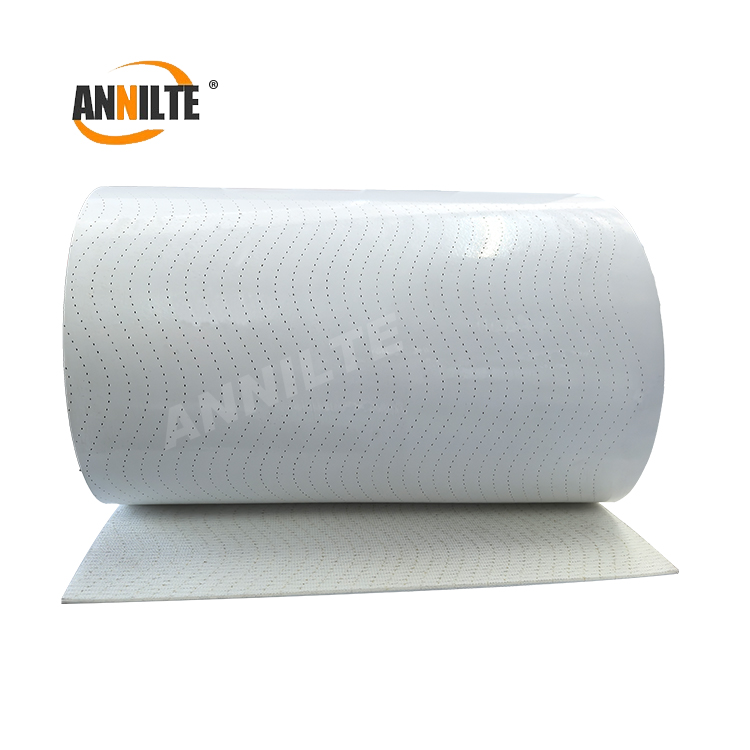
Annilte manufactures perforated conveyor belts for the Gerber range including GT5250, XLC7000, Z7, S3200, Z1, and Paragon models . The construction uses virgin PU with a multi-layer polyester tensile core, wave-pattern micro-perforation, and vulcanized joints. Emergency orders ship within 24 hours from raw material stock .
If you’re diagnosing a belt problem and want a second opinion on whether replacement is actually needed, send the symptoms and a photo of the belt surface. We’ll tell you what we see—even if the answer is “that belt has life left.”

R&D Team
Annilte has a research and development team consisting of 35 technicians. With strong technical research and development capabilities, we have provided conveyor belt customization services for 1780 industry segments, and gained recognition and affirmation from 20,000+ customers. With mature R&D and customization experience, we can meet the customization needs of different scenarios in various industries.

Production Strength
Annilte has 16 fully automated production lines imported from Germany in its integrated workshop, and 2 additional emergency backup production lines. The company ensures that the safety stock of all kinds of raw materials is not less than 400,000 square meters, and once the customer submits an emergency order, we will ship the product within 24 hours to respond to the customer's needs efficiently.
As a leading Chinese conveyor belt manufacturer with 17 years of industry experience, Annilte is proud to hold both ISO quality management certification and the RoHS environmental directive. Our manufacturing facilities meet “Green Factory” standards, and we are also an internationally recognized SGS Gold Supplier.
We offer a comprehensive range of customizable belt solutions under our own brand "ANNILTE", designed to meet diverse industrial needs.
Should you require further information about our products or capabilities, please do not hesitate to contact us.
WhatsApp: +86 185 6019 6101 Tel/WeChat: +86 185 6010 2292
E-mail: 391886440@qq.com Website: https://www.annilte.net/
Post time: Nov-25-2026