

Most Gerber conveyor belt replacements fail for the same reason: the buyer orders the right dimensions in the wrong material. The belt fits. It tracks. It holds vacuum—for a while. Then the surface hardens, or the perforations clog, or the blade starts leaving tracks that never close up. The replacement was technically correct and practically wrong.
This guide is about the decision that happens before the order: PU or felt. Not the sales pitch for either, but the operating conditions that make one clearly better than the other on a Gerber cutter.
The Short Answer Before the Detail
Felt for thin, delicate, and high-vacuum-sensitive materials. Synthetic felt’s breathable structure distributes vacuum more evenly across low-ply stacks, and its soft surface cushions blade contact. For apparel, technical textiles, and any application where material lift during cutting is the primary failure risk, felt is usually the right starting point .
PU for abrasive, thick, and high-cut-resistance applications. Virgin PU with a multi-layer polyester core resists knife tracks and surface chipping better than felt under heavy blade contact. For carbon fiber prepreg, thick leather, and multi-layer industrial composites where the blade penetrates deeply and repeatedly, PU holds its surface integrity longer .
If you cut both, you need two belt specs. A single “compromise” belt will underperform on both ends.
What Actually Separates PU from Felt on a Gerber
Vacuum Distribution: Felt Wins on Consistency, PU Wins on Durability
Felt’s needle-punched structure creates uniform breathability across the entire belt surface. The vacuum doesn’t depend on perforation pattern alone—the material itself passes air. On a Paragon LX or a Z1 running single-layer fabric, this means fewer dead zones and less material lift at the edges of the cutting bed .
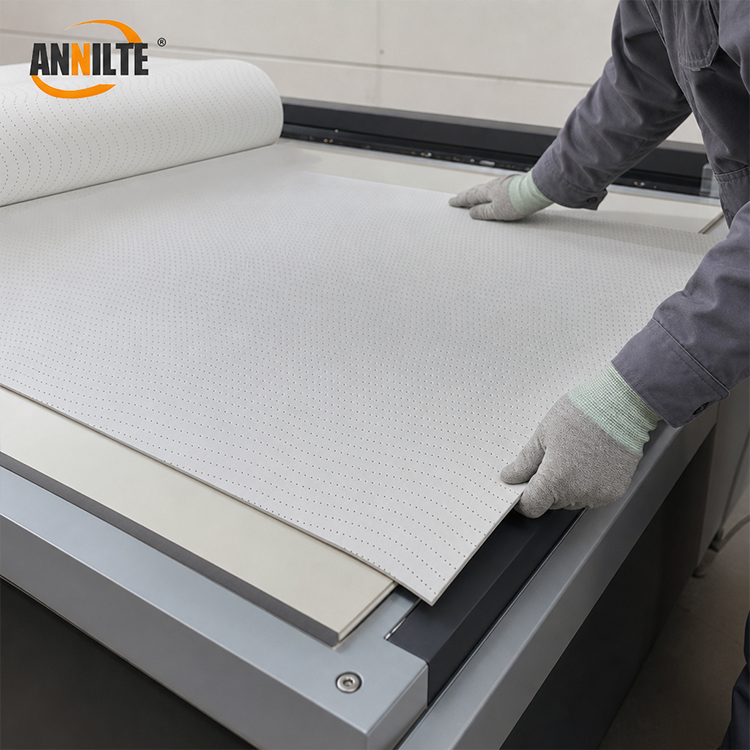
PU relies on CNC-perforated holes for vacuum transmission. The hole pattern must match the machine’s airflow characteristics. Annilte’s PU Gerber belts use wave-pattern micro-perforation with spacing controlled to roughly 1mm, engineered for even vacuum across the cutting surface . A PU belt with a generic hole pattern will hold vacuum unevenly, and the material will tell you about it before the belt shows visible wear.
Blade Contact: Felt Absorbs, PU Resists
The blade on a Gerber cutter penetrates the belt surface on every cut. Felt absorbs that contact. The fibers compress and recover, protecting the blade edge and reducing the frequency of sharpening or replacement. This is why felt is standard on machines cutting delicate or abrasive-to-the-blade materials .
PU does not absorb. It resists. A properly formulated PU cover with a Q-bouncing gel layer rebounds after knife contact rather than developing deep tracks . The trade-off: PU protects the belt, not the blade. If blade life is your primary cost concern, felt may be the better economic choice even if the belt itself wears faster.
Static: Both Can Be Treated, but the Treatment Matters
Static buildup causes material to cling to the belt and misalign during cutting. Synthetic felt belts can incorporate conductive fibers to dissipate static. PU belts can include anti-static additives in the compound . The question to ask a supplier is not whether their belt is “anti-static,” but what surface resistivity the belt achieves and under what humidity conditions. A belt that dissipates static in a conditioned cutting room may not perform the same in an unconditioned facility.
Thickness: The Number That Gets Guessed Most Often
Annilte’s guidance for Gerber felt belts recommends replacing when thickness drops by 20%, not when visible damage appears . A belt that has lost 20% of its thickness has already changed the blade-to-material relationship. Cut depth varies. Vacuum distribution shifts. The belt still “works,” which is why the replacement gets delayed until quality problems surface.
For PU belts, thickness loss is less linear. The surface either holds its resilience or it doesn’t. Inspect for knife tracks that don’t rebound, chipping at the perforation edges, and any visible change in surface texture. If the surface feels different from a new belt in the same zone where cuts are deepest, the cover compound has degraded.
Typical thickness ranges for Gerber applications: Felt belts commonly run 4–6mm depending on the model and material . PU belts are specified to match the machine’s original configuration. Do not substitute thickness without confirming the effect on blade clearance and vacuum performance.
A Replacement Decision Checklist
Before ordering, confirm these four points. If any answer is “not sure,” the belt you receive may not solve the problem you’re trying to solve.
- Primary material being cut. Felt for thin/delicate/high-vacuum-sensitive. PU for abrasive/thick/high-knife-contact.
- Current belt’s failure mode. If it failed at the perforations, the hole pattern or PU compound is the issue. If it wore unevenly, tracking or tension is the issue. If it lost vacuum before visible wear, the material may have been wrong for the application.
- Thickness at replacement. Felt: replace at 20% thickness loss, not at visible damage. PU: replace when surface resilience is gone in the cutting zone.
- Joint tolerance. Ask for the joint thickness tolerance. A splice that sits proud of the belt surface disrupts the cutting head on every pass. Annilte uses vulcanized joints intended to match belt body thickness .
When the Belt Arrives: A 10-Minute Verification
Do not install a replacement belt without checking these three things first.
Measure the width and length against the old belt before removal. Manufacturing variance exists. A belt that is 2mm off in width may track fine on a worn machine and fail on a tight one.
Inspect the joint. Run a straightedge across the splice. Any gap under the straightedge means the joint is proud. Install it and the cutting head will feel it.
Check perforation consistency if PU. Hold the belt up to light. The holes should be uniform in size and spacing across the full width. Any visible clustering or missed holes indicates a pattern problem, not a manufacturing “tolerance.”
What Annilte Covers for Gerber Replacements
Annilte manufactures replacement belts for the Gerber range including Z1, XLC7000, Z7, GT5250, S3200, Paragon HX/LX, and DCS series . PU belts use virgin material with a multi-layer polyester tensile core and CNC-perforated patterns. Felt belts are available in double-side green and high-density grey constructions with controlled permeability. Emergency orders ship within 24 hours from raw material stock.
If you’re unsure which material fits your application, send the machine model, material type, and the failure mode of the current belt. We’ll tell you what the symptoms point to—even if the answer is that felt will outperform PU for your specific cutting profile.

R&D Team
Annilte has a research and development team consisting of 35 technicians. With strong technical research and development capabilities, we have provided conveyor belt customization services for 1780 industry segments, and gained recognition and affirmation from 20,000+ customers. With mature R&D and customization experience, we can meet the customization needs of different scenarios in various industries.

Production Strength
Annilte has 16 fully automated production lines imported from Germany in its integrated workshop, and 2 additional emergency backup production lines. The company ensures that the safety stock of all kinds of raw materials is not less than 400,000 square meters, and once the customer submits an emergency order, we will ship the product within 24 hours to respond to the customer's needs efficiently.
As a leading Chinese conveyor belt manufacturer with 17 years of industry experience, Annilte is proud to hold both ISO quality management certification and the RoHS environmental directive. Our manufacturing facilities meet “Green Factory” standards, and we are also an internationally recognized SGS Gold Supplier.
We offer a comprehensive range of customizable belt solutions under our own brand "ANNILTE", designed to meet diverse industrial needs.
Should you require further information about our products or capabilities, please do not hesitate to contact us.
WhatsApp: +86 185 6019 6101 Tel/WeChat: +86 185 6010 2292
E-mail: 391886440@qq.com Website: https://www.annilte.net/
Post time: Nov-25-2026