

“Food grade” is one of the most abused phrases in the conveyor belt industry. A supplier can print it on a quotation, stamp it on a product page, and still be unable to produce a single document that proves the belt actually complies with food-contact regulations. For distributors reselling into food factories, and for plant buyers signing off on a line, that gap between claim and documentation is where real risk sits.
This guide covers what food grade PU conveyor belt actually means in practice, which specification points determine whether a belt survives on a food line, and how to separate suppliers who understand food processing from those who simply sell rubber and plastic.
The Compliance Question Comes First
Before thickness, width, or surface pattern, a food-grade PU belt needs a document trail.
“Food grade” as a marketing term carries no legal weight. What matters is conformity with specific regulations. For the US market, that means FDA 21 CFR compliance for repeated food-contact use. For Europe, it means EU Regulation 10/2011 for plastic materials, supported by a Declaration of Conformity that the manufacturer or distributor is legally obliged to provide .
A supplier who cannot state which regulation applies to the grade being quoted, and cannot supply the corresponding declaration, is not set up for serious food industry business. This is worth testing on a sample order before committing to a container load.
For wet-product zones—meat, poultry, seafood, dairy—hygienic design certification adds another layer. EHEDG certification, for example, signals that the belt’s surface geometry and construction have been assessed for cleanability, not just material safety. Forbo’s FLT U30 series carries EHEDG Type EL Class I AUX certification alongside FDA and EU compliance, specifically for wet or damp product applications . Not every food line needs this level of certification. Raw meat and dairy lines usually do. Dry bakery transfer often does not.
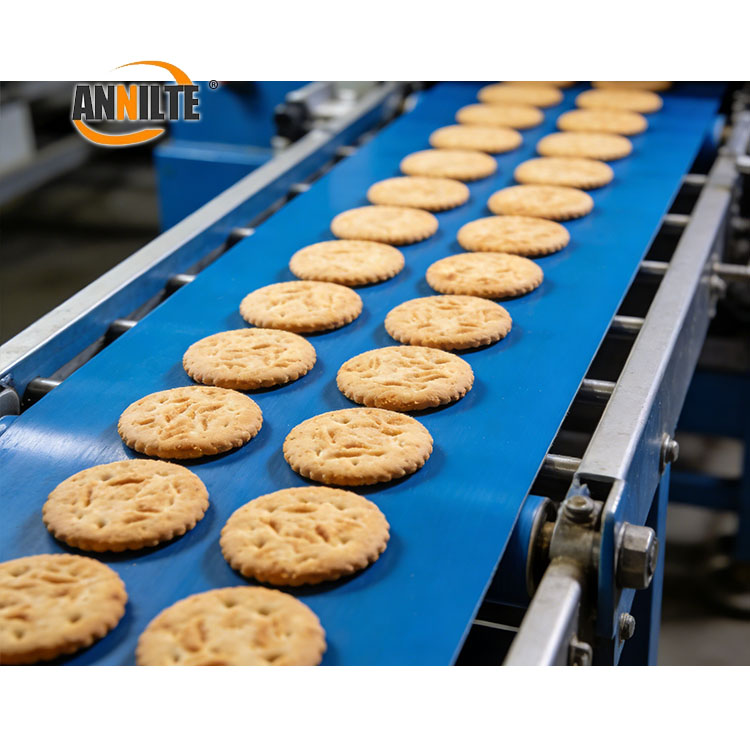
What Actually Matters in the Belt Construction
Once compliance is established, the specification points that determine performance on a food line are narrower than most listings suggest.
Joint construction. The splice is where most belt failures begin. PU belts for food use are commonly joined with toothed splices, steel clips, or vulcanized endless joints. For food plants, a toothed splice finished flush is generally preferred because it leaves fewer crevices for product to catch and makes cleaning more reliable. Ask whether the joint is rated for the smallest pulley on the customer‘s machine—a joint that holds on a large drum can crack on a small one.
Surface pattern, matched to the product. Smooth PU works for general conveying. But for inclined lines, wet product, or sticky dough, the top-face pattern makes a practical difference in both grip and release. Forbo’s food line timing belts, for example, offer inverted pyramid, fine texture, and high-grip patterns specifically for dough, meat, and confectionery applications . A distributor who can offer two or three pattern options covers most customer situations without excessive inventory.
Cut resistance, if sharp product is involved. Standard PU handles abrasion well. But fish bones, crusts, and blade contact during cutting or portioning can damage a standard belt surface. Annilte’s cut-resistant PU belt uses a thickened surface layer designed to resist scratching and cutting from sharp objects, and the company claims the surface can self-heal from minor knife contact . For fish processing or any line where blades come close to the belt, this is worth specifying separately from general food-grade PU.
Fabric backing and total thickness. Food-grade PU belts typically run from about 0.8mm to 4.0mm in total thickness, with 1.5–3.0mm covering most food processing positions. The polyester carcass determines tensile strength and dimensional stability. One point buyers often miss: the fabric treatment and the PU top layer both need to meet food-contact requirements. The declaration should cover the whole construction, not just the top coat.
For Food Plant Buyers: A Quick Checklist
If the belt will touch food directly, ask for these before placing the order:
The specific grade being quoted, in writing. The applicable food-contact regulation (FDA 21 CFR, EU 10/2011, or both). A Declaration of Conformity for that grade. If the line runs wet product, whether the belt carries any hygienic design certification. And if sharp product or blades are present, whether cut resistance has been specified separately from standard food-grade PU.
A supplier who answers these questions clearly is worth a trial order. One who deflects with “all our belts are food grade” is telling you something useful about how they handle technical questions.
For Distributors: Building a PU Range That Sells
PU belting is a wide category. Trying to cover all of it ties up capital without differentiating you from every other distributor with a catalogue.
A practical starting range for food industry customers:
1.5–2.0mm, smooth top, white or blue for general food conveying, light packaging, and bakery transfer. 2.5–3.0mm, smooth or lightly patterned for meat, poultry, and wet-product lines where cleanability drives the specification. 3.0–4.0mm, patterned top for inclined conveying, dough handling, and applications needing grip.
For cut-resistant grades, one or two specs in the 3.0–5.0mm range cover fish, poultry deboning, and any line where blades are a factor. Annilte’s cut-resistant PU line is positioned for exactly this segment—fish processing, sharp-product conveying, and applications where standard PU would fail prematurely .
On widths, follow the machines that dominate your territory. In Europe and North America, 500mm, 600mm, 800mm and 1000mm cover a large share of food processing positions.
The margin in PU belting is not in the commodity roll. It is in being the distributor who can answer the compliance question, recommend the right pattern or cut-resistant grade, and ship a properly joined belt the same day when a line is down. That is what earns the repeat order.

R&D Team
Annilte has a research and development team consisting of 35 technicians. With strong technical research and development capabilities, we have provided conveyor belt customization services for 1780 industry segments, and gained recognition and affirmation from 20,000+ customers. With mature R&D and customization experience, we can meet the customization needs of different scenarios in various industries.

Production Strength
Annilte has 16 fully automated production lines imported from Germany in its integrated workshop, and 2 additional emergency backup production lines. The company ensures that the safety stock of all kinds of raw materials is not less than 400,000 square meters, and once the customer submits an emergency order, we will ship the product within 24 hours to respond to the customer's needs efficiently.
As a leading Chinese conveyor belt manufacturer with 17 years of industry experience, Annilte is proud to hold both ISO quality management certification and the RoHS environmental directive. Our manufacturing facilities meet “Green Factory” standards, and we are also an internationally recognized SGS Gold Supplier.
We offer a comprehensive range of customizable belt solutions under our own brand "ANNILTE", designed to meet diverse industrial needs.
Should you require further information about our products or capabilities, please do not hesitate to contact us.
WhatsApp: +86 185 6019 6101 Tel/WeChat: +86 185 6010 2292
E-mail: 391886440@qq.com Website: https://www.annilte.net/
Post time: Oct-24-2026