

Chocolate cooling tunnels punish belts that were specified for general food conveying. The temperature cycle alone—warm enrobing side, cold tunnel side, back again—creates conditions that a standard food-grade PU datasheet never addresses. Three things fail first: the release surface as chocolate contracts, the splice geometry as the belt goes cold, and the cleaning routine when cocoa butter and sugar dust set into places a brush cannot reach.
This guide is for distributors specifying belts for confectionery customers and for plant buyers who are replacing belts more often than the maintenance schedule suggests.
What “Food Grade” Misses for Cooling Tunnel Service
Compliance is the starting line, not the finish. A PU belt can carry FDA and EU 10/2011 declarations and still behave poorly in a cooling tunnel. Esbelt’s chocolate processing documentation is unusually direct on this: their TPU belts for cooling tunnel exits are described as withstanding low temperatures while maintaining longitudinal flexibility for knife-edge configurations . Märtens lists cooling tunnel service in sweets and chocolate as a named application for their PU belts, and specifically cites “excellent lay flat properties” as a top characteristic .
Takeaway for buyers: if the supplier’s product page lists “food conveying” but not cooling tunnel service, ask directly whether the grade has been run in a tunnel at the customer’s actual belt-surface temperature. A belt that is flat on a bench at 20°C can develop a wave at 5°C.
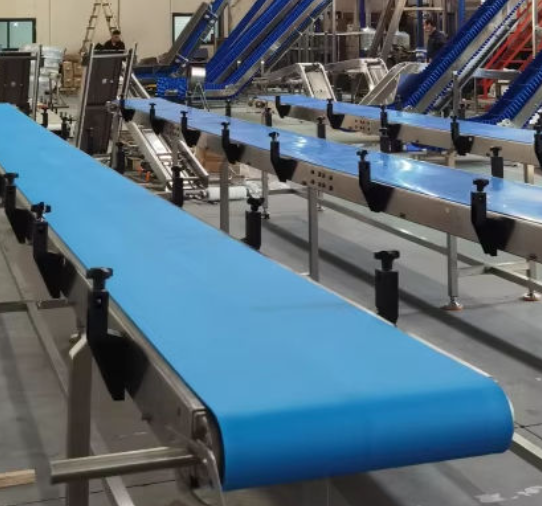
The Release Surface: Why Smooth Isn’t Enough
Chocolate contracts as it cools. A surface that releases cleanly at enrobing temperature can grip as the product shrinks. The relevant property is not thickness or hardness—it is the top-coat chemistry.
Esbelt specifies “low adhesion” as a requirement for chocolate cooling applications, and describes the ideal surface as “brilliant, smooth, homogeneous, non-porous” to prevent chocolate accumulation at the product base . Märtens emphasizes an “extremely smooth, dense PU surface” that resists microbial deposits and is easy to clean under frequent cleaning cycles .
Selection threshold: ask the supplier whether the top coat is formulated for fat release. If the answer is generic (“all PU releases well”), request a sample and do a bench test: pour tempered chocolate on a 200mm strip, cool to tunnel temperature, and check release without flexing the belt. A surface that needs flexing to release will cause product marking on the line.
Cocoa Butter vs. Sugar Dust: Two Residues, Two Cleaning Approaches
Chocolate residue in a tunnel is not one contaminant. Cocoa butter liquefies at warm temperatures and solidifies as the belt cools. Sugar dust and fine chocolate particles are dry and migrate into splice gaps and edge profiles. A cleaning method that addresses one may not address the other.
The operational reality is difficult enough that Ammeraal Beltech acknowledges keeping belts at required cleanliness in cocoa processing is a known challenge, and recommends metal-detectable belt components due to contamination risk . For buyers evaluating cleaning capability, the practical question is whether the belt surface tolerates the cleaning method the plant intends to use—not whether the belt is “easy to clean” in the abstract.
Practical check for plant buyers: if the plant uses or plans dry steam cleaning (surface temperatures around 120°C with vacuum extraction), confirm the belt’s continuous service temperature at the surface, not just the tunnel ambient. Standard PU grades typically top out below this range; a grade specified for higher-temperature cleaning is a different product line.
The Splice Problem in Cold Tunnels
The splice is a mechanical joint. Adhesive, fastener, or compressed construction at the joint does not expand and contract at the same rate as the homogeneous belt body. In a cooling tunnel, the belt cycles through temperature on every revolution. A splice that was flush at room temperature can lift slightly at tunnel temperature. That lift becomes a catch point, and a catch point becomes a tracking problem.
Märtens lists finger splice, overlapped splicing, adhesive splice, and stainless hook or plastic spiral fasteners as joining options for their PU belts . For cooling tunnel service, the hierarchy of preference is: adhesive or finger splice first, mechanical fasteners last. Mechanical fasteners introduce metal or plastic components with different thermal behavior and more places for chocolate to accumulate.
Verification step for distributors: when quoting a tunnel belt, confirm with the supplier whether the splice has been tested at the customer’s cold-side pulley diameter and tunnel temperature. A splice rated at ambient may fail at 5°C on a small cold-end pulley. If the supplier cannot answer, specify a finger splice with a longer finger length (Märtens-style interlocking fingers, not a butt joint) to distribute stress across a larger joint area.
Belt Construction: What to Specify Beyond “PU”
Thickness and carcass. Food-grade PU belts commonly run 0.8–4.0mm total thickness . For cooling tunnels, 1.5–2.5mm with a two-ply polyester carcass covers most confectionery positions. The carcass determines dimensional stability through temperature cycling—a single-ply belt is more likely to wander as it warms and cools.
Antistatic, if the tunnel is in a dry environment. Static buildup can attract sugar dust to the belt surface and complicate cleaning. Märtens offers anti-static versions via woven-in carbon fibre threads . Specify this only if the plant has reported static-related dust adhesion; otherwise standard grades are adequate.
Edge condition. A clean, sealed edge resists cocoa butter wicking into the fabric carcass. Ask whether edges are cut and sealed or laser-finished. Unsealed cut edges are a common failure point in wet or fat-heavy environments.
What to Ask Before You Quote or Order
For distributors: three questions to the supplier before you put a tunnel belt on a quotation.
Does this grade carry a named cooling tunnel reference, not just “food conveying”? What is the splice type, and has it been run at the customer’s cold-end pulley diameter? What is the surface temperature tolerance for cleaning—not the ambient tunnel temperature?
For plant buyers: request a 500mm sample of the exact grade quoted. Run it through the tunnel for one production shift. Check three things: release without flexing, splice flatness at cold temperature, and residue behavior after the plant’s normal cleaning routine. A supplier confident in their grade will send the sample. One who deflects to a datasheet is telling you something useful.

R&D Team
Annilte has a research and development team consisting of 35 technicians. With strong technical research and development capabilities, we have provided conveyor belt customization services for 1780 industry segments, and gained recognition and affirmation from 20,000+ customers. With mature R&D and customization experience, we can meet the customization needs of different scenarios in various industries.

Production Strength
Annilte has 16 fully automated production lines imported from Germany in its integrated workshop, and 2 additional emergency backup production lines. The company ensures that the safety stock of all kinds of raw materials is not less than 400,000 square meters, and once the customer submits an emergency order, we will ship the product within 24 hours to respond to the customer's needs efficiently.
As a leading Chinese conveyor belt manufacturer with 17 years of industry experience, Annilte is proud to hold both ISO quality management certification and the RoHS environmental directive. Our manufacturing facilities meet “Green Factory” standards, and we are also an internationally recognized SGS Gold Supplier.
We offer a comprehensive range of customizable belt solutions under our own brand "ANNILTE", designed to meet diverse industrial needs.
Should you require further information about our products or capabilities, please do not hesitate to contact us.
WhatsApp: +86 185 6019 6101 Tel/WeChat: +86 185 6010 2292
E-mail: 391886440@qq.com Website: https://www.annilte.net/
Post time: Nov-24-2026