

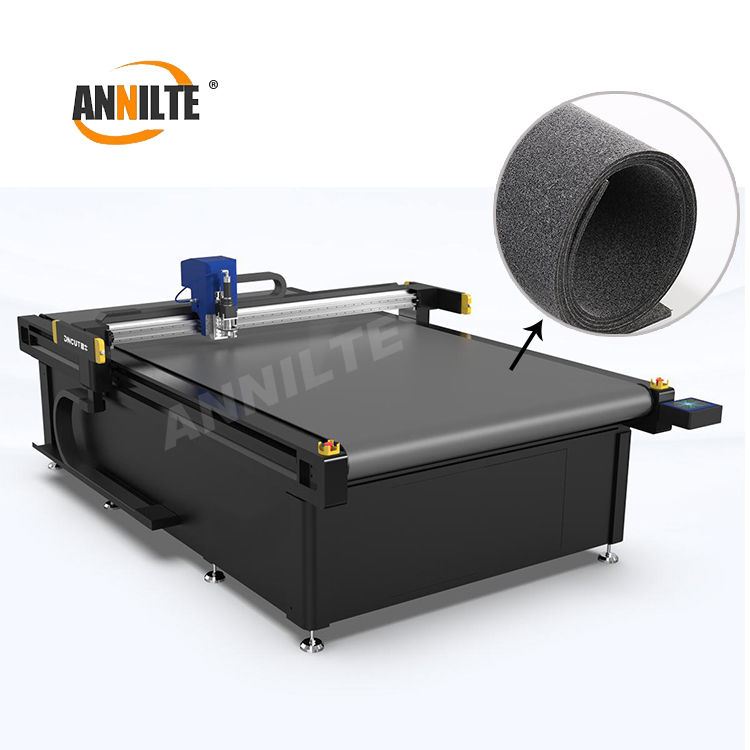
Leather cutting is not fabric cutting with a different material loaded. The hide is irregular, variable in thickness, and expensive enough that surface damage during handling is a real cost. The felt belt underneath it has to do three things at once: hold the hide flat under vacuum, absorb knife penetration without shedding fibers onto the grain side, and protect the hide from the table surface during transfer.
If you‘re sourcing felt for a leather-cutting machine, the specs that matter are not identical to those for textile production.
Why leather changes the felt requirement
On a fabric cutter, the felt belt mostly needs consistent airflow and cut resistance. On a leather cutter, the hide itself changes the equation.
Leather is heavier and stiffer than most fabrics. It doesn‘t conform to the belt surface the way a textile stack does, which means vacuum hold depends more heavily on the belt‘s permeability and the vacuum zone layout than on the material‘s own weight pressing down. A belt that works on fabric may not pull a hide flat enough for accurate nesting.
The second difference is surface sensitivity. The grain side of a hide can be marked by a rough belt surface, a raised splice, or fiber transfer. Patent literature on leather-cutting conveyor systems describes felt belts being used specifically because the material is held by vacuum while the belt‘s thickness protects the aspirating plane from the knife. That protective role is more critical on leather because the cost of a damaged hide is higher than a damaged meter of fabric.
The third difference is cutting depth variability. Hide thickness varies across a single piece. The knife has to penetrate fully through the thickest areas, which means it contacts the belt more aggressively in some zones than others. A felt that compresses unevenly under that variable contact will produce inconsistent cut-through across the hide.
What leather-cutting felt needs to deliver
Vacuum hold on a non-conforming material. The felt structure has to let air through evenly so the hide is pulled flat across the full cutting area. Look for controlled permeability rather than maximum openness—too open and the vacuum system can‘t build holding force, too closed and the hide won‘t seat.
Surface that won‘t mark the grain. For shoe uppers, leather goods, and automotive interior leather, the belt surface in contact with the material should be smooth and non-shedding. Low-grade felt that pills under knife contact releases fibers that can transfer to the hide surface. A dense, uniform felt surface avoids this.
Cut resistance matched to variable penetration. Leather cutting often runs deeper Z-depth than thin textile cutting because the knife must clear variable hide thickness. The felt needs enough density to resist grooving without becoming so hard that it doesn‘t absorb the blade.
A splice that doesn‘t telegraph. On a leather table, a raised joint creates a bump the hide passes over. On a surface-sensitive material, that can leave a mark. A flat wedge splice keeps the working surface continuous.
Machine contexts worth knowing
Leather cutting on conveyorized systems spans several platform types.
Comelz CZ series is built specifically for shoe and leather goods production, with cutting areas sized for hide work (CZ Plus L at 1850 × 840 mm). The felt on these machines is working directly under oscillating knives on a material where surface quality is the product.
TESEO Xi runs leather alongside fabric and synthetic materials, with a conveyor belt on the working surface for roll and hide processing. The vacuum system uses sectorized control, which means the felt‘s permeability needs to be consistent across the full width for the zoning to work as designed.
ATOM cutting systems appear in leather and shoe material production, and customs records show conveyor belts described as microfiber construction being imported as spare parts for ATOM leather-cutting machines. This is consistent with the broader pattern: leather-cutting belts tend toward dense, fine-fiber felt rather than open, lofty constructions.
For broader platform compatibility, replacement felt suppliers list leather as a standard application alongside Zünd, Gerber, Esko, Lectra, and Bullmer machines. The felt construction for those platforms when cutting leather may differ from the textile-spec belt—worth confirming with the supplier rather than assuming the standard replacement is the right choice.
What to send a supplier
Machine brand and model. Leather-cutting configurations vary even within a model line, and the conveyor setup affects belt dimensions.
Material being cut. Shoe upper leather, upholstery hide, and technical leather have different surface sensitivity and thickness ranges.
Original belt thickness and a photo of the splice. Thickness determines how much knife penetration the belt can absorb before the blade reaches the table. A photo of the existing splice tells the supplier what joint style the machine was set up for.
Whether the belt surface contacts the grain side or the flesh side. This affects surface finish requirements and whether fiber shedding is a critical failure mode.

R&D Team
Annilte has a research and development team consisting of 35 technicians. With strong technical research and development capabilities, we have provided conveyor belt customization services for 1780 industry segments, and gained recognition and affirmation from 20,000+ customers. With mature R&D and customization experience, we can meet the customization needs of different scenarios in various industries.

Production Strength
Annilte has 16 fully automated production lines imported from Germany in its integrated workshop, and 2 additional emergency backup production lines. The company ensures that the safety stock of all kinds of raw materials is not less than 400,000 square meters, and once the customer submits an emergency order, we will ship the product within 24 hours to respond to the customer's needs efficiently.
As a leading Chinese conveyor belt manufacturer with 17 years of industry experience, Annilte is proud to hold both ISO quality management certification and the RoHS environmental directive. Our manufacturing facilities meet “Green Factory” standards, and we are also an internationally recognized SGS Gold Supplier.
We offer a comprehensive range of customizable belt solutions under our own brand "ANNILTE", designed to meet diverse industrial needs.
Should you require further information about our products or capabilities, please do not hesitate to contact us.
WhatsApp: +86 185 6019 6101 Tel/WeChat: +86 185 6010 2292
E-mail: 391886440@qq.com Website: https://www.annilte.net/
Post time: Nov-11-2026