

Most felt conveyor belt replacements fail for the same reason: the buyer matches thickness and ignores density. A 4.0mm belt with the wrong felt structure will bolt onto the machine, track straight for a week, and then start losing vacuum hold on exactly the parts that used to cut clean. On a European CNC cutting table running Zünd, Gerber, Esko, or Lectra platforms, that pattern usually traces back to a belt that was never specified for the vacuum system it sits on.
This guide is written for maintenance engineers and procurement staff sourcing replacement felt belts for cutting tables in Europe. It covers the three specs that actually determine performance, the thickness range that fits most platforms, and the compliance paperwork worth confirming before a belt crosses the border.
The density range that separates a working belt from a return
Felt density is not a marketing number. It determines how much air moves through the belt and how the surface behaves under knife contact. Standard industrial felt for cutting tables sits in a density range where airflow and cut resistance are balanced. Generic felt often falls below that range, which is why it feels softer out of the box and compacts faster once vacuum is applied.
A practical benchmark: ask the supplier for density in g/m². If they cannot state it, the belt was not made for vacuum cutting. Annilte’s cutting table belts are produced in a density range that keeps permeability stable through the working life, not just the first shift . Higher density resists compression under vacuum, which is what preserves hold-down force on small nested parts where the material mass alone isn‘t enough to keep things flat.
Takeaway: Request density in g/m² before ordering. A supplier who can‘t provide it is selling felt, not a vacuum belt.
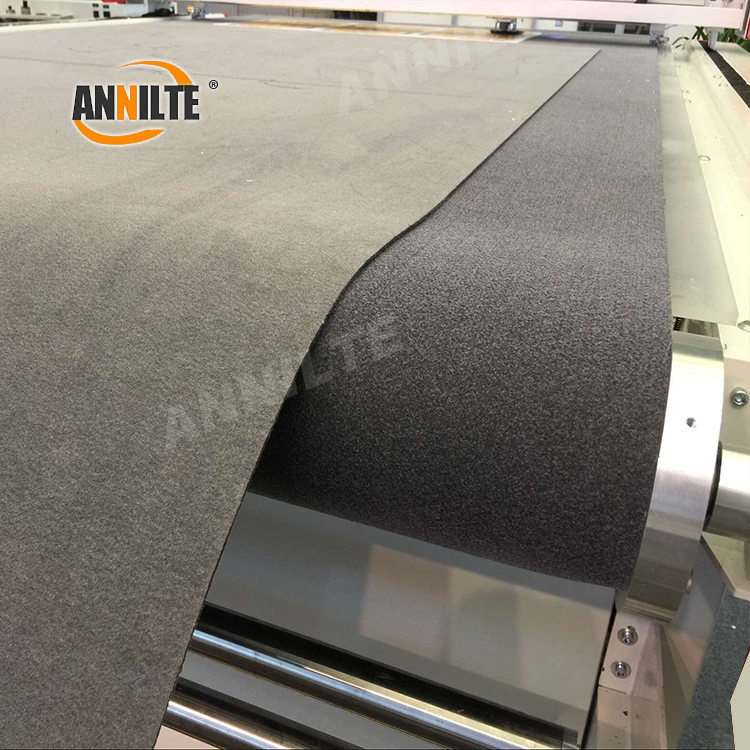
Thickness is a working allowance, not a quality grade
European cutting tables commonly run 2.5mm, 4.0mm, and 5.5mm felt belts. The choice depends on cutting depth and material, not a “thicker is better” logic.
2.5mm fits machines with limited Z-travel or where the knife runs shallow. It gives less sacrificial material before the blade reaches the table, so it suits thin films, paper, and single-layer textiles.
4.0mm is the working standard for most European platforms cutting apparel, technical textiles, foam, and packaging. It provides enough depth for the blade to clear the material without excessive penetration, and it maintains airflow across the surface as the belt ages .
5.5mm is for deep through-cutting or abrasive materials where the knife needs more clearance. But the trade-off is real: thicker felt can require more vacuum capacity to achieve the same hold-down force, and excessive Z-depth will destroy a 5.5mm belt as fast as a 2.5mm one.
Takeaway: Measure the old belt in an uncut area, not the cutting zone. A worn belt reads thin where the knife has compressed it, and ordering to that number reproduces the problem.
What European buyers should confirm before the belt ships
The belt itself is a mechanical component. But procurement in Europe increasingly asks about documentation that sits alongside it.
Under Regulation (EU) 2023/1230, which replaces the Machinery Directive as of January 2027, economic operators have defined obligations for machinery and related products placed on the EU market . A replacement felt belt sold as a spare part is not the same as a machine, and the compliance burden differs. What matters practically is that the supplier can provide material declarations and traceability information consistent with what your own compliance team needs for customs and liability records.
Ask for a material composition statement and a batch reference. If the belt is part of a machine package you are reselling or integrating, confirm with your compliance lead whether the end configuration triggers additional documentation. A supplier who ships felt with no material declaration creates a paperwork problem downstream.
Takeaway: Request a material composition sheet and batch number with the quotation. It costs the supplier nothing and saves your compliance team a follow-up later.
What to send for a dimensioned quote that fits the first time
Belt dimensions on European cutting tables are not universal across a model line. A Zünd G3 M belt will not fit a G3 L or 3XL. The model number alone is not enough.
Send these four items and the quote will match the machine:
Machine brand and full model. Not “Zünd G3” but “G3 M-1600” or “G3 L-2500.”
Old belt measurements. Width across the full belt, and length measured around the endless loop. If the belt is open, measure the flat length and note the splice type.
A photo of the old splice. Wedge splice, toothed joint, and steel clip connectors install differently. The replacement should match what the machine‘s tracking system was set up for.
Material being cut and typical Z-depth. A belt for thin film at shallow depth has different requirements than a belt for 20mm foam at full penetration.
Takeaway: A photo of the old belt‘s surface after removal tells the supplier whether the failure was compaction, grooving, or edge fraying. That changes the recommendation.
FAQ
Can I use a standard 4.0mm felt belt from a local supplier?
Only if the density and airflow match the vacuum system’s requirements. Thickness matching is not enough. A local belt with lower density will feel correct on installation and lose hold-down force within weeks.
How often should a felt conveyor belt be replaced on a European cutting table?
It depends on cutting hours, material abrasiveness, and Z-depth. A belt that still looks intact but has started to compact will cause part shifting before visible wear appears. Replace when vacuum hold degrades or when the surface shows uneven compression in the cutting zone.
Is CE marking required for a replacement felt belt shipped to Europe?
A felt belt sold as a standalone spare part is generally not subject to the same CE marking requirements as the machine it fits. Confirm with your compliance lead based on how the belt is declared and whether it is integrated into a machine package. Material declarations and traceability are the practical documents to request.

R&D Team
Annilte has a research and development team consisting of 35 technicians. With strong technical research and development capabilities, we have provided conveyor belt customization services for 1780 industry segments, and gained recognition and affirmation from 20,000+ customers. With mature R&D and customization experience, we can meet the customization needs of different scenarios in various industries.

Production Strength
Annilte has 16 fully automated production lines imported from Germany in its integrated workshop, and 2 additional emergency backup production lines. The company ensures that the safety stock of all kinds of raw materials is not less than 400,000 square meters, and once the customer submits an emergency order, we will ship the product within 24 hours to respond to the customer's needs efficiently.
As a leading Chinese conveyor belt manufacturer with 17 years of industry experience, Annilte is proud to hold both ISO quality management certification and the RoHS environmental directive. Our manufacturing facilities meet “Green Factory” standards, and we are also an internationally recognized SGS Gold Supplier.
We offer a comprehensive range of customizable belt solutions under our own brand "ANNILTE", designed to meet diverse industrial needs.
Should you require further information about our products or capabilities, please do not hesitate to contact us.
WhatsApp: +86 185 6019 6101 Tel/WeChat: +86 185 6010 2292
E-mail: 391886440@qq.com Website: https://www.annilte.net/
Post time: Nov-24-2026