

On a CNC vacuum cutting table, the felt conveyor belt is not just a moving surface under the material. It‘s the medium through which vacuum reaches the workpiece. If the belt‘s airflow is wrong, the table can‘t hold parts flat no matter how hard the pump runs.
That‘s why replacing a belt based on thickness alone often reproduces the problem it was meant to fix.
Why thickness is the wrong starting point
Two felt belts can both measure 4.0 mm and perform completely differently under vacuum. Thickness tells you how much cutting allowance the belt has before the blade reaches the table. It does not tell you how much air moves through the felt, how the surface recovers after knife contact, or how the belt behaves under constant tension.
What actually governs vacuum performance is felt density and structure. A belt that‘s too dense restricts airflow—the vacuum pump works harder, suction at the surface drops, and small parts start shifting. A belt that‘s too open lets air through freely but develops knife grooves faster and loses surface stability, which also affects hold-down as the belt wears unevenly.
The practical consequence: a belt that matches the original thickness but not the original density will feel wrong from day one, even if it looks correct on the machine.
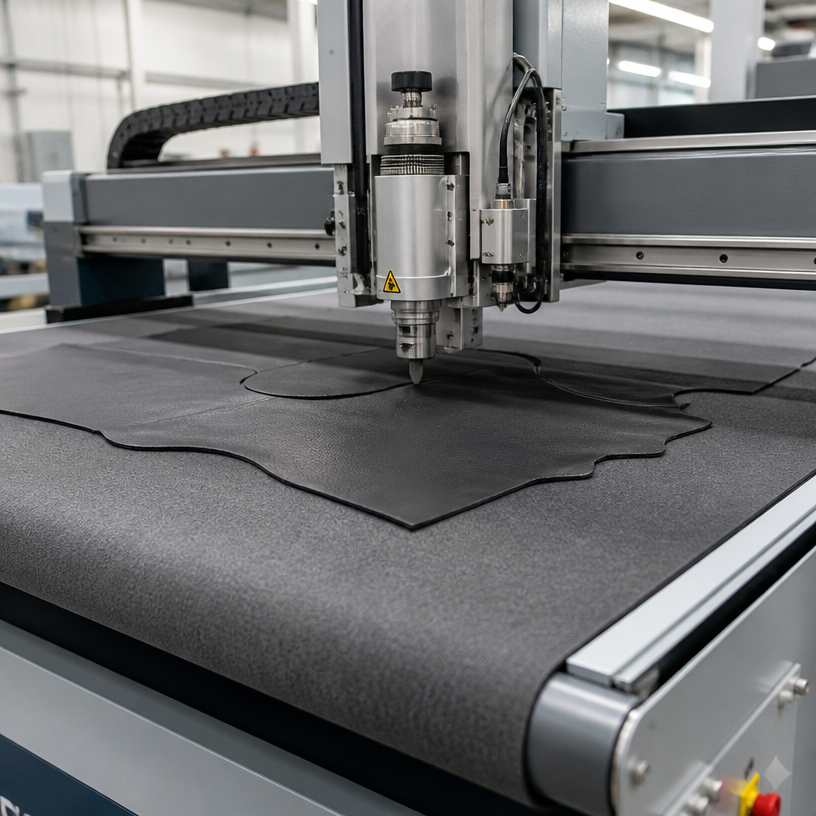
What the vacuum table demands from the belt
Four properties need to be balanced, and they pull against each other.
Air permeability. Vacuum suction passes through the felt to hold the material. If airflow is insufficient, the material lifts at the edges or shifts during the cut. If airflow is excessive for the pump‘s capacity, holding force never builds properly.
Cut resistance. The oscillating or vibrating knife penetrates the material and contacts the belt surface. The felt needs enough density to resist grooving, but not so much that it becomes hard and doesn‘t absorb the blade. Fine knife marks are normal and expected—the goal is controlled wear, not a belt that can‘t be cut.
Dimensional stability. On a wide vacuum table, a belt that elongates under tension will mistrack. As it drifts, the vacuum field shifts with it, and cutting coordinates go out of alignment. Low-elongation construction matters more on wide tables than narrow ones.
Splice quality. A raised joint creates a bump the cutting head crosses on every pass. On a vacuum table, an uneven splice also disrupts the vacuum seal at that point. A flat wedge splice keeps both the cutting surface and the vacuum field continuous.
Common thickness ranges and what they suit
Aftermarket suppliers typically offer 2.5 mm, 4.0 mm, and 5.5 mm constructions for CNC cutting tables. The choice depends on the cutting depth and material, not a universal “best” size.
2.5 mm is used where the cutting head has limited Z-travel or where a thinner working layer is required. It offers less sacrificial depth, so blade contact reaches the table sooner on deep cuts.
4.0 mm is the common middle ground for many digital cutting applications, balancing cutting allowance, flexibility, and vacuum airflow. It‘s a practical starting point for general textile, foam, and packaging work.
5.5 mm and thicker provides more working depth for through-cutting or abrasive materials. But thicker is not automatically better. Excessive knife penetration destroys a thick belt just as fast as a thin one, and thicker felt can require more vacuum capacity to achieve the same hold-down force.
What to send a supplier for a replacement
Machine brand and model. Vacuum zone layout and table width vary even within a model line.
Original belt thickness, measured in an area that hasn‘t been heavily cut or compressed. A worn cutting zone will read thinner than the original spec.
A photo of the old belt‘s surface and splice. The surface photo tells the supplier whether the failure was compaction, grooving, or edge fraying. The splice photo shows what joint style the machine was set up for.
Material being cut and typical cutting depth. A belt for thin film at shallow Z-depth has different requirements than a belt for thick foam at full penetration.
Whether vacuum hold has been degrading gradually or dropped suddenly. Gradual loss points to belt compaction. Sudden loss suggests the belt has shifted or the splice has failed.

R&D Team
Annilte has a research and development team consisting of 35 technicians. With strong technical research and development capabilities, we have provided conveyor belt customization services for 1780 industry segments, and gained recognition and affirmation from 20,000+ customers. With mature R&D and customization experience, we can meet the customization needs of different scenarios in various industries.

Production Strength
Annilte has 16 fully automated production lines imported from Germany in its integrated workshop, and 2 additional emergency backup production lines. The company ensures that the safety stock of all kinds of raw materials is not less than 400,000 square meters, and once the customer submits an emergency order, we will ship the product within 24 hours to respond to the customer's needs efficiently.
As a leading Chinese conveyor belt manufacturer with 17 years of industry experience, Annilte is proud to hold both ISO quality management certification and the RoHS environmental directive. Our manufacturing facilities meet “Green Factory” standards, and we are also an internationally recognized SGS Gold Supplier.
We offer a comprehensive range of customizable belt solutions under our own brand "ANNILTE", designed to meet diverse industrial needs.
Should you require further information about our products or capabilities, please do not hesitate to contact us.
WhatsApp: +86 185 6019 6101 Tel/WeChat: +86 185 6010 2292
E-mail: 391886440@qq.com Website: https://www.annilte.net/
Post time: Nov-16-2026