

Two felt belts can leave a supplier with the same numbers on the invoice — 4.0 mm, 1.8 m wide — and behave like two different products on the same cutting table. One holds its edge through a full production cycle. The other starts shedding fibre at the selvedge within weeks, and the cutting room begins blaming the operator, the knife, the vacuum, anything except the belt.
The invoice is not a specification. On a needle-punched felt belt, thickness is one variable out of five that decide service life, and it is usually the only one the buyer asks about.
This guide covers how the belt is actually built, what each variable does at the knife, how the joint affects both performance and freight, and what changes when the same belt runs in a Southeast Asian cutting room.
What "4.0 mm felt belt" does not tell you
A needle-punched felt belt is made by needling fibre batts into a base, then densifying, calendering and (for endless belts) joining. Five variables come out of that process, and only the first one is normally written on a quotation:
| Variable | What it controls | Where it shows up on the floor |
| Thickness | Knife penetration depth, clearance to the table surface | Knife marks on the cutting surface, incomplete cut on the bottom ply |
| Fibre composition | Heat resistance, abrasion resistance, moisture regain | Edge fuzzing, shrinkage, belt slackening in humid months |
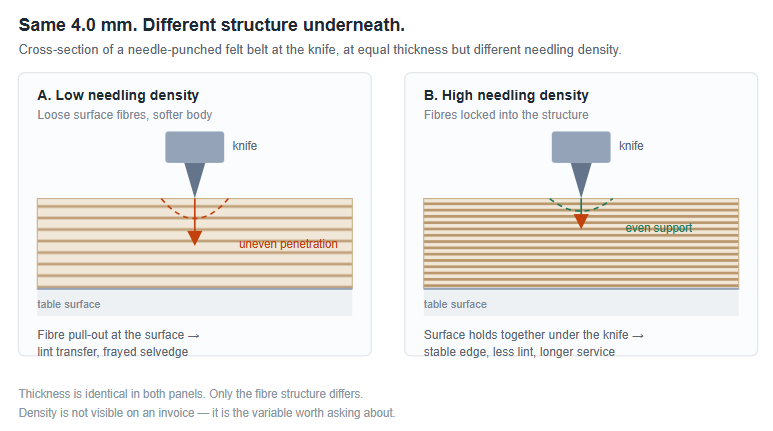
| Needling density | Surface integrity, fibre pull-out resistance | Lint on dark fabric, fuzzy selvedges, dust in the cutting room |
| Density / hardness | Compressibility under knife pressure | Visible indentation on leather, uneven support on thin materials |
| Joint type | Straightness at the seam, tensile continuity | Blade deflection at the seam, belt tracking drift |
Two suppliers can quote "4.0 mm wool-blend felt" and be selling genuinely different products. Thickness is easy to measure and easy to copy. Needling density and density are neither — which is exactly why they are worth asking about.
What each variable actually does at the knife
Thickness is set by the machine maker, not by preference. The knife has to penetrate far enough to cut the bottom ply, but not far enough to score the table surface or the belt below. When replacing a belt, matching the original thickness is the safe move. Changing it — even by a few tenths of a millimetre — shifts the effective cutting depth and, on machines with a fixed blade depth, moves the problem to the bed.
Fibre composition decides how the belt behaves away from the knife. Wool brings resilience and recovery after compression, which is why it dominates cutting-underlay applications. Blends trade some of that recovery for abrasion resistance and dimensional stability. The trade-off is real: a belt that resists abrasion well may hold a compression set faster, and a belt that recovers perfectly may fuzz at the selvedge under a hard-driven knife.
Needling density is the variable most often skipped in the conversation. Dense needling means the surface fibres are locked into the structure instead of sitting on top of it. On a cutting table this shows up as less fibre transfer onto the material — the difference between a clean grey felt and a felt that leaves a haze on light-coloured fabric after a few hundred cycles. It also governs how the selvedge behaves: a loosely needled edge starts to fray from the outside in.
Density and hardness matter most on leather, technical textiles and thin synthetics, where the belt is also the support surface. A belt that compresses unevenly under the knife leaves a witness mark on the material underneath. This is one of the few variables a buyer can test cheaply — press a thumbnail or a durometer into a sample at several points and see whether the reading is consistent across the width.
[FIGURE 2 — Joint construction options: endless woven loop, finger/step splice, metal clipper lacing. See fig2-joint-types.svg]
Joint options: performance, freight and installation
The joint is where belts fail first and where freight costs are decided. Three constructions are common on cutting tables:
Endless (woven as one continuous loop). No joint at all. Best straightness, no seam to deflect the blade, longest service life. The constraint is logistics and installation: an endless belt must be slipped over the rollers, which means the machine has to be accessible, and the belt ships as a bulky loop rather than a folded pack.
Finger or step splice, heat-pressed. The two ends are cut into interlocking fingers or a stepped profile and bonded under heat and pressure. Straightness depends entirely on how the splice was made — a splice cut square by hand will show as a bump that deflects the blade at every pass. Done properly, this is the practical compromise: near-endless running with a belt that can be shipped flat and installed without dismantling the machine.
Metal clipper lacing. Hooks are set into both ends and joined with a pin. Fast to install and easy to replace on site, which makes it attractive for maintenance teams. It is also the least smooth option at the seam, and the pin is a wear part — on a cutting table, the lacing is the first place to check when the blade starts marking the material at regular intervals.
For buyers in Southeast Asia, the joint choice is also a freight and stocking decision. A spliced belt ships flat in a carton and can be held as a spare in a distributor's warehouse. An endless belt cannot. That single difference often decides whether a factory can recover from a belt failure in days or in weeks.
The Southeast Asia factor: humidity, and the wait for a spare
Two conditions in this region change how a felt belt should be specified and stored. Neither appears on a spec sheet.
Tropical humidity. Wool and wool-blend felts absorb moisture from the air. In cutting rooms in Vietnam, Thailand, Indonesia and Malaysia, workshop humidity during the rainy season can stay near saturation for weeks at a time. The visible effects are dimensional: the belt can take up moisture, soften slightly and lose tension, and a belt that was tracking correctly in the dry season can start drifting on the pulleys. The invisible effect is storage — a spare belt left in its packing against a concrete wall or on a factory floor will absorb moisture and can develop mildew before it is ever installed.
Practical measures: keep spare belts in sealed packing with desiccant, store them flat and off the floor, and rotate stock so no belt sits for years. Where humidity is extreme, specify a blend and a density that hold dimension better, and accept the small trade-off in compression recovery.
Spare-part lead time. Ocean freight and customs clearance put weeks between a purchase order and a belt on the table. In markets where a replacement is sourced from China, a single belt failure that stops a cutting line costs far more than the belt. The standard practice among experienced cutting rooms is to hold one spare belt per machine — ideally the same construction and the same joint type, so the swap is a like-for-like replacement rather than a re-specification under pressure.
Distributors serving garment and footwear clusters from Ho Chi Minh City to Bandung carry a narrower range than a factory might expect, and usually in the widths that move fastest. A buyer who needs a non-standard width or a specific joint should plan for that lead time rather than discover it during a breakdown.
How to specify a replacement in five lines
Send these five lines and a supplier can quote something meaningful instead of a thickness:
- Machine make and model, plus table width and belt length (or the original belt's marked size).
- Original belt thickness, and whether the current belt is endless or spliced.
- Material being cut — fabric, leather, technical textile, corrugated, composite — and the number of plies typically stacked.
- Known problems with the current belt: edge fuzzing, lint transfer, tracking drift, marking, seam bump.
- Destination port and whether the belt is being stocked as a spare or installed immediately.
That is enough to narrow construction, density and joint without a site visit. Anything less usually ends with the supplier quoting the cheapest belt that matches the thickness — which is how the problem started.
Installation notes that prevent most early failures
- Track before tensioning. Align the belt on the pulleys at low tension, run it slowly by hand, then bring tension up. Tensioning a misaligned belt locks the misalignment in.
- Check the splice direction. A spliced belt has a preferred running direction. Running it backwards puts the splice step against the knife edge.
- Re-check tension after the first shift. New felt settles. The belt that was correct at installation will be marginally loose after a few hours of running.
- Watch the selvedge, not the middle. Edge fraying is the earliest signal of a tracking problem or a belt that is being over-driven.
FAQ
Can I replace a 4.0 mm belt with a 4.5 mm belt? Only if the machine's blade depth and table clearance allow it. On most cutting tables the thickness is a fixed design value. Confirm with the machine maker before changing it — the belt is usually not the place to gain clearance.
How long should a felt belt last? It depends on knife pressure, material, hours per shift and how well the belt is tracked. Suppliers who quote a lifespan in months without asking those four questions are guessing. Ask instead for the construction variables and a sample to test.
Why does my belt leave lint on dark fabric? Usually needling density and surface finishing. A loosely needled felt releases surface fibre under the knife. It is a construction issue, not a cleaning issue.
Is an endless belt always better than a spliced belt?
In running quality, yes. In practice, a well-made finger splice outperforms a poorly installed endless belt, and it ships and installs far more easily. The quality of the splice matters more than the category.
Do I need a different belt for leather than for fabric? Often yes. Leather shows compression marks, so density and surface finish matter more; fabric stacks punish edge fraying and lint transfer instead. The same thickness can serve both, but not the same construction.

R&D Team
Annilte has a research and development team consisting of 35 technicians. With strong technical research and development capabilities, we have provided conveyor belt customization services for 1780 industry segments, and gained recognition and affirmation from 20,000+ customers. With mature R&D and customization experience, we can meet the customization needs of different scenarios in various industries.

Production Strength
Annilte has 16 fully automated production lines imported from Germany in its integrated workshop, and 2 additional emergency backup production lines. The company ensures that the safety stock of all kinds of raw materials is not less than 400,000 square meters, and once the customer submits an emergency order, we will ship the product within 24 hours to respond to the customer's needs efficiently.
As a leading Chinese conveyor belt manufacturer with 17 years of industry experience, Annilte is proud to hold both ISO quality management certification and the RoHS environmental directive. Our manufacturing facilities meet “Green Factory” standards, and we are also an internationally recognized SGS Gold Supplier.
We offer a comprehensive range of customizable belt solutions under our own brand "ANNILTE", designed to meet diverse industrial needs.
Should you require further information about our products or capabilities, please do not hesitate to contact us.
WhatsApp: +86 185 6019 6101 Tel/WeChat: +86 185 6010 2292
E-mail: 391886440@qq.com Website: https://www.annilte.net/
Post time: Nov-10-2026