

Most guides about the egg collection belt for chicken farm purchase focus on what happens after you choose a supplier: installation, tensioning, maintenance. That sequence is backwards.
The quality of the belt you receive is largely determined by the quality of the inquiry you send. A vague request—“Please quote 500 meters of egg belt for layer farm”—forces the supplier to guess. They will guess based on their most common configuration, which may or may not match your chicken house. The belt arrives. It is the correct material. It is the correct price. But it is the wrong width for your cage front, or the splice configuration is unsuited to your row length, or the elongation exceeds what your tensioner can absorb.
At Annilte, we have seen this pattern repeat across hundreds of inquiries. The farms that get the right belt on the first shipment are not the ones with the largest budgets. They are the ones who ran a technical audit before contacting any supplier.
This guide is that audit. It is written for the procurement manager or farm engineer who is about to send an RFQ and wants to ensure the response they receive is actually usable. We will cover what to measure, what to photograph, what to document about your existing system, and which questions to ask that separate a manufacturer from a trader.
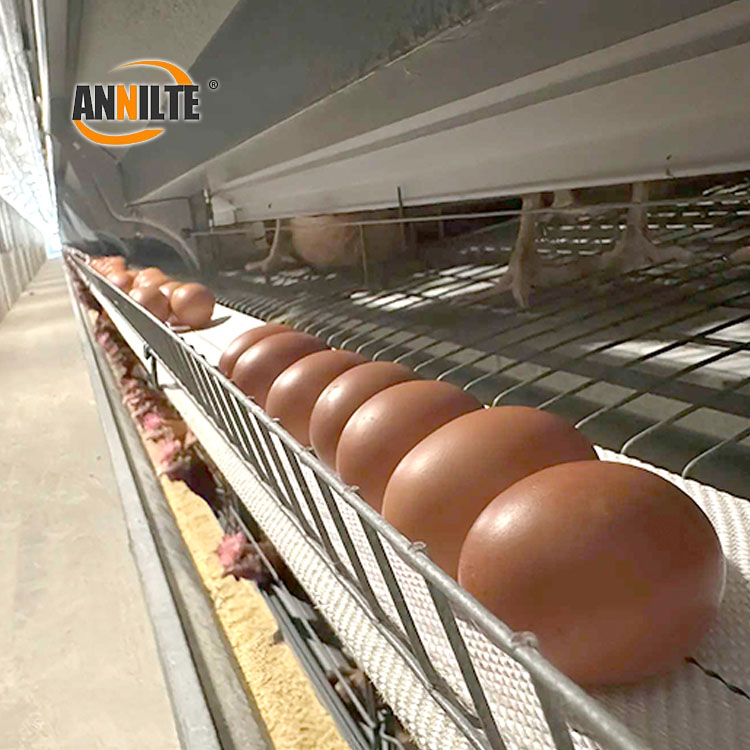
The Information Gap: What Suppliers Actually Need vs. What Buyers Typically Send
A supplier cannot recommend a belt specification without knowing the housing system. But most buyers send only three data points: total meters required, belt width, and material preference. This is insufficient for a technically sound quote.
What a Complete Inquiry Contains
A complete inquiry for an egg collection belt for chicken farm application should include:
Housing system type. H-type cage, A-type cage, automatic nest, or floor system. Each uses a different belt configuration.
Belt count per row. H-type cages use one belt per tier. A four-tier H-type house has four belts per row. Automatic nests use one belt per row, regardless of tier count.
Row length and total belt length. Not the same number. A 120-meter row with a spliced loop requires more belt than the row length alone.
Belt width and thickness of the current belt. If replacing, measure the existing belt. If new installation, measure the drive pulley face width and the guide clearance.
Roll-out height. The distance from the cage lip or nest mat to the belt surface. This determines whether a standard belt will cradle eggs or drop them.
Drive and tensioner configuration. Where is the drive pulley? Where is the tensioner? What is the adjustment range? A belt with high elongation will exhaust a short-range tensioner quickly.
Cleaning method. Cold water rinse only, or chemical disinfection? This determines whether standard PP is acceptable or a surface-treated belt is required.
Photographs. A photo of the roll-out point, the transfer end, and the splice on the existing belt tells a supplier more than a paragraph of description.
Why This Matters
A supplier who receives complete information can quote a belt that fits the application. A supplier who receives incomplete information will either ask follow-up questions (the good outcome) or quote a generic belt (the common outcome). The first response tells you which type of supplier you are dealing with.
Belt Width: The Measurement Most Buyers Get Wrong
Belt width is the most frequently mis-specified dimension in egg collection belt for chicken farm purchases. The error usually originates from measuring the wrong part of the system.
Measure the Guide, Not the Belt
If you are replacing an existing belt, measuring the old belt seems obvious. But the old belt may be stretched, trimmed, or non-standard. The more reliable measurement is the guide channel through which the belt runs.
- Cage systems: Measure the clear width between the front guide and the cage frame. The belt should run with minimal lateral play but without binding.
- Nest systems: Measure the distance between the side guides at the collection table end. Nest belts are wider than cage belts, and the table interface determines the maximum usable width.
The Catalogue Trap
Catalogue widths are reference values, not guarantees. Common cage belt widths are cited around 100 mm, and nest belts around 250 mm. But a farm that orders “100 mm” without measuring the actual guide may receive a belt that is 3 mm too wide to track properly, or 5 mm too narrow to prevent eggs from slipping off the edge.
Annilte supports custom widths from 50 mm to 700 mm for this reason. A supplier who offers only catalogue widths is not a manufacturer of application-specific belts; they are a reseller of standard stock.
The Elongation Question: What to Ask and Why the Answer Matters
Elongation is the specification that determines whether your tensioner will last the life of the belt. It is also the specification most buyers never ask about.
The Wrong Question
“What is the tensile strength?” Tensile strength describes the load at which the belt breaks. An egg collection belt should never approach its breaking load. The number is irrelevant for this application.
The Right Question
“What is the elongation at our operating tension?” This number tells you how much the belt will stretch under normal running conditions. A belt with high elongation will require repeated tensioner adjustments and may exhaust the adjustment range before the belt reaches mid-life.
For layer farm applications, low elongation is more valuable than high ultimate strength. A belt that stretches 2% at operating tension is preferable to a belt that stretches 5% but has a higher breaking point.
What a Manufacturer’s Answer Reveals
A manufacturer will have elongation data from material testing. A trader will forward the question to a factory and may not understand the answer. The response to this single question is one of the clearest signals of supplier capability.
The Splice Configuration: Why “Standard” Is Not Good Enough
Every egg collection belt for chicken farm applications has at least one splice. The splice is the weakest point in the system and the most common cause of unplanned downtime. The splice configuration should be specified in the inquiry, not left to the supplier’s default.
Sewn vs. Ultrasonic Welded
Both methods are used in the industry. Sewn splices are traditional and acceptable for short belt loops, such as those on H-type cage tiers. Ultrasonic welding combined with reinforced edge stitching is more durable for long nest belts, where the splice is subjected to repeated flexing over a longer run.
The Question to Ask
“What splice method do you recommend for our belt width and row length?”
A supplier with application experience will give different answers for a 100 mm cage belt and a 250 mm nest belt. A supplier who recommends the same splice for both has not considered how the belt will actually run.

R&D Team
Annilte has a research and development team consisting of 35 technicians. With strong technical research and development capabilities, we have provided conveyor belt customization services for 1780 industry segments, and gained recognition and affirmation from 20,000+ customers. With mature R&D and customization experience, we can meet the customization needs of different scenarios in various industries.

Production Strength
Annilte has 16 fully automated production lines imported from Germany in its integrated workshop, and 2 additional emergency backup production lines. The company ensures that the safety stock of all kinds of raw materials is not less than 400,000 square meters, and once the customer submits an emergency order, we will ship the product within 24 hours to respond to the customer's needs efficiently.
As a leading Chinese conveyor belt manufacturer with 17 years of industry experience, Annilte is proud to hold both ISO quality management certification and the RoHS environmental directive. Our manufacturing facilities meet “Green Factory” standards, and we are also an internationally recognized SGS Gold Supplier.
We offer a comprehensive range of customizable belt solutions under our own brand "ANNILTE", designed to meet diverse industrial needs.
Should you require further information about our products or capabilities, please do not hesitate to contact us.
WhatsApp: +86 185 6019 6101 Tel/WeChat: +86 185 6010 2292
E-mail: 391886440@qq.com Website: https://www.annilte.net/
Post time: Oct-31-2026