

The Gerber Paragon LX is not a high-ply workhorse. It was designed for a different job: small batches, quick response, just-in-time production. It cuts up to 2.75 cm of vacuum-compressed material, and it does so with a conveyorized bed that moves work through the cutting zone without stopping . That operating profile shapes what the belt needs to do—and it is not the same spec that suits a GT5250 or an XLC7000.
Most replacement belt sourcing guides treat all Gerber models as one category. The Paragon LX sits at the low-ply, high-mix end of the range. If you specify a belt for it using the same assumptions you would apply to a high-ply cutter, you will likely overpay for cut resistance you do not need, or compromise on vacuum consistency that you absolutely do need.
What the LX Actually Demands From Its Belt
The LX’s cutting height is modest: 2.75 cm compressed . That means the knife is not plunging through seven centimeters of fabric on every stroke. Blade contact is lighter, and the belt surface does not take the same punishing abuse as a high-ply machine. A belt with an extremely thick, heavily reinforced cover compound is not necessarily a better choice for the LX. It may track poorly on the machine’s pulley configuration and add cost without improving service life.
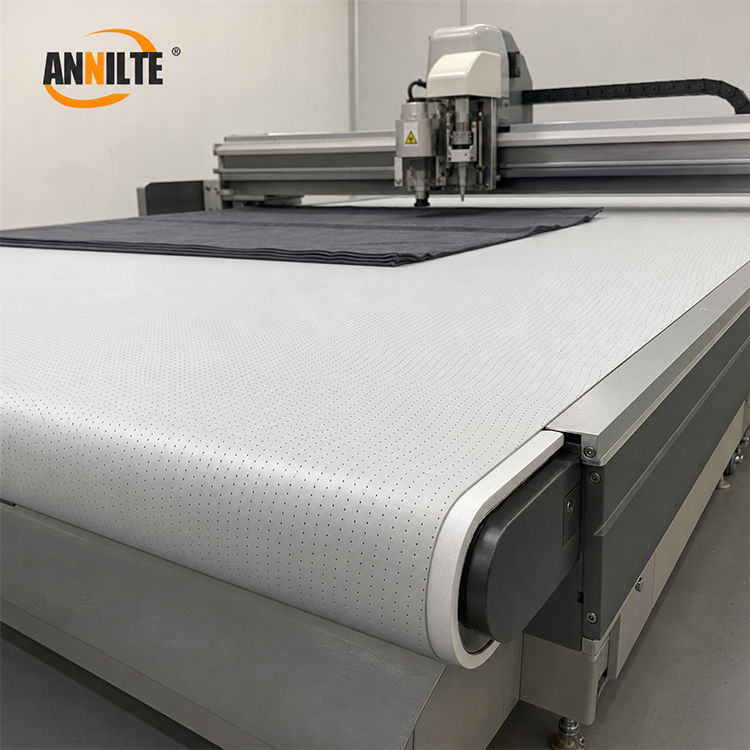
What the LX does demand is consistent vacuum across a relatively thin material stack. Low-ply cutting leaves less room for error. If the vacuum drops in one zone, a single layer of fabric lifts, the knife catches it, and the part is scrap. The belt’s perforation pattern has to distribute vacuum evenly across the full cutting width, not just in the center where airflow is easiest.
Annilte manufactures perforated belts for the Paragon range, including the LX, with CNC-controlled hole patterns that the company says are engineered for uniform vacuum distribution rather than simple punched holes . For LX operators, the relevant question is whether the hole spacing and diameter match the machine’s airflow characteristics. A generic perforation pattern that works on a high-ply cutter may not deliver the same consistency on a low-ply bed where material is thinner and less forgiving.
The Belt Material Decision: PU vs. Felt for Low-Ply Work
Annilte’s own product documentation notes that Gerber systems use different belt materials depending on application. PU belts are positioned for high-speed transport and heavier industrial materials, while synthetic felt belts are described as better suited for precision fabric processing because of their vacuum permeability and blade protection .
For a Paragon LX running apparel, automotive interior trim, or light composites in small batches, that distinction matters. A felt belt’s breathable structure can provide more even vacuum hold across delicate or low-loft materials. A PU belt’s toughness may be overkill if the knife is not making deep, repeated contact with the surface. The choice should follow the material mix in your cutting room, not a generic “Gerber compatible” label.
Annilte’s felt belt guidance for the Paragon series recommends a standard industrial felt at roughly 4mm thickness, with a typical replacement cycle of 6 to 10 months depending on volume and material . That is a starting point, not a universal answer. A cutting room running three shifts on abrasive technical textiles will see different wear than one running single-shift apparel samples.
What to Verify Before Ordering an LX Belt
Hole pattern alignment with the LX vacuum bed. Ask for the hole diameter and spacing in millimeters. A supplier who has actually worked with the Paragon LX should be able to provide this without hesitation. Annilte’s compatibility documentation lists the Paragon HX, LX, and VX series as covered models for its perforated belts , which is a reasonable baseline, but the specific hole spec for the LX should still be confirmed against your machine.
Belt tracking on the LX conveyor frame. The LX is a conveyorized system, and tracking drift is a common failure mode for replacement belts that do not hold their dimensions. Annilte uses a low-elongation polyester core and what it calls HST (Heat Setting Technology) to stabilize the belt against stretch . Whether that claim holds in your cutting room depends on installation tension and the machine’s roller condition, but the construction approach is the right question to ask about.
Joint quality. A bump at the splice on a low-ply cutter can cause the knife to skip or deflect, especially on thin materials where there is no cushioning stack above the belt. Annilte states that its Gerber replacement belts use seamless vulcanization technology for a joint that matches the belt body in thickness . For LX applications, this is worth confirming with a sample before a full order.
A Short RFQ Checklist for Paragon LX Belts
- Belt material recommendation based on your actual material mix (felt vs. PU)
- Hole diameter and spacing (mm) for the LX pattern
- Tensile construction and expected elongation under working tension
- Joint method and thickness tolerance
- Expected service life range for your cutting volume and material type
- Whether a sample can be built to the specified construction
The Paragon LX is a machine built for flexibility and speed on short runs. The belt should be specified with the same logic: matched to the material and the machine, not simply pulled from a generic Gerber replacement list. A few questions before the order cost less than a week of scrapped low-ply work.

R&D Team
Annilte has a research and development team consisting of 35 technicians. With strong technical research and development capabilities, we have provided conveyor belt customization services for 1780 industry segments, and gained recognition and affirmation from 20,000+ customers. With mature R&D and customization experience, we can meet the customization needs of different scenarios in various industries.

Production Strength
Annilte has 16 fully automated production lines imported from Germany in its integrated workshop, and 2 additional emergency backup production lines. The company ensures that the safety stock of all kinds of raw materials is not less than 400,000 square meters, and once the customer submits an emergency order, we will ship the product within 24 hours to respond to the customer's needs efficiently.
As a leading Chinese conveyor belt manufacturer with 17 years of industry experience, Annilte is proud to hold both ISO quality management certification and the RoHS environmental directive. Our manufacturing facilities meet “Green Factory” standards, and we are also an internationally recognized SGS Gold Supplier.
We offer a comprehensive range of customizable belt solutions under our own brand "ANNILTE", designed to meet diverse industrial needs.
Should you require further information about our products or capabilities, please do not hesitate to contact us.
WhatsApp: +86 185 6019 6101 Tel/WeChat: +86 185 6010 2292
E-mail: 391886440@qq.com Website: https://www.annilte.net/
Post time: Nov-02-2026