

Why Coconut Shell Handling Breaks Ordinary Belts
Coconut shells are not a gentle material. Whether you are feeding a biomass power plant, a charcoal briquetting line, or a coconut oil processing facility, the shells arrive sharp-edged, irregularly sized, and often contaminated with residual oil and moisture. A conveyor belt specified for general aggregate or grain duty will fail prematurely in this environment—not because it is poorly made, but because it was never designed for the specific combination of abrasion, oil attack, and fire risk that coconut shells present.
This guide is written for plant engineers, procurement managers, and maintenance supervisors who need to specify a coconut shell conveyor belt that survives the duty cycle and keeps the line running. We will cover the material characteristics that dictate belt selection, the compound properties that matter, and the specification checklist you should demand from any supplier before placing an order.
1. Understanding the Material: What Makes Coconut Shells Aggressive
Before selecting a belt, it helps to understand what the belt is actually up against. Coconut shells in bulk handling typically originate from one of two streams: dehusking and shelling operations at coconut processing plants, or imported PKS (palm kernel shell) and coconut shell fuel stock at biomass power facilities . In both cases, the material presents three distinct challenges.
Abrasion and Impact. Shell fragments range from fine granular material to large, hard pieces with sharp fracture edges. At transfer points where the belt receives the material, impact energy can gouge the cover rubber or penetrate through to the carcass. Once the fabric or steel cord is exposed, moisture ingress and cord corrosion follow rapidly.
Oil Contamination. Coconut shells retain residual coconut oil, particularly in processing streams where the shell has been separated from the meat. Vegetable oils can permeate standard rubber compounds, causing swelling, softening, and a measurable loss of tensile strength. A belt that absorbs oil also loses its flame resistance, because the absorbed oil itself becomes a fuel source .
Fire Risk. Biomass fuels including coconut shell and PKS are highly combustible. Friction from a misaligned belt, a seized idler, or hot material carryover can ignite accumulated dust. For any conveyor operating in a biomass feed line, flame-resistant belting is not optional—it is a fundamental safety specification .
2. Belt Construction: What to Specify and Why
2.1 Cover Compound: The First Line of Defense
The top cover takes the direct abuse. For coconut shell service, a heavy-duty abrasion-resistant compound is the baseline requirement. Standard abrasion-resistant grades (typically 60–90 mm³ ISO 4649 loss) handle the shell fragments reasonably well, but the oil exposure demands additional consideration.
If the shell stream carries measurable oil carryover—common in coconut oil processing plants—specify an oil-resistant cover compound. Bandō’s FR-BIOS™ data illustrates the performance gap clearly: in a palm oil immersion test, their oil-resistant compound showed only +1.5% volume change, compared to +86.5% for ordinary rubber . That order-of-magnitude difference determines whether the belt lasts years or months.
For biomass power applications where fire risk is the dominant concern, the cover compound must also meet flame resistance standards (JIS K 6324 or equivalent). Crucially, the oil resistance and flame resistance must be engineered together; an oil-soaked belt loses its self-extinguishing properties.
2.2 Carcass Selection: Fabric vs. Steel Cord
For most coconut shell conveying applications, multi-ply EP (polyester-nylon) fabric provides the right balance of impact resistance, troughability, and cost. The fabric plies absorb impact energy at transfer points better than steel cord, which can suffer from localized cord breakage under repeated sharp-impact loading.
Steel cord becomes the better choice when the conveyor is long, the tonnage is high, and the belt tensions exceed what fabric can handle economically—typically beyond several hundred meters of center distance. For the majority of plant-level coconut shell handling conveyors (under 200 meters), fabric carcass is the practical selection.
2.3 Surface Configuration: Cleats, Sidewalls, and Coverage
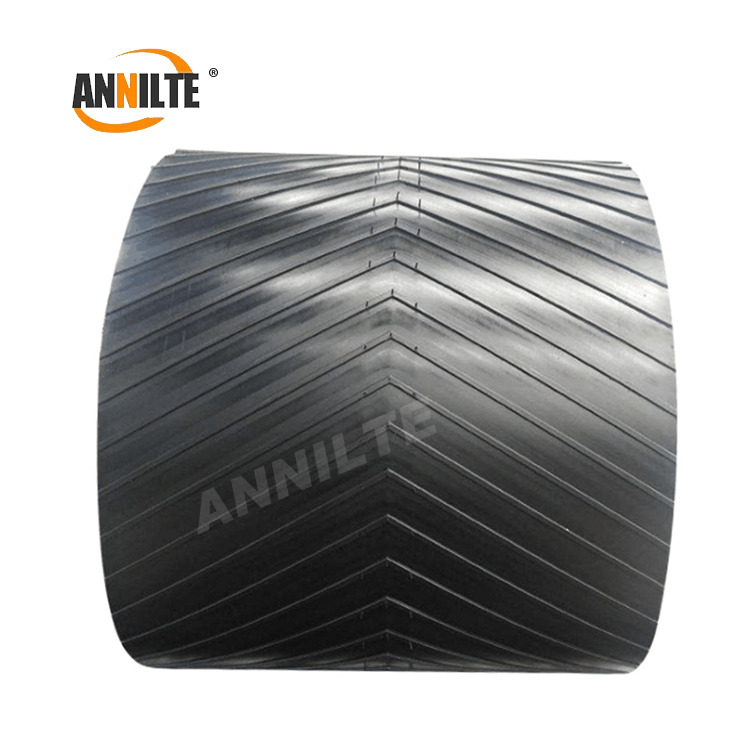
Coconut shell is a lumpy, free-flowing material with a tendency to roll. On inclined conveyors, cleated belts with sidewalls prevent material rollback and spillage. The cleat height and pitch should be matched to the maximum lump size and the incline angle. For steep inclines (above 20°), a sidewall belt with transverse cleats is the standard configuration.
On horizontal runs, a smooth cover is sufficient, but consider edge protection if the belt tends to mistrack. Coconut shell dust is fine and abrasive; once it lodges between the belt edge and the pulley, edge fraying accelerates quickly.
3. Specification Checklist for Procurement
When you issue an RFQ for a coconut shell conveyor belt, include the following parameters in the technical requirement. This protects you from receiving a “one-size-fits-all” quotation that under-specifies the compound and shortens service life.
| Parameter | Recommended Specification | Why It Matters |
|---|---|---|
| Cover compound | Abrasion-resistant, optionally oil-resistant | Shell edges gouge soft rubber; oil swells standard compounds |
| Flame resistance | Self-extinguishing per JIS K 6324 or equivalent | Mandatory for biomass fuel handling |
| Top cover thickness | 6–8 mm for high-impact transfer points | Sacrificial rubber for sharp shell edges |
| Carcass | EP fabric, 3–5 ply depending on tension | Impact absorption and troughability |
| Cleat/sidewall | Required for incline >15° | Prevents rollback and spillage |
| Operating temperature | -20°C to +80°C (standard range) | Covers ambient plant conditions |
| Joint type | Vulcanized splice for permanent installations | Mechanical fasteners loosen under vibration |
For reference, typical small-scale coconut shell conveyors in processing plants handle around 2 tons per hour with belt widths of 300–500 mm and speeds of 0.5 m/s . Biomass power plant feed conveyors run significantly wider and faster, often 650 mm and above, with capacities measured in tens of tons per hour .
4. Common Failure Modes and How to Avoid Them
Cover gouging at the loading point. The most frequent cause of premature belt replacement is impact damage directly under the chute. Mitigation: install impact idlers or a drop box to reduce free-fall velocity, and specify a thicker top cover (8 mm rather than 6 mm) in this zone. Some operators use a sacrificial impact bar above the belt to absorb the worst of the energy.
Oil-induced swelling and delamination. If the belt swells, the splice integrity is compromised and edge fraying begins. Mitigation: confirm the oil resistance of the cover compound with actual immersion test data from the supplier—not just a datasheet claim. The Bandō data cited earlier is the kind of evidence you should request .
Fire from friction or hot carryover. Biomass conveyors have a documented fire risk. Mitigation: flame-resistant belt compound, adequate belt alignment monitoring, and temperature sensors at the drive pulley. Never substitute a non-flame-rated belt to save cost in a biomass feed line.
Mistracking due to material buildup. Coconut shell dust accumulates on idler rolls and pulleys, causing the belt to run off-center. Mitigation: specify self-cleaning wing pulleys at the tail and take-up, and include a belt scraper (primary cleaner) at the head pulley to remove carryback before it reaches the return strand.
5. Why Annilte for Coconut Shell Conveyor Belts
Annilte has manufactured conveyor belting for industrial applications for over 15 years, with ISO quality certification and SGS gold supplier status . Our PU and rubber belt capabilities cover the full range of food-grade, oil-resistant, and heavy-duty industrial specifications .
For coconut shell handling specifically, we work with plant engineers to match the belt construction to the actual duty: cover compound, carcass plies, cleat profile, and joint method. We do not quote a “standard” belt and leave the application risk with the buyer.
What to send us for a precise quotation:
- Material: coconut shell (raw, crushed, or PKS blend)
- Capacity (t/h) and belt width required
- Center distance and incline angle
- Oil presence (yes/no) and flame rating requirement
- Any existing belt specification or failure history
Our engineering team will respond with a specification recommendation and a quotation within one business day.

R&D Team
Annilte has a research and development team consisting of 35 technicians. With strong technical research and development capabilities, we have provided conveyor belt customization services for 1780 industry segments, and gained recognition and affirmation from 20,000+ customers. With mature R&D and customization experience, we can meet the customization needs of different scenarios in various industries.

Production Strength
Annilte has 16 fully automated production lines imported from Germany in its integrated workshop, and 2 additional emergency backup production lines. The company ensures that the safety stock of all kinds of raw materials is not less than 400,000 square meters, and once the customer submits an emergency order, we will ship the product within 24 hours to respond to the customer's needs efficiently.
As a leading Chinese conveyor belt manufacturer with 17 years of industry experience, Annilte is proud to hold both ISO quality management certification and the RoHS environmental directive. Our manufacturing facilities meet “Green Factory” standards, and we are also an internationally recognized SGS Gold Supplier.
We offer a comprehensive range of customizable belt solutions under our own brand "ANNILTE", designed to meet diverse industrial needs.
Should you require further information about our products or capabilities, please do not hesitate to contact us.
WhatsApp: +86 185 6019 6101 Tel/WeChat: +86 185 6010 2292
E-mail: 391886440@qq.com Website: https://www.annilte.net/
Post time: Oct-21-2026